By Natalie Willis, Reporter, Valley Ag Voice
Throughout September, agriculture has been at the forefront of both legal and legislative battles, with the ultimate winners and losers awaiting a final tally.
Notably, litigation over water and animal welfare has intensified, while local Kern County officials push back against state policies that threaten to undermine California agriculture.
CLEAN WATER ACT
On Sept. 5, the Ninth Circuit Court of Appeals ruled that irrigated agriculture remains exempt from the Clean Water Act. This ruling in “Pacific Coast Federation of Fishermen’s Associations v. Nickels” affirms that irrigation return flows through farm drains do not require federal permits, provided they are not commingled with non-agricultural discharges like industrial or municipal waste.
To contextualize, the lawsuit was led by a group of environmental and fishing organizations who sought to challenge the operation of California’s Grassland Bypass Project in the Central Valley, which conveys irrigation return flows from nearly 100,000 acres of farmland and diverts them to Mud Slough, a tributary of the San Joaquin River.
The project improves water quality in the wildlife refuges and wetlands while sustaining the productivity of surrounding farmland, according to the Bureau of Reclamation.
According to a report from the office of attorneys Somach Simmons and Dunn, the Clean Water Act is limited to regulating the discharge of pollutants from point sources rather than those from nonpoint sources. Point sources include any discernible conveyance such as a pipe or well, whereas a nonpoint source is untraceable to any single source. Nonpoint sources of pollution would include windblown dust, and road and highway runoff.
In 1977, Congress created a statutory exemption to the permit requirements for point source discharges from irrigated agriculture, declaring that farmers who rely on irrigation should not face tighter or more restrictive rules than those dependent on rainfall.
In a “friend of the court” brief, the California Farm Bureau and other agricultural groups explained that the lawsuit conflicts with the congressional intent of the Clean Water Act and threatens irrigated agriculture in the West.
The environmental plaintiffs argued that discharges from the Grassland Bypass Project included non-agricultural related pollutants — that is, groundwater seepage, runoff from non-irrigated lands, sediment, and water from a solar facility — and should not be exempt from federal permitting requirements under the Clean Water Act.
However, the ruling of the Ninth Circuit found that the alleged pollutants came from farming-related sources, allowing the project to remain exempt.
“We agree with the district court that the Project’s exempt status should be upheld and reject Plaintiffs’ contention that the commingling of any amount of nonpoint source pollution from a nonagricultural source forecloses the exemption,” the ruling stated. “To adopt Plaintiffs’ position would contravene the text, purpose, and structure of the Clean Water Act and render the exemption for irrigated agriculture a dead letter.”
Farm Progress explained that the Court’s opinion reaffirmed three key principles. First, requiring permits for every irrigation drain would overwhelm regulators, making the system administratively unfeasible. Second, irrigators should not be subjected to heavier regulation than rain-fed operations, ensuring parity among farmers. Finally, the Court recognized the practical limits of science, noting that it is nearly impossible to trace every pollutant particle back to its origin.
While a resounding victory for California agriculture, it is important to note that the federal exemption does not apply if agricultural drains accept pollutants from nonpoint sources.
SINKING CASE
On Sept. 23, the Eastern Tule Groundwater Sustainability Agency lost two key motions in Tulare County Superior Court in a lawsuit filed by the Friant Water Authority and Arvin-Edison Water Storage District.
According to a press release from the Friant Water Authority, the case stems from a 2021 settlement requiring ETGSA to use penalty funds to address land subsidence from excessive groundwater pumping.
“ETGSA’s unwillingness to address subsidence continues to threaten the conveyance capacity of the Friant-Kern Canal, a critical water delivery infrastructure for agriculture and groundwater sustainability throughout the Central Valley,” FWA stated. “In 2024, FWA and AEWSD sued ETGSA for failing to meet those obligations. Since then, ETGSA has launched a series of legal maneuvers aimed at avoiding accountability, arguing both that the agreement was void from the start and that, because of its own internal management issues, it could no longer perform under the settlement.”
Tulare Superior Court Judge Bret Hillman denied ETGSA’s motions for summary judgement and for stay of litigation, rejecting claims as speculative and insufficient. The case is set for trial on December 22, 2025. FWA and AEWSD leaders said the rulings affirm accountability and protect water resources for farmers and communities.
PROP 12
California’s Proposition 12 continues to make a hog of itself, with Missouri-based pork processor Triumph Foods becoming the first processor to file a lawsuit against it. Prop 12 is a California law regulating the sale of eggs and pork products based on animal housing requirements.
“Congress has already acted and regulates pork production in our country,” Matt England, President and CEO of Triumph Foods, said in a press release. “A national food supply chain depends on consistent regulation from the federal government, free from a patchwork of interfering state requirements.”
Triumph Foods claims its lawsuit includes claims never pursued by any plaintiff before and expands the U.S. Department of Justice’s challenge against Prop 12. The lawsuit builds on the pork processor’s approach to Massachusetts’ Question 3, where the company was successful in its fight to strike down part of that state law for violations of the Dormant Commerce Clause, which also exists in Prop 12.
The Dormant Commerce Clause limits state authority to regulate commerce.
Triumph Foods explained that the federal government already regulates this space, and states cannot add to and interfere with those regulated spaces when preempted by the authority of Congress.
KERN OPPOSES PROP 50
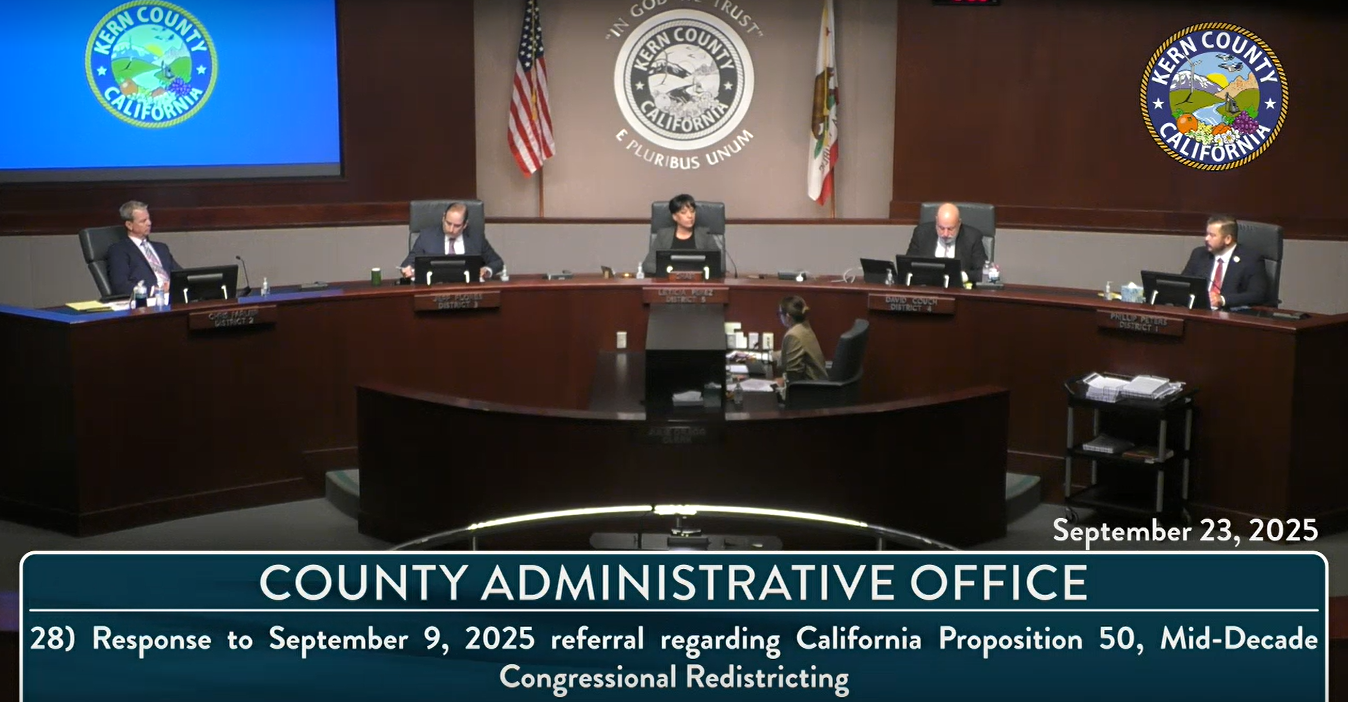
During the Kern County Board of Supervisors meeting on Sept. 23, the supervisors received a legislative report on Proposition 50. This proposition, slated for the Nov. 4 special election ballot, will determine whether the state’s current congressional districts will be suspended.
California’s congressional districts were drawn by an independent commission, but Prop 50 would temporarily replace them with a map that heavily favors Democrats for the 2026-2030 election cycle.
According to the California Farm Bureau, if Prop 50 passes, rural communities would be unfairly represented.
“Rural representation is critical in government. Prop 50 will hurt farmers and ranchers by silencing the rural vote and removing the independent commission from the longstanding, voter-approved process,” California Farm Bureau President Shannon Douglass stated. “Politicians should never draw their own districts to favor political parties and themselves.”
After hearing the legislative report from Thomas Brown, chief intergovernmental and legislative affairs officer from the Kern County Administrative Office, the Kern County Board of Supervisors voted to oppose Prop 50.
Well, four of the supervisors voted to formally oppose Prop 50, while Supervisor Leticia Perez voted against opposing it.