Valley Natural Beverages marks a milestone with ribbon cutting of Ultra High Temperature and Extended Shelf-Life milk packaging plant.
By Natalie Willis, Reporter, Valley Ag Voice
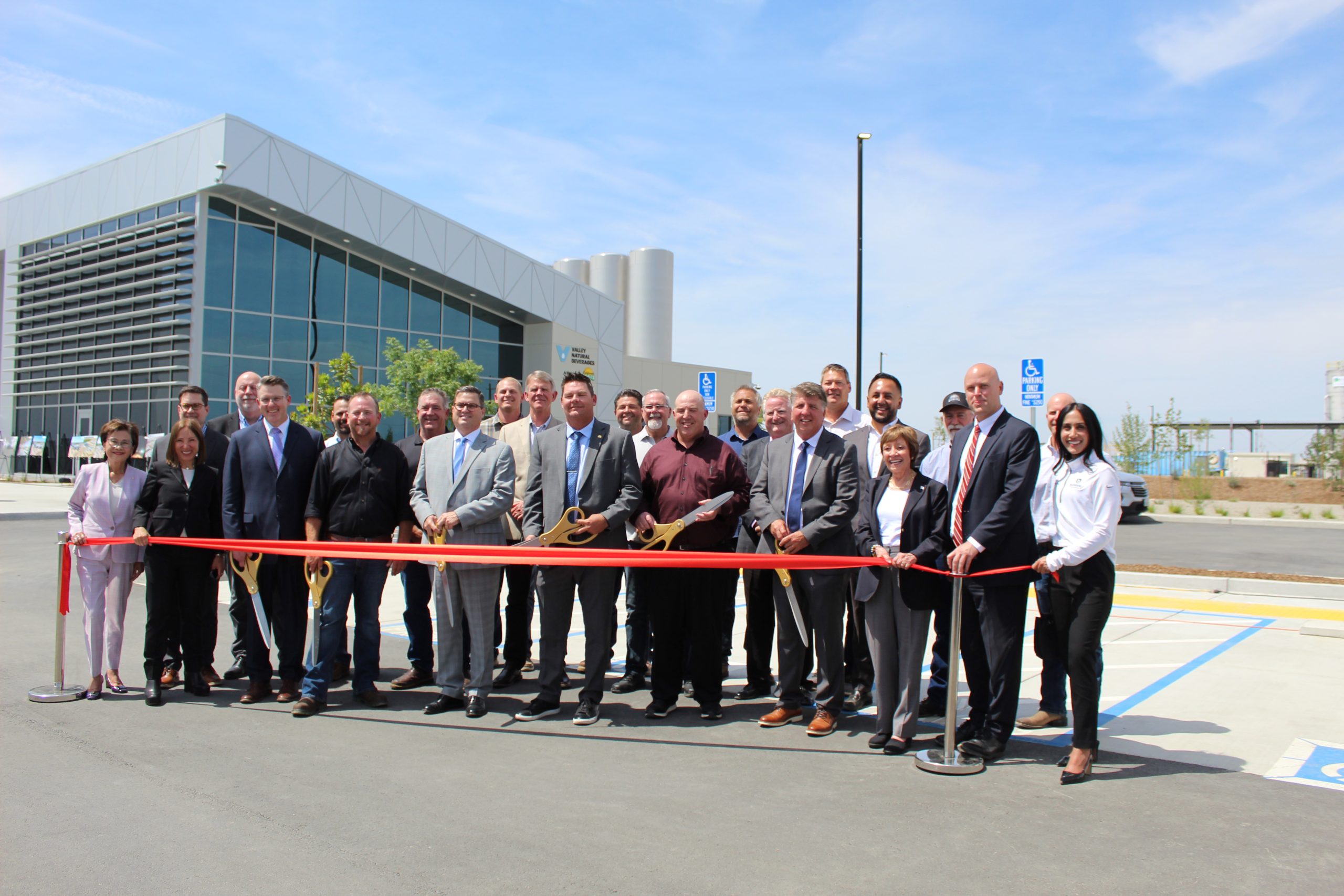
On April 30, Bakersfield welcomed a new dairy processing plant to its repertoire of agribusiness investments, marking a significant step forward in local value-added agriculture and job creation for Kern County.
Valley Natural Beverages, an Extended Shelf Life and Aseptic Ultra High Temperature dairy bottling facility, is a first-of-its-kind vertically integrated Class 1 facility in California. The greenfield site is situated on 40 acres of land and operates in a 200,000-square-foot processing plant.
The facility is part of California Dairies, Inc.’s network of six co-ops across the state, solidifying CDI’s status as California’s largest milk marketing cooperative and the second largest in the nation. According to Brad Anderson, president and chief executive officer of CDI, the co-op produces roughly 17 billion pounds of milk per year across approximately 300 member-owner farms.
Nearly all of these farms are family-owned and operate primarily in the Central Valley.
Anderson explained that, through this investment, CDI is shifting toward not just clearing milk but doing so in a more profitable way.
“It’s really a start of a new future in lots of ways. The co-op has been a proud co-op, it’s cleared a lot of member milk over many, many years with that being the primary focus and now we’re beginning a new journey around accomplishing that, plus doing it in a profitable way, in a sustainable way, in a way that we’re making consumer preferred products instead of just products we want to produce,” Anderson said. “And so, this facility allows us to start that journey in earnest and really allows us to return a bigger profit back to our members so they can continue to invest in both their farms and the co-op itself.”
By utilizing ESL and Aseptic UHT processing, the facility prioritizes extending shelf life and product freshness, effectively reducing waste. It will produce a range of dairy products — including ultra-high temperature milk, cream, condensed milk, skim milk, and powdered milk.
MOO-VING ON UP
The new CDI facility represents a significant investment for California’s dairy industry, featuring advanced technology and the capacity to serve both current and future generations of dairy farmers.
Cory Vanderham, CDI member-owner and dairyman, explained that this is a generational plant that will feed into the future of the California dairy industry for years to come.
“This is a generational plant, not just for the ones who are before us, not for us now, that are producing now, it’s for our kids in the future too,” Vanderham said. “This plant is going to definitely let our future dairymen, our kids, whoever they are, really succeed and let them feed the world with the best milk that can be made and that’s from California dairies.”
As such, siting the facility in Bakersfield, despite the challenges posed by California’s regulatory process, was a necessary step toward securing that future, Anderson explained.
Still, the construction process was not without its setbacks. The initial planning for the facility began in 2020, but the global pandemic — combined with the war in Ukraine — led to unprecedented inflation, with stainless steel prices rising by nearly 300%, he explained.
Anderson credited CDI’s partnership with local and state agencies as a key factor in navigating the regulatory process and completing the first phase of the facility on time and within budget.
“So, administratively it’s a lot, but I will tell you the partnership again with the city, county, and state, they allowed that process to go smooth and pretty painless,” Anderson said. “They have truly been a partner to make sure that this is a showcase and something to be proud of for these new jobs created and that we’re going to be good stewards within the community.”
During the ribbon cutting ceremony, Kern County District 4 Supervisor David Couch explained that the city of Bakersfield played a pivotal role in bringing the project within city limits.
“Normally this type of facility would be out in the unincorporated areas, and I think at one time it might’ve even been planned to go there, but it’s in the city limits of Bakersfield, and it wouldn’t be here without the mayor, the council, the city staff,” Couch said. “And I really appreciate the fact that you guys worked on this and supported this and got it done.”
Couch reflected on the dairy industry’s seasoned history in Kern County, specifically pointing to the mass relocation of dairies in Chino and the Inland Empire in the early 2000s. Despite a less-than-lukewarm reception, he noted that they persevered, established themselves in the region, and ultimately helped make facilities like Valley Natural Beverages a reality.
“You hung in there, and you moved here. You established your dairies here — they’re still here — and now you’re here with this facility,” Couch said. “So, I just want to compliment you for your ‘stick-to-itiveness,’ if that’s a word. We appreciate it, and that’s kind of what Kern County’s all about.”
RANCH TO PLANT
The plant’s location on Gosford Road, north of Taft Highway, is ideally located roughly 130 miles away from the Port of Los Angeles and plays into the facility’s ability to ship long-life milk products.
According to a press release, it is strategically located to eliminate 312,000 ranch-to-plant miles per year.
“All the milk that’s currently in Kern County goes south to LA or north to one of our two plants in Tipton or Visalia — our two milk powder and butter plants,” Peter Ernster, senior vice president of Valley Natural Beverages, said in a prior interview with Valley Ag Voice. “Really, what VNV offers would be an opportunity to have that milk made by dairies in the Kern County area and then be shipped and processed and shipped back out as finished product out in Kern County… most of the milk is gonna come within 10 miles of the plant, which is a tremendous amount of mileage saving.”
Anderson echoed the importance of the plant’s location, explaining that having a dairy processing plant in the middle of dairy country was long overdue. Additionally, the property was a perfect fit.
“It was truly a unicorn. It had all of the infrastructure we needed. The zoning was already what we needed, and the city has been absolutely amazing,” Anderson said. “And so, all the pieces just fit together.”
Currently, the plant has completed the first phase of its construction — that is, three filling lines. The full build-out, according to Anderson, will result in 10 to 12 filling lines.
The facility currently has space to accommodate two additional lines without requiring significant interior construction, he explained. A separate section of the plant has already been built and roofed but remains unfinished inside. This area will be completed as part of phase two, allowing for the installation of another three to four lines.
The final phase of expansion will involve extending the southernmost wall of the building to make room for an additional three to four lines. These expansions are planned over the next five years and will be driven entirely by demand. However, with the current three lines nearly sold out, Anderson expects to move into phase two relatively soon.
MILK MONEY
The facility will create roughly 100 jobs initially, with expectations to grow as the construction phases move forward, Anderson explained.
He highlighted that these jobs will be high-paying due to the mechanization and robotic equipment that require skilled individuals to operate.
“This is not just a plant full of minimum wage jobs, and so some of those people are people that already lived in the community, others have moved here because of it, and they’re buying homes, they’re putting their kids in school, they’re buying groceries here,” Anderson said. “So, they’re contributing in every way to the community, and we look forward to seeing that grow over time.”
Anderson explained that the plant’s success is an indicator of the future of agribusiness investment in Bakersfield and Kern County.
“I think it says that when you plan it correctly, you bring the local and state organizations along with you…it’s absolutely possible, and we’ve proven it here.” Anderson said. “Is that true everywhere in California? Obviously, I can’t say, but our experience is that Kern County, the city of Bakersfield, is committed to their citizens and creating high paying jobs and bringing more revenue to the community. And I think they’ve embraced us because we are doing it the right way.”
Additionally, the facility will benefit all dairy farmers — not just CDI members — by increasing Class 1 utilization.
“It’s very important to us to be contributing to the overall agricultural community, the overall dairy community, not just our CDI members,” Anderson said. “And we’re committed to work together with them to make sure that California continues to stay number one in the US.”