By Julie Finzel, Range and Livestock Farm Advisor, UC Cooperative Extension
In 2019, Das et al, published a study that documented nearly 20% blue oak mortality in Sequoia National Park. They found that the severe drought from 2012 to 2016 caused a significant increase in blue oak mortality when compared to pre-drought rates, which are closer to 5% annually.
During the worst year of this drought, 2014, I remember driving through Kern County and observing areas where the grass never sprouted below a certain elevation. The hills never turned green. At this time, I received calls from landowners concerned about their oak trees dying. A couple of my colleagues received similar calls. In response, we decided to start a small research study tracking Blue Oak vigor and mortality at three sites; one in Tulare County, one in Madera County, and one in San Benito County. We have about four years of data from this research. I once heard someone say that oaks grow for 100 years and die for 100 years. Four years of data on a tree species that lives for centuries isn’t enough to draw any real conclusions from; however, at the Tulare site, we did have one tree die in the first year.
In the process of designing the study, we learned some interesting facts about oaks (and ourselves). For example, when an oak tree dies, it releases nitrogen in the soil which can cause an increase in grass production, or sometimes, an increase in weedy species like Italian thistle. This nitrogen increase in the soil can last for up to 20 years. Also, in what I am guessing is a response to water stress, blue oaks will sometimes shed their most recent years growth from the tips of their branches, leaving little oak twigs all over the ground. Finally, all my professional training taught me to assess the landscape and examine the ground carefully. Studying oak trees required me to learn a new skill; looking up into the trees. It was like learning to write left-handed.
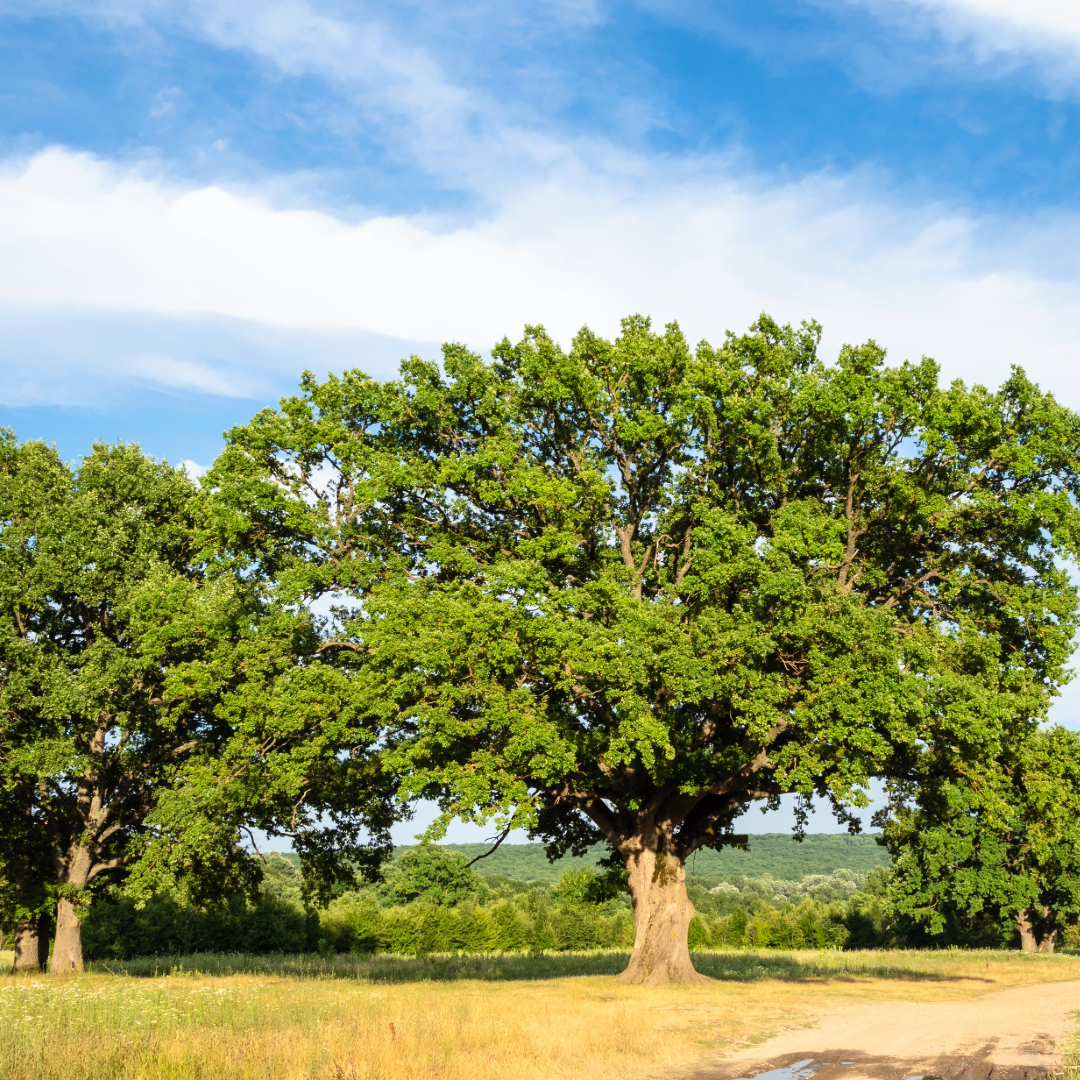
Blue oaks are considered a keystone species as their presence defines the landscape. Their acorns provide food for wildlife, their canopy provides shade for animals (and people!), their leaves are a nutritious snack for deer, and oak woodlands are home to many wildlife species.
In the 1990’s, UC scientists and others conducted a great deal of research on oak trees and oak woodlands. This effort was known as the Integrated Hardwood Range Management Program (IHRMP). Much of their research can be found archived at https://ucanr.edu/site/uc-oaks. One of the key drivers of this research was a lack of young oak trees, or a lack of oak regeneration. A careful observer can identify oak trees of similar age and size on rangelands—evidence of pulses of oak regeneration throughout the years (Stahle et al, 2013). Recent oak regeneration can be observed in some places, such as in wetter areas and on north facing slopes, but in many areas, no young oaks can be found on the landscape. The IHRMP studied oak regeneration extensively looking for a driver behind the lack of young oaks. Ground squirrels, cattle grazing, and the non-native annual grasses that dominate the landscape were all considered. Ultimately, no single cause could be identified. Rather, it seemed to be a combination of multiple factors. Science struggles with murky waters like this.
I know it might seem strange to mention drought when the National Weather Service (NWS) says a strong El Niño is building in the Pacific Ocean. However, California is known for cyclic weather patterns of drought. In 2014, the NWS reported 2.41 inches of rainfall for the Bakersfield area. In contrast, in the winter of 2022-2023 when Tulare Lake returned, the NWS recorded 10.26 inches of rainfall for the Bakersfield area. Average rainfall for the Bakersfield area is about 6.15 inches.
It is well known that grass growth varies greatly depending on the amount of rain received each winter. Each year, I visit sites across Kern and Tulare counties to collect samples of grass and weigh them to estimate forage production. This is one of my favorite times of year because I get to visit so many beautiful places during my extensive tour of Kern and Tulare counties. The data I collect is sent to the Farm Services Agency and the County Agricultural Commissioners to help with drought designations. This year, rainfall was slightly above average at just over seven inches, and the timing of the rain was near perfect for grass growth. It is no surprise that the rangelands grew a lot of grass this year and there was no reportable forage loss. Even the Mojave desert looked great and produced a lot of forage. I was even treated to a desert rainstorm during my annual visit this year!
One thing is clear as I visit rangelands and interact with livestock producers. Being a cattle rancher or a sheep producer can be a tough gig; they depend on mother nature for the water needed to grow feed for their livestock. But just like farmers across Kern County, they are proud to produce a healthy, nutritious food product to help feed America.
References Cited
Das, A.J., N.J. Ampersee, A.H. Pfaff, N.L. Stephenson, T.J. Swiecki, E.A. Bernhardt, P.K. Haggerty, and K.R. Nydick. 2020. “Tree mortality in blue oak woodland during extreme drought in Sequoia National Park, California.” Madroño 66(4):164-175. https://doi.org/10.3120/0024-9637-66.4.164.
Stahle, D.W., R.D. Griffin, D.M. Meko, M.D. Therrell, J.R. Edmonson, M.K. Cleaveland, L.N. Stahle, D.J. Burnette, et al. 2013. “The ancient blue oak woodlands of California: Longevity and hydroclimatic history.” Earth Interactions 17(12): 1-23. Available here.