USDA data reveals disproportionate impacts of Prop 12 on small farms and consumers.
By Natalie Willis, Reporter, Valley Ag Voice
California’s Proposition 12 — otherwise known as the Farm Animal Confinement Initiative — has been a source of national controversy since it passed in 2018. To put it mildly, Prop 12 established new minimum requirements on farmers to provide more space for egg-laying hens, breeding pigs, and veal calves.
The law prohibits the sale of animal products within California if they were not raised according to Prop 12’s housing requirements. Punishable by death.
Well, not really — but it is a criminal offense to sell certain animal products like whole pork meat if the sow that bore the pig was not housed within 24 square feet of space. Failure to meet the legal requirements can result in a $1,000 fine, imprisonment in the county jail for up to 180 days, or both.
Additionally, businesses selling illegal products are in violation of California’s unfair competition laws and may face additional fines.
While it is a state mandate, the proposition has affected producers in other states who must comply with the standards in order to continue sales to California. The state accounts for roughly 13% of the nation’s pork consumption but imports roughly 99.87% of its pork products.
New data from the U.S. Department of Agriculture finds that 27% of U.S. pork producers have made or are making investments to comply with Prop 12, but the average capital cost for retrofitting or rebuilding facilities is estimated at $3,500 to $4,500 per sow. The exact cost depends upon the region, existing infrastructure, and scale of operation.
This information was shared by USDA Secretary Brooke Rollins in a letter to the House Committee on Agriculture Chairman Glenn “GT” Thompson on July 21. The letter explained that compliance costs have disproportionately affected small to mid-size producers, with 12% of small pork operations — less than 500 sows — leaving the market or shifting away from breeding.
Additionally, retail pork prices in California have increased by almost 19% in June compared to the same month last year. A study conducted by the USDA in May found that the state’s low-income families reduced pork purchases by 22% since the law’s implementation on Jan. 1, 2024.
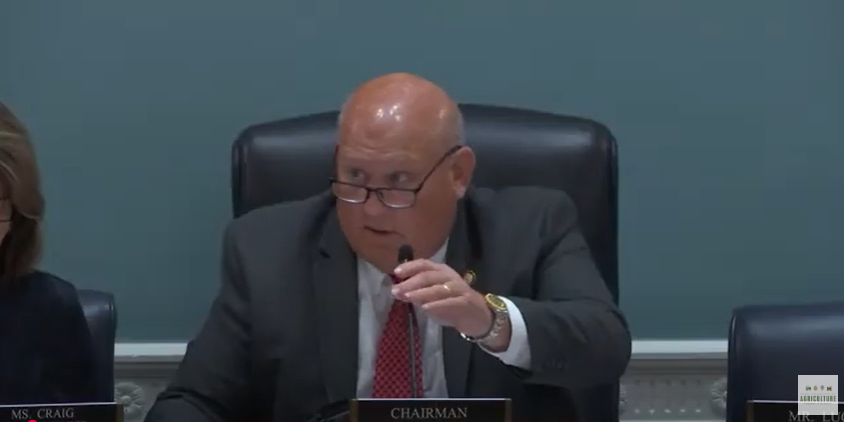
Today, Thompson utilized the USDA findings for his opening remarks at the full committee hearing, “An Examination of the Implications of Proposition 12.”
“The data shows that both producers and consumers are facing significant cost increases due to Prop 12,” Thompson said. “It begs the question – if producers are paying more, and consumers are paying more, who is winning?”
Because the “One, Big Beautiful Bill Act” addressed several priorities normally included in the five-year farm bill, Thompson is setting his sights on passing a “Skinny” Farm Bill. During his opening remarks, Thompson explained that a provision, Section 12007, was introduced in the Farm, Food, and National Security Act of 2024 to supplement the negative effects of Prop 12 on out-of-state producers.
The section aims to protect farmers’ ability to raise animals according to their chosen methods, while also acknowledging the need for some consistency in production standards across the country.
“It does not undo thousands of state-based agricultural laws, and it does not restrict a states’ right to impose standards within their own borders. It simply clarifies that states cannot impose, as a condition for sale or consumption, a production standard on livestock, unless that livestock is located within the states’ borders,” Thompson said. “This means that Prop 12 will stand in California, but only for those producers within California’s borders.”
Currently, Thompson is drafting the next farm bill, and both the House and Senate Agriculture Committees are actively conducting hearings. They plan to move the bill forward this fall.
FRY ‘EM UP
In other Prop 12 news, the Department of Justice filed a lawsuit against the state of California, Governor Gavin Newsom, Attorney General Rob Bonta, and other state officials over “burdensome and unnecessary regulations” on the production of eggs and poultry products.
The lawsuit claims that California regulations, particularly Prop 12, have contributed to high egg prices by imposing unnecessary red tape on the production of eggs.
“Through a combination of voter initiatives, legislative enactments, and regulations, California has effectively prevented farmers across the country from using a number of agricultural production methods which were in widespread use—and which helped keep eggs affordable,” the lawsuit states.
When Prop 12 was still a ballot initiative in 2018, the non-partisan Legislative Analyst’s Office detailed the fiscal effects of the measure, explaining that it would likely result in an increase in prices for eggs, pork, and veal.
The LAO explained that firstly, it would result in farmers needing to remodel or build new housing to accommodate space requirements which would also be more expensive to maintain on an ongoing basis. Second, it could take several years for farmers in California and other states to change housing systems to meet requirements, leading to a shortfall in supply.
“California’s regulation of eggs has, however, been effective in raising prices for American consumers,” the lawsuit stated. “Indeed, Proposition 12 alone has ‘caused a significant increase’ in egg prices, ‘and therefore led to a sizeable reduction in consumer surplus.’”