By Natalie Willis, Reporter, Valley Ag Voice
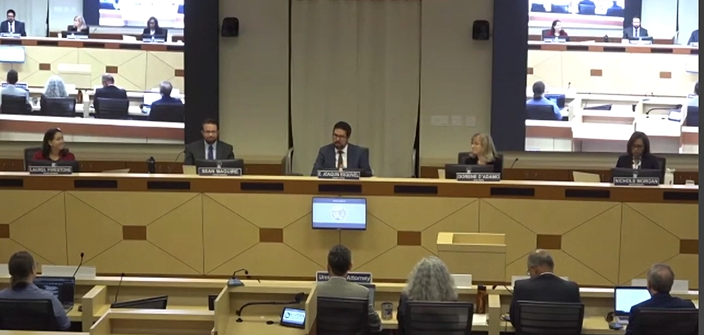
On September 17, the State Water Resources Control Board voted unanimously not to place the Kern Subbasin on probation under the Sustainable Groundwater Management Act. Instead, the basin will be placed back under the jurisdiction of the California Department of Water Resources.
During the continued probationary hearing for the subbasin, State Water Board staff explained that the Groundwater Sustainability Agencies have substantially resolved previously identified deficiencies.
While additional work is needed before the Groundwater Sustainability Plan is considered completely adequate, staff explained that the subbasin is likely to achieve sustainability by 2040, as directed by SGMA.
E. Joaquin Esquivel, Chair of the State Water Resources Control Board, explained that SGMA is still in the plan development phase, but implementation is where the rubber meets the road.
“What we acknowledge here is that there is still ongoing work, that this is an iterative process, but we want to give ourselves the best opportunity here to move forward in a way that gives us that best chance as we go into uncertain years ahead,” Esquivel said. “Uncertain hydrologically, uncertain on the ability to develop funding, and so many of the other pressures that you all are needing to balance at the local level to get all of this done.”
Vice Chair Dorene D’Adamo noted the complexity of the Kern Subbasin, the largest in California, with its numerous GSAs and water users.
“Early on, I spent a fair amount of time in Kern County meeting with whoever wanted to meet, and I just was really concerned because it felt like it was gonna be a real heavy lift, not just because of the challenges, the hydrologic challenges, but the diversity within the basin…but the last several months, and then some has just been really time well spent,” D’Adamo said.
“Thank you so much for just rolling up your sleeves and getting to work,” she added.
The resolution passed 5–0, marking a milestone for Kern but also a reminder that the hardest work — implementation — still lies ahead.
“This is a moment to celebrate, but the true work and implementation continues on,” Esquivel said.
GSP IMPROVEMENTS
The 2025 plan consists of seven GSPs — one foundational subbasin GSP and six GSPs with blue pages that contain GSA-specific info. For reference, the Kern Subbasin hosts 20 GSAs. According to the staff review, the new plan shows several improvements to make groundwater management more consistent, protective, and responsive to community needs.
Notably, the 20 GSAs have improved coordination across the entire basin instead of working separately allowing for shared standards and goals for groundwater levels and quality. They have also identified where data is still missing and committed to filling all monitoring gaps by the end of 2026.
Most groundwater level thresholds are now set at levels that protect existing water users, and if water levels fall too low, the GSAs will address the impacts, including helping households and public systems with well mitigation.
“The GSAs have a revolving reserve fund of $3.5 million per year for well mitigation,” the staff review stated. “The mitigation plan has two tracks for assistance: a mitigation track for domestic wells with less than five service connections (up to $90,000 per well) and a technical assistance track for public supply wells (up to $50,000 per well).”
Additionally, families with dry domestic wells can receive emergency drinking water delivered within 24 hours and hauled water within 72 hours.
Other key improvements include setting clear targets for mitigating land subsidence by 2040, working with the Friant Water Authority on cost-sharing for canal repairs, and creating a policy responding to any exceedance of thresholds.
The Kern County Subbasin GSAs have already begun implementing the 2025 GSPs.
REMAINING CONDITIONS
State Water Board staff commended the updated GSP for addressing the identified deficiencies in previous GSPs. However, there are three remaining issues that must be addressed by the basin’s GSAs prior to submitting the revised plan to DWR.
First, the subbasin will need to provide an adequate mitigation program for drinking water wells to manage groundwater management activities that cause chemicals, including 1,2,3-Trichloropropane, to rise above the safety limits set in the GSPs.
Secondly, the plan must incorporate a mitigation program to protect small community wells, or homes that share one well with four or more households.
Lastly, staff recommended the removal of the May 2026 expiration date for the Kern Non-Districted Land Authority GSA Joint Exercise of Powers Agreement. If the agreement ends, parts of the subbasin would be left unmanaged, which could trigger state intervention.
SEVEN OVERDRAFTED BASINS
Of the seven subbasins deemed inadequate by DWR, the Kern Subbasin is the third to be sent back to the department for review. The Kaweah and Chowchilla subbasins went back to DWR oversight earlier this year.
Although Tulare Lake was the first subbasin put on probation in 2024, penalties for farmers have been delayed due to a preliminary injunction issued by Kings County Superior Court Judge Kathy Ciuffini in a lawsuit brought by the Kings County Farm Bureau against the State Water Board.
Tule Subbasin was the second to be placed on probation and is currently going through the probationary process.
The remaining overdrafted basins, Delta-Mendota and Pleasant Valley, are awaiting dates for their respective Water Board hearings.