
By Julie Finzel, Range and Livestock Farm Advisor, UC Cooperative Extension
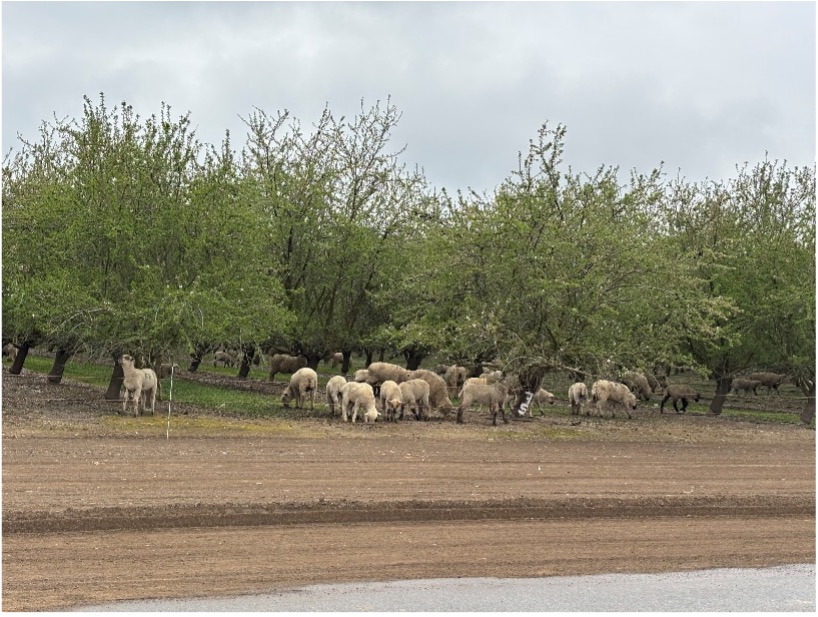
Interest in using sheep to help manage cover crops and improve soil health in orchards is growing. However, food safety concerns exist because almond harvest is done in part on the ground.
In response to this concern, my team and I designed a two-year research project to measure fecal pathogens in the soil of grazed almond orchards. We have two study sites; both are managed using cover crops and sheep grazing. We collected manure samples from the sheep, soil samples prior to grazing, and soil samples zero to 120 days post-grazing in regular, timed intervals on grazed and ungrazed blocks. Pathogen analysis focused on variants of E. coli, including E. coli O157:H7.
While this was a two-year study, we currently only have results from the first year to share. In Year 1, six out of 20 manure samples tested positive E. coli O157:H7 from Farm A and nine out of 20 manure samples tested positive for generic E. coli from Farm B. From a total of 300 soil samples collected, two soil samples tested positive, both post-grazing. On Farm A, one soil sample from Day Zero post-grazing tested positive for generic E. coli. On Farm B, one soil sample from Day 60 post-grazing tested positive for both generic E. coli and E. coli O157:H7. Both samples were from the wetting zone under the tree canopy. We were not able to test to determine if the positive samples were from sheep or from another source. But it should be noted that past Day 60, there were no positive samples for any fecal coliforms on either orchard. The current standard practice is to have animals removed a minimum of 120 days prior to harvest.
Another concern when integrating grazing into orchard management is potential costs. As part of this study we looked at potential costs and returns when integrating sheep grazing. In our analysis we included a grazing fee of $60/acre for 2 passes through an orchard (of note, sheep only made one pass in both orchards in this study). Cost savings included less mowing, one less herbicide application, reduced sweep and mow for naval orangeworm winter sanitation, and less compost application. No reduced revenue or additional revenue was included in the calculations. Altogether, our budget analysis showed a potential savings of $7 an acre.
The preliminary findings from this study are promising. No samples tested positive for fecal pathogens past 60 days post-grazing indicating that the current 120 day rule is sufficient to maintain the food safety of ground-harvested almonds post-grazing. Further, our budget analysis indicates that integrating sheep grazing can have a positive impact on the bottom line for almond producers. Sheep producers in the southern San Joaquin valley have mobile operations, well-suited to seasonal orchard grazing. However, sheep producers must place priority on the well-being of their sheep and maintaining a strong business model. As a result, the availability of sheep for orchard grazing may be limited in some circumstances. It is important to work closely with the livestock producer to balance the almond production schedule with the logistics of livestock production.