By Natalie Willis, Reporter, Valley Ag Voice
With the Kern County Subbasin’s State Water Resources Control Board hearing set to continue on September 17, an updated 2025 Groundwater Sustainability Plan is hopeful to prevent a probationary designation.
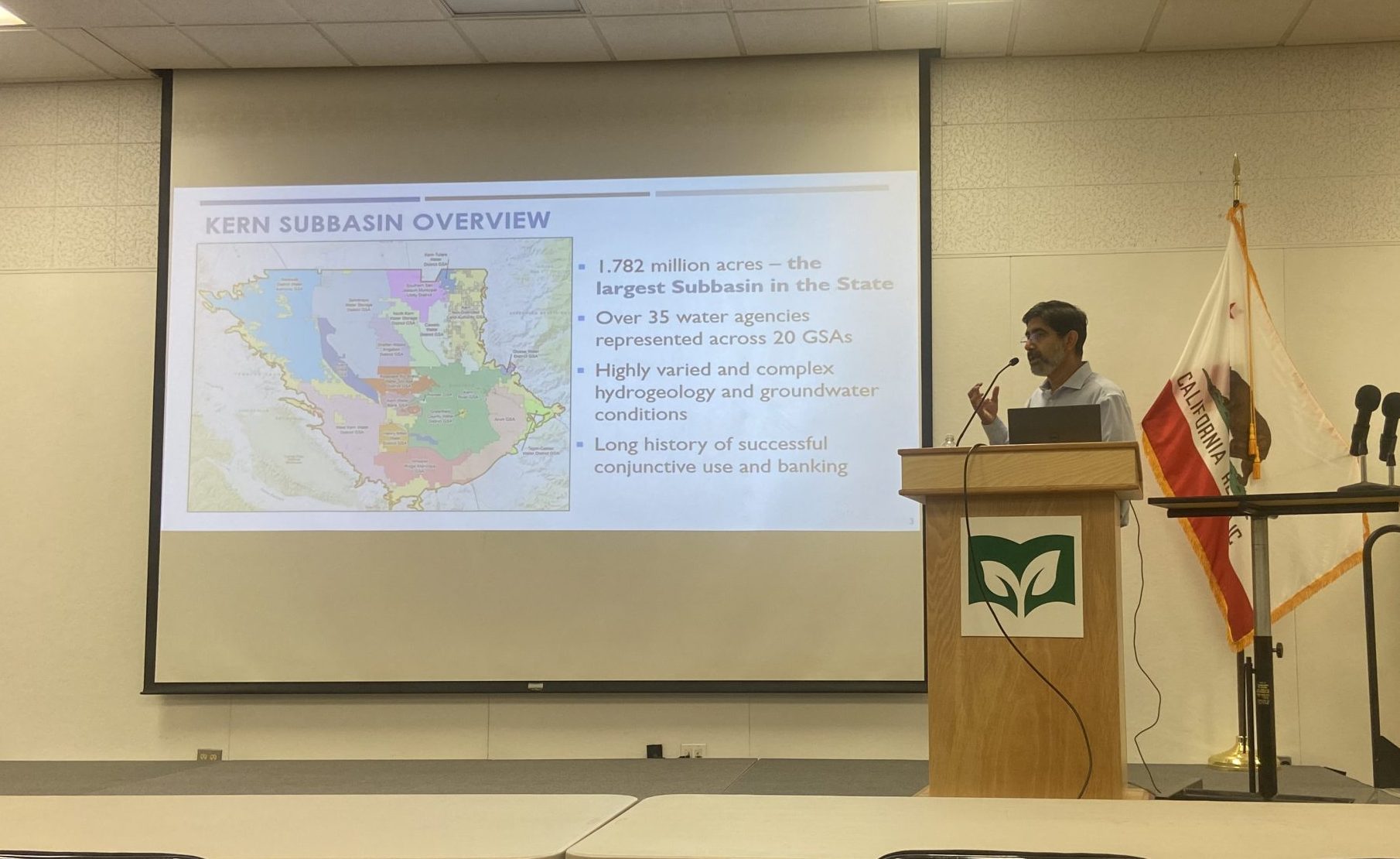
Close to 1,000 pages, the revised GSP enhances coordination between over 20 different groundwater sustainability agencies and 35 water agencies — combined, these agencies cover the largest subbasin in the state.
On Aug. 26, the Water Association of Kern County and the Kern County Farm Bureau hosted a technical meeting on the GSP and the Sustainable Groundwater Management Act. According to Intera Consulting’s principal water resources engineer, Abhishek Singh, the updated plan is the product of thousands of hours of collaborative work among local GSAs, technical experts, and state staff.
“The 2025 plan consists of seven GSPs. We have one foundational subbasin GSP, and then six GSPs with blue pages that contain GSA-specific info,” Singh said. “This was really important because there’s so much diversity and complexity within the Kern Subbasin that specific GSAs needed to have their own document where they could include that detail.”
The updated GSP includes several refinements and improvements to address the deficiencies in the old plan, with a focus on data gaps, monitoring, and groundwater quality. Specifically, the plan expands groundwater level and quality monitoring to include nearly all domestic wells in the basin and refines the definition of an “undesirable result.”
Additionally, clear notification protocols for well owners were established, as well as enhanced mitigation programs for dry wells, small systems, and water quality issues. A revised Subsidence Action Plan, developed with the Friant Water Authority and DWR, is also included.
For more detailed information on the plan and its revisions, visit kerngsp.com.
PROOF IN PUDDING
According to Singh, while the Kern Subbasin looks good on paper, it has also made progress in terms of boots-on-the-ground implementation.
“We’re actually ahead of schedule in terms of reaching sustainability, in terms of correcting overdraft, collecting data,” Singh said. “Proof’s in the pudding, and we’re not just talking the talk, we’re walking the walk.”
The 2025 Plan aims to stabilize groundwater levels by 2030 and develops protocols for investigating, documenting, and communicating minimum threshold exceedances, he explained. The goal to stabilize groundwater levels 10 years ahead of SGMA’s 2040 sustainability requirement intends to reduce long-term land subsidence.
Singh explained that local GSAs, such as Wheeler Ridge-Maricopa and Semitropic, are already implementing projects like pumping moratoriums, surcharges, and demand management programs to avoid or minimize subsidence.
“We’ve defined these thresholds for water levels, water quality, and subsidence,” Singh said. “If any of those thresholds are exceeded, we have an action plan to communicate to GSAs, to communicate with stakeholders, and let them know that there’s been an exceedance and what action is being taken to account for the impact from that exceedance or avoid it in the future…this is a very rigorous protocol for investigating, documenting and communicating those exceedances.”
According to Singh, 99% of the subbasin’s overdraft can be corrected through demand reduction, land conversion, water budgets, groundwater charges, pumping restrictions, with GSAs already making strong progress.
“Our plan is more than a plan,” Singh said. “If you look into our appendices, these implementation provisions are really getting into actions on the ground.”
Recent data shows that demand reduction is ahead of schedule, with about half of the projects and management actions already implemented. Singh explained that these efforts, combined with wet years and recharge activities, have reduced the 372,000-acre-foot deficit and increased groundwater storage by 2.75 million acre-feet.
This feat was recognized in a DWR report, explaining that the Kern Subbasin had the greatest increase in groundwater storage in water year 2024.
Overall, Singh explained, the revised GSP has a high likelihood of keeping the Kern Subbasin from a probationary designation.
“I think the plan really exceeds the standards that…if you look at plans that have been approved by both DWR and the State Board, I think the Kern Subbasin plan meets all those thresholds and exceeds them in many regards,” Singh said.
Jenny Holtermann, executive director of WAKC and president of KCFB, said the Farm Bureau is preparing a support letter that farmers can sign onto online. The letter, directed to the State Water Board, is expected to be available no later than Sept. 2.
For more information about the upcoming probationary hearing, visit the Water Board’s website.