By Natalie Willis, Reporter, Valley Ag Voice
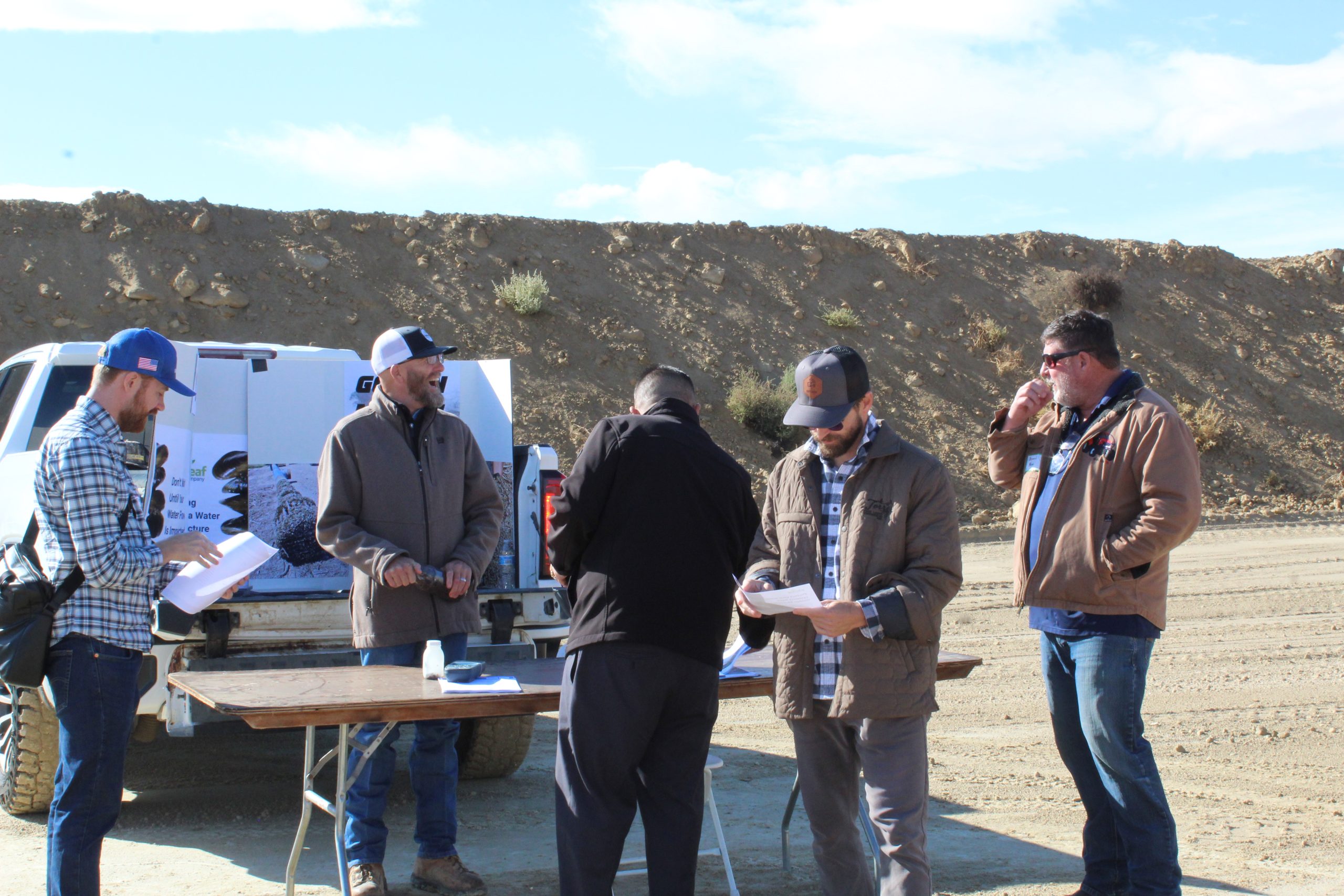
On October 22, H.M. Holloway and the Kern County Farm Bureau co-hosted the first Soils in Action field day event at Holloway’s gypsum mine in Lost Hills, California. According to Brian Milne, vice president of communications for Holloway, the field day was inspired by the general lack of regional events focused on soil health.
“There’s a lot of events out there, but not a ton focused just on soil health. So, that was the primary reason, and also, to show people where Holloway gypsum comes from at the mine here,” Milne said.
Growers, agronomists, crop advisors, and others interested in soil health attended, with opportunities to visit over 30 exhibitors at the tradeshow and hear from industry experts on maintaining high-quality soil to benefit their operations.

The speakers covered several topics including salinity management, drone imaging, microbes and nitrogen mineralization, AgTech and precision application, different forms of gypsum, and a timely discussion on golden mussels. Representatives from the University of California, Davis, Sunridge Nurseries, Greenleaf Ag – a Bennett Company, Holloway, the University of California Cooperative Extension, Kern Machinery, California State University, Bakersfield, and Grimmway Produce Group hosted these speaker stations.
According to Allie Cushnyr, senior agronomist with Holloway, while the event was dedicated to soil health, she also wanted to include discussions on ag technology and California’s ongoing battle with the invasive golden mussels which continue to clog vital water infrastructure.
“If we ignore key things like golden mussels and we’re not talking about that, then we’re not going to have farming,” Cushnyr said.
Daniel Terry, director of sales and ag products at Holloway Gypsum, explained that they hope to make the Soils in Action field day a recurring event. He noted that new products continue to hit the market, but research and scientific verification is currently lagging innovation.
“That’s why we’re here right now,” Terry said. “We want to start an open dialogue, we want to start presenting something new to everybody, and we’re hoping this starts to shed some light on what’s out there and what can happen as we all work together.”
TRUE GYPSUM AT HOLLOWAY
Cushnyr gave a presentation on the different types of gypsum and explained the unique properties of Hollway’s gypsum. Gypsum is a natural mineral commonly used in agriculture to improve soil structure, add calcium and sulfur to boost crop productivity, and improve water filtration, among other uses.
According to Cushnyr, Holloway has mined gypsum for over 90 years, and its gypsum stands apart from the rest. Holloway’s original gypsum is an organic, naturally mined Dihydrate form, which allows it to dissolve and works faster than anhydrite alternatives.
“This material is a dihydrate material that you’re standing on, which means that it has two water molecules on it, which means it’s very soluble and will move into your soil structure,” Cushnyr said. “The whole reason you use dihydrate is because when water hits it, whether it be your irrigation or the rain, it’s going to move into the soil. And when it’s moving into the soil, you’re ideally replacing your sodium ions on your [Cation Exchange Capacity] of the soil with calcium ions.”
She explained the importance of leaching the soil underneath the root zone. As part of the agronomy programs Cushnyr runs for growers, she takes soil samples within the root zone and below the root zone to understand what leached, what still needs to leach, and how much progress has been made.
Along with mining its own gypsum, Holloway carries a wide variety of soil amendments, fertilizers and nutrients to get growers’ soils on the right track.
GOLDEN MUSSELS
John Bison from Greenleaf Ag hosted a speaker station to discuss the golden mussel — an invasive species native to China and Southeast Asia that was initially detected in the Sacramento-San Joaquin Delta and O’Neill Forebay in October 2024.
Bison explained that the golden mussel spread quickly in California, and efforts to mitigate the species are ongoing.
“Everything in the State Water Project water across the aqueduct has golden mussels in every ounce of water. They are a broadcast spawner, and they can spawn multiple times in a season,” Bison said. “We know based on studying them in other countries, they spawn between six and 13 times in a summer. We don’t know what triggers them. We thought it was temperature. We know they start spawning at about 60-degree water temperatures. But we’re finding, for example, this year we’ve documented eight spawns, individual spawns this year in the aqueduct.”
He explained that while quagga mussels and zebra mussels spawn once or twice a year and take six to eight months to come to maturity, golden mussels spawn up to 13 times a year and come to maturity in two months. Further, they can be sexually mature in three months, meaning every three months, the juvenile mussels are creating their own larvae.
The danger of this species is its ability to plug irrigation systems and block water flow in the state, Bison explained.
The current treatment protocol is a copper sulfate pentahydrate, but Bison explained that not all copper sulfate pentahydrates are successful. Currently, California has approved only four chemistries to fight golden mussels, and copper remains the cheapest and most effective option.
Bison utilizes a continuous, low-dose treatment of copper, which has proven to be the best fight against the species currently. He explained that the low dose keeps it from harming other fish or wildlife.
According to Bison, federal and state funding are both needed to effectively mitigate the golden mussel. Specifically, he explained that the impact on concrete will require federal assistance. Essentially, mussels need calcium to build their shells, and the east side of the Valley has naturally low-calcium snow runoff.
When the water is low in calcium, Bison explained that mussels naturally go to the concrete, where they pull 20% of the calcium out of it, ultimately weakening the structure.
“Coming into an El Niño season, think of all the bridges going across the aqueduct right now…some of the studies say it could weaken the concrete up to 80%,” Bison said.
Additionally, golden mussels attach to water infrastructure pipes and colonize in large groups in certain areas, causing metal corrosion.
“Just by them being in the pipe will corrode the metal and weaken the concrete and just destroy our infrastructure of our pipes and our water systems in the state of California,” Bison said. “It’s not only the risk of them plugging up the water and stopping the flow; it’s also weakening an aging water infrastructure.”
He explained that while his efforts as an applicator have resulted in 100% mortality of mussels where he applies treatment, it’s impossible to treat every colony given how fast the mussels keep spreading.
“So, we’re fighting [the Department of Water Resources] to treat the actual aqueduct at the source,” Bison said. “It’s yet to be seen if they’re going to do that or not, but hopefully they will.”
The cost of treating this invasive species is more than local agencies can handle, Bison explained. He pointed to efforts in China – where the golden mussel is indigenous and has indigenous predators — explaining that it costs them roughly $12 billion a year to fight the species.
“Kern County has declared a [local] state of emergency, but all that is, is a letter to the Governor, and he’s done nothing,” Bison said.
He explained that he is focused on spreading the word about how severe the issue is, educating people on the topic, and fighting for state and federal funding to help growers fight golden mussels.
“This problem in California is only starting to move east,” Bison said. “This is a problem that’s going to affect at least the southern states, all the way to the east coast. It’s just not there yet.”