By Natalie Willis, Reporter, Valley Ag Voice
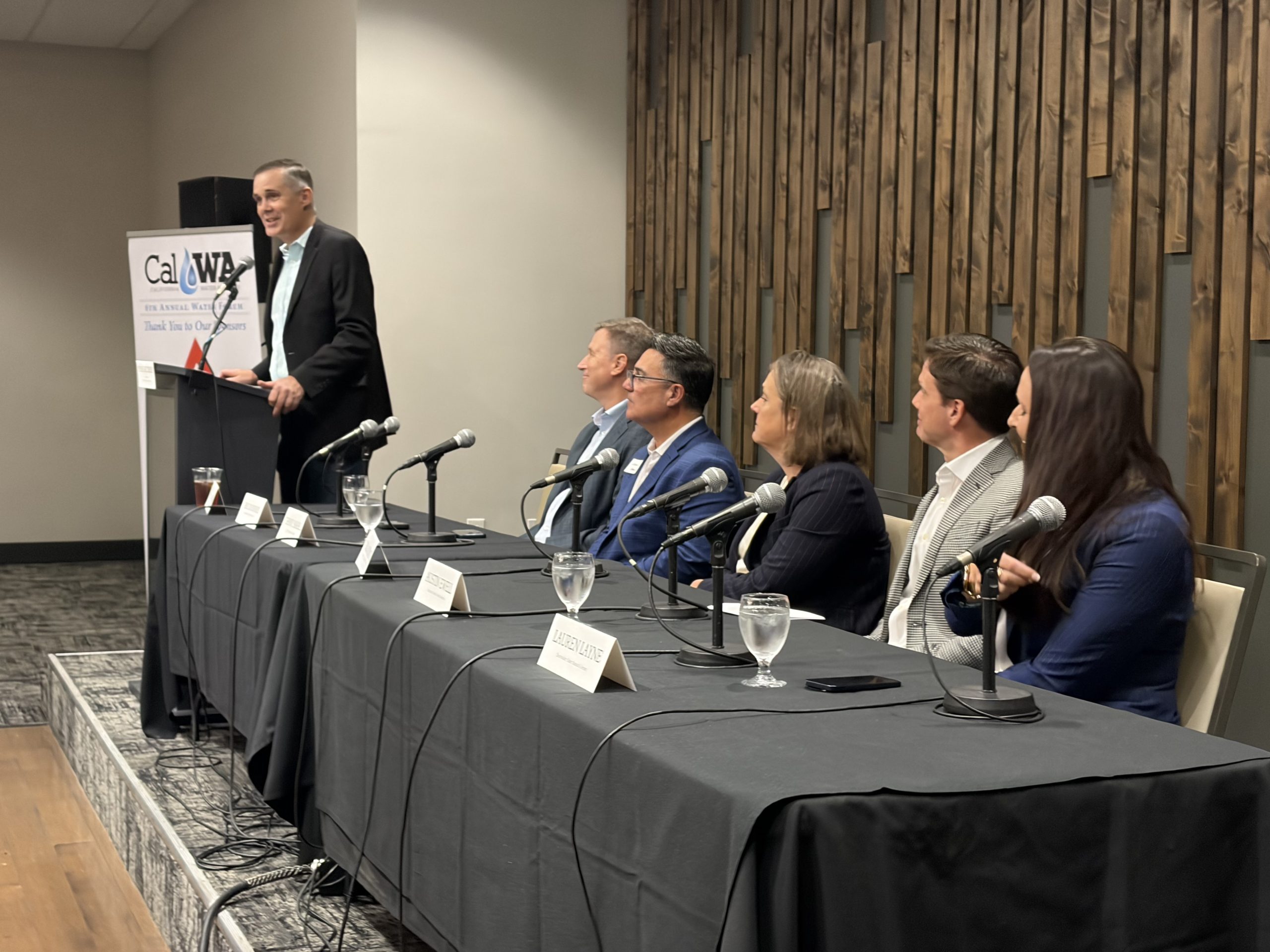
On October 1, the California Water Alliance hosted its sixth annual Water Forum in Fresno, featuring insights from policymakers and local leaders in water, agriculture, and business. Along with remarks from Central Valley Congressman Vince Fong, the forum included an expert panel discussion on California’s water future.
According to Ryan Jacobsen, moderator of the panel and CEO of the Fresno County Farm Bureau, the panelists were uniquely suited to discuss water reliability, infrastructure, policy, and practical solutions to the state’s water challenges.
Panelists included Executive Director of the Water Blueprint for the San Joaquin Valley Austin Ewell, CEO of the Friant Water Authority Johnny Amaral, Founder and CEO of Weather Tools Rob Doornbos, Water Law and Public Agency Attorney Lauren Layne, and Karla Nemeth, executive director of the Association of California Water Agencies and former director of the California Department of Water Resources.
Jacobsen began the discussion by asking each panelist to describe the obstacles to establishing greater water reliability in the state. According to Layne, regulations and legislation continue to hinder meaningful progress.
“A lot of it comes down to ‘What do I have to do from a regulatory compliance standpoint?’” Layne said. “Not because I’m not willing to comply, but because there are so many different regulatory requirements that we are having to comply with, it makes it very complicated.”
Ewell explained that establishing partnerships between local, state, and federal leaders is critical to help secure funding for water infrastructure and other collaborative projects to improve water supply availability. He pointed to the recent groundbreaking ceremony for the first phase of the Friant-Kern Canal’s Pump Station Replacement Project, which benefited from state and federal funding.
“That is a perfect example where you found local, state, and federal partners that were able to work together to bring funding and a certain focus for a real, critical result,” Ewell said. “Ultimately, partnerships are going to help us get through a lot of what we’re facing now.”
Nemeth explained that, within her new role at the Association of California Water Agencies, she has been focused on clearly articulating the interconnectedness of how water moves in California.
“The onus is really on us to be able to tell that broader California narrative of a California system and how it’s supposed to work and what it means to work with the challenges ahead,” Nemeth said. “That’s what I’m focused on in terms of something that we’re lacking in the water community to be more effective in Sacramento.”
Amaral took a more focused approach on the effect that the Sustainable Groundwater Management Act has had on agricultural production in the Central Valley. He explained that, for growers in subbasins under state probation, the future of their operations is difficult to predict.
Specifically, Amaral explained that the State Water Resources Control Board is proposing a pumping moratorium within two miles of the Friant-Kern Canal under the interim plan for the Tule Subbasin.
“The State Board has made an announcement that they intend to impose a two-mile moratorium on either side of the Friant-Kern Canal for 30 miles,” Amaral said. “So, that’s any pumping, any pumping irrespective of the depth, irrespective of your recharge credits. Their announcement was that they were going to implement a complete moratorium of two miles on each side of the canal.”
Doornbos, as a developer of precipitation forecasting technology, explained that the biggest barrier to water reliability is that there is not a statewide, accurate seasonal precipitation forecasting approach to allow growers to plan their seasons with greater certainty.
PARTNERSHIPS FOR PROGRESS
Throughout the forum, the need for partnerships among state, federal, and local leadership was emphasized, specifically pertaining to securing the funds necessary to improve the state’s aging water infrastructure.
According to Amaral, the Phase 1 Pump Station Replacement Project for the Friant-Kern Canal is an example of state, federal, and local partnership in action.
“If you can get the politics to align on a project, you can do good things…we just did a groundbreaking this morning to replace five pump stations,” Amaral said. “These are projects that are funded by, I’m just going to say it, President [Donald] Trump and Governor [Gavin] Newsom are on the same page funding these projects. So, it can be done. You just have to make sure you have the magic sauce to do it.”
According to Nemeth, ACWA is working on a vision to promote California’s water future as a priority for state policymakers.
“It’s challenging behind the scenes to get people on the same page and see a path and a future that is hopeful,” Nemeth said. “On the state side, I continue to think most of the things that we need to do is going to require either significant state funding or new authorizations at the state level. I think there are certain things we can do around the margins, but we have real challenges that require and involve the Legislature.”
She explained that ACWA’s vision prioritizes delivering critical water infrastructure, modernizing California’s regulatory and operational systems, and protecting affordability. According to Nemeth, having a solutions-based framework that connects water users on these issues will push state leaders into action.
“Any governor that comes in doesn’t inherently want to work on water. They think it’s divisive — you know, the water users don’t get along, let alone the environmental folks — and they don’t want to do it unless they have to. But hydrology is starting to show up where they have to,” Nemeth said. “I think it would be important as a launching off point for the water users to have something that can point to and say, ‘This is what we agree on.’”
According to Nemeth, the ACWA vision could align with organizations like the Water Blueprint for the San Joaquin Valley which released its final Unified Water Plan on September 23.
Ewell explained that the Unified Water Plan has been provided to the U.S. Bureau of Reclamation which will ultimately transmit the document to Congress.
“That effort and continued effort of the Blueprint is to provide, at a minimum, a unified voice so that we can have that unified ask when we are talking with the legislators, when we’re talking with the lawmakers,” Ewell said. “That ‘Here are the answers to the questions, here are the solutions, and here’s how we’ll make the Valley thrive.’”
LIGHTNING STRIKES
According to Amaral, the Water Blueprint’s Unified Water Plan provided answers to many of the state’s prevalent water challenges, but meaningful action from state and federal leaders is yet to occur.
“The last time something meaningful on water regulation happened in D.C. was the [Water Infrastructure Improvements for the Nation] Act of 2016, 10 years ago. So, lightning strikes rarely, but it strikes from time to time,” Amaral said. “With all the work that the Blueprint’s doing, and ACWA does, and the Friant does, and Westlands does, and everybody does to get a really good proposal with really good ideas, it still requires a federal and a state administration to say … ‘This is what the policy’s going to be to move water in California. This is what the needs are in California, and this is how we’re going to — irrespective of what party we have behind our name — we’re going to figure out a way to push this forward because the people of California need it.'”
During his remarks, Congressman Fong explained that increasing water supply in California remains a top priority for his office. Specifically, he said he is focused on water infrastructure funding, recharge efforts, and the state’s water allocations and operations.
In order to make progress, Fong explained he needs a partner at the state level.
“For me, I need a state partner…when these policy windows open, it’s like changing lanes in the 405 — you’ve got to be ready to go. Because that opportunity closes very, very quickly,” Fong said. “Your advocacy on the state side is extremely important, and sometimes you’ve got to be aggressive. Sometimes you’ve got to throw sharp elbows, because I guarantee you the other side is doing the same thing.”
CA WATER ALLIANCE
The California Water Alliance is a non-profit advocacy and educational organization founded in 2009 that promotes reliable and sustainable water policies for the state.
For more information about the organization and future events, visit californiawateralliance.org.