By Natalie Willis, Reporter, Valley Ag Voice
The Kern County Farm Bureau was established in 1914 to protect and advance the future of local farmers and ranchers. For more than a century, this work has involved countless hours of policy advocacy, public relations, and education to create a favorable environment for agriculture, freeing farmers to focus on what they do best — feeding the world.
Acting as the voice of local agricultural interests, Kern County Farm Bureau presidents have helped steer the ship through historical turning points, increasing regulatory strains, and evolving industry pressures that demand steady leadership and vision.
MAKING HISTORY
Fred H. Hall was the first president of the Kern County Farm Bureau, serving a two-year term and leading the Farm Bureau to 202 members. Hall also established the “Farm Bureau Monthly of Kern County” which detailed harvest conditions, Farm Bureau meetings, and generally kept farmers and ranchers apprised of happenings in local agriculture.
“On his rounds through the county, the Farm Advisor has often been asked where a certain number of cows or hogs could be bought or sold or where a certain implement could be disposed of,” an excerpt from the May 1, 1915, newsletter stated. “For some time, a Farm Bureau Exchange has been conducted, and we believe that with the publication of the Farm Bureau Monthly, the efficiency of the exchange will be greatly increased.”
For added history, Hall maintained a 200-acre alfalfa and hog ranch four miles southeast of Kern, according to “History of Kern County, California” by Wallace M. Morgan.
“From whatever standpoint of life of Mr. Hall is viewed, whether as deputy sheriff and marshal in his earlier years or as a special agent of the Santa Fe Railroad Company, whether as a member of the state legislature promoting measures for the welfare of his constituents, whether as the owner of alfalfa lands or as a large stakeholder in oil organizations and water companies, he is found to be a man of versatile abilities, possessing a high order of intelligence, devoted to the commonwealth of his nativity, well-informed concerning its possibilities and eager to develop its vast resources,” Morgan wrote.
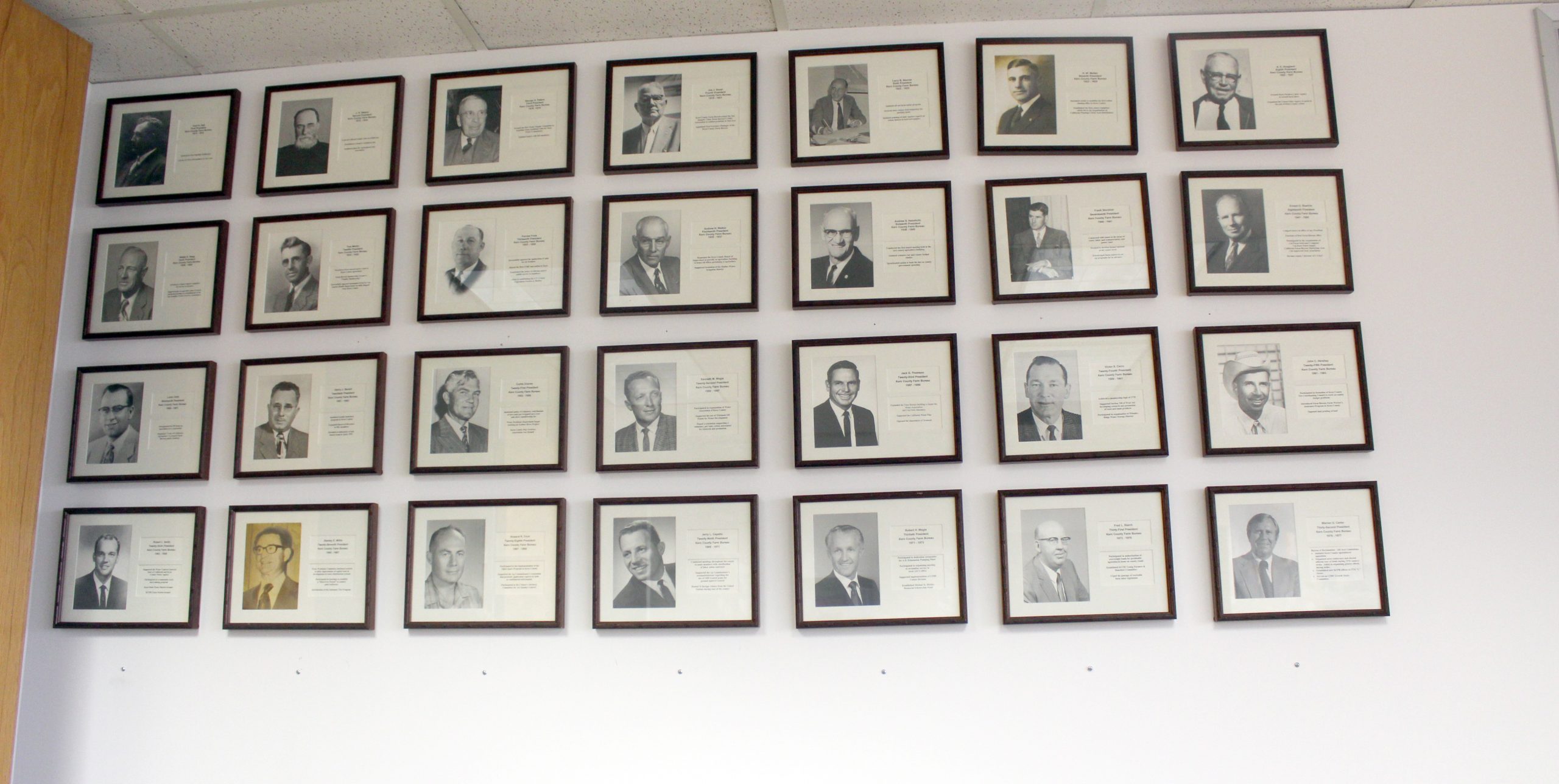
The spirit captured in this picture of Kern County Farm Bureau’s first president lives on through the 56 leaders who followed, each bringing a diversity of knowledge, involvement, and dedication to advancing the agricultural community.
Other notable accomplishments from 1914-1929 include the lowering of railroad freight rates on alfalfa hay, which J.H Waters achieved during his 1915-1916 term. Waters also established a farmer’s telephone line and laid the foundation for the Agricultural Fair Association.
George H. Peters, president from 1916–1919, formed the first Water Supply Committee to negotiate with the State Water Commission, addressing one of Kern’s most pressing needs. By the end of his term, membership had grown to 825.
Shortly after, Larry B. Nourse, who served from 1922–1923, initiated farm safety programs, secured more county fruit inspectors for packing sheds, and ensured daily cotton futures reports were printed in local newspapers.
The seventh president H.W. Mellen, serving from 1923–1925, established the Kern Farmers Labor Agency to recruit farm labor and organized the Cotton Sales Agency to assist growers with marketing their crops. Likewise, in his term, A.E. Hoagland expanded upon those efforts by continuing to strengthen labor recruitment and cotton marketing services for local farmers.
The tenth president, Walter E. Haag is credited with activating a rodent control committee to serve farmers and supported the cooperative plan of cotton marketing which led to the creation of the San Joaquin Cotton Growers Association.
FOUNDATION OF ADVOCACY
Since 1930, Kern County Farm Bureau presidents have championed practical policies for agriculture, advocating on issues ranging from local county matters to federal initiatives.
For instance, during the decade preceding the Great Depression, the fluid milk industry in California experienced substantial growth, according to the California Department of Food and Agriculture. This growth was especially noticeable in Southern California, with many new producers entering the field and others expanding operations.
However, the Los Angeles Health Department wanted to charge Kern County dairymen an extra fee for their milk coming into the city. The president at the time, Tom Martin, fought and won against the assessment fee from L.A.
From there, Kern County Farm Bureau presidents have led efforts to advocate for fair policies that support the industry rather than hinder it. This legacy includes President Forrest Frick’s successful fight against a proposed fertilizer sales tax in the 1930s and 32nd President Warren Carter’s opposition to the Bureau of Reclamation’s 160-acre limitations in the late 1970s.
The same legacy evolved through the generations of leadership, with the most recent voice of Kern County agriculture, Jenny Holtermann, spearheading grassroots efforts to oppose harmful legislation in Sacramento.
As the 56th president, Holtermann represented farmers and ranchers at the local, state, and national levels, advocating for policies and shaping legislation that affected agriculture. Though her term has ended, her steady presence at water meetings, regulatory hearings, and her own experience as an almond farmer place her in the history book of exceptional Farm Bureau presidents.
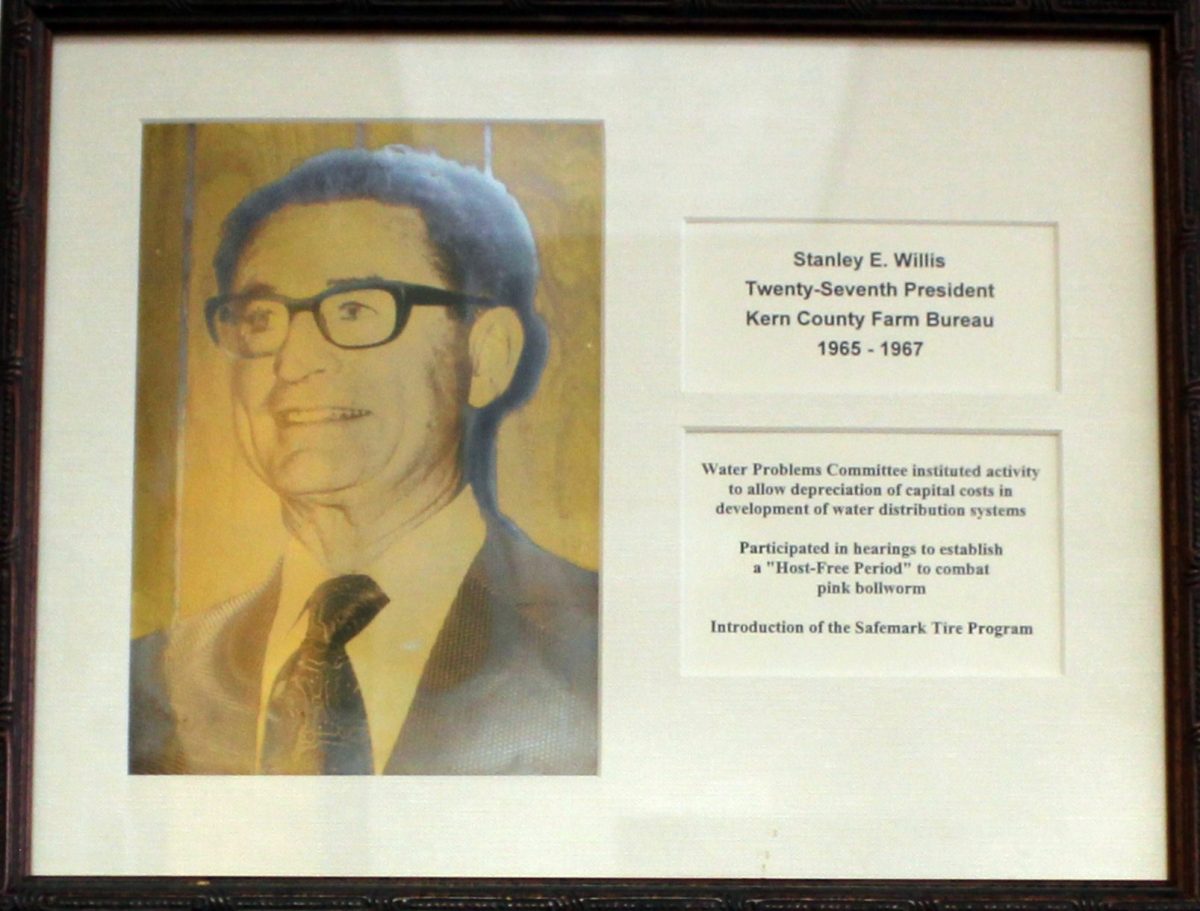
Stanley E. Willis served as the 27th Kern County Farm Bureau president from 1965-1967. (Photo: Natalie Willis/Valley Ag Voice)
WILLIS CHRONICLES
As a personal aside, it would be a missed opportunity not to recognize the 27th Farm Bureau president Stanley E. Willis, my grandfather.
During his term, Willis chaired the Water Problems Committee, which advocated for the depreciation of capital costs in the development of water distribution systems. Throughout his career as a farmer and advocate for the agricultural community, Willis sought to make water infrastructure more financially accessible to farmers.
Additionally, he participated in hearings to establish a “Host-Free Period” to combat the pink bollworm, a significant pest affecting cotton crops. This initiative was crucial in protecting local agriculture from pest-related damage.
Willis also played an active role in shaping local agricultural policy, involving himself in broader political debates. For instance, during the War on Poverty era, Willis was forthright in his opposition to the National Farm Workers Association for fostering discord in Kern County.
ENDURING LEGACY
Shaped, in part, by past Kern County Farm Bureau leadership, Kern County agriculture is poised for continued, steady guidance under incoming president Todd Snider. As the owner of Western Ag Crop Insurance Services, Snider brings extensive expertise in crop insurance policies and programs.
In addition to his professional experience, Snider has recently partnered in a pistachio farm, giving him firsthand insight into both the business and production sides of agriculture.
“That was also kind of a crossover and strengthening my role here in my business as an insurance agent, insuring farmers and their crops. Now I have skin in the game with them,” Snider said. “I am the first Snider landowner and farmer with ownership of the land.”
He explained that a primary factor influencing the lifelong investment of farming were his two daughters.
“I just want my family and my daughters to understand what goes into being a farmer and what goes into producing food and fiber,” Snider said. “And just the historical side of it, the legacy side of farming families and the generational commitment they make.”
He noted that one of his daughters, a freshman at Liberty High School, recently elected to participate in agricultural classes.
While farm life is new to Snider, he is well-seasoned in leadership. He is active in nonprofit organizations such as the Bakersfield Homeless Center and the Alliance Against Family Violence — which merged into the Open Door Network — experiences that shaped his knowledge on fundraising and community engagement.
Snider intends to strengthen the Farm Bureau’s financial footing, working toward building reserves and long-term stability while ensuring that the organization continues to serve farmers effectively.
The heart of Snider’s approach is a simple guiding principle — “Keep it simple, and let’s continue the trajectory of what the Farm Bureau presidents have done before me.”
On policy work, Snider is no stranger to advocating for agriculture in Sacramento and Washington, D.C. He explained that he has advocated in D.C. since 2011 on crop insurance and farm policy, and plans to bring that experience to the Farm Bureau with a commitment to representing local farmers on issues from water and labor to regulation and market challenges.
“You’re a farmer and you’re farming. You’re not sitting at home watching every news story and everything that comes across the Assembly so that you can go call your Assemblyman or woman and make adjustments or ask for them to not put those in,” Snider said. “But that’s what Farm Bureau does…we are an advocacy group for the farmer because they are busy farming.”
As he begins his term, Snider envisions strengthening the legacy of former Farm Bureau presidents, ensuring that Kern County remains at the forefront of California’s agricultural future.
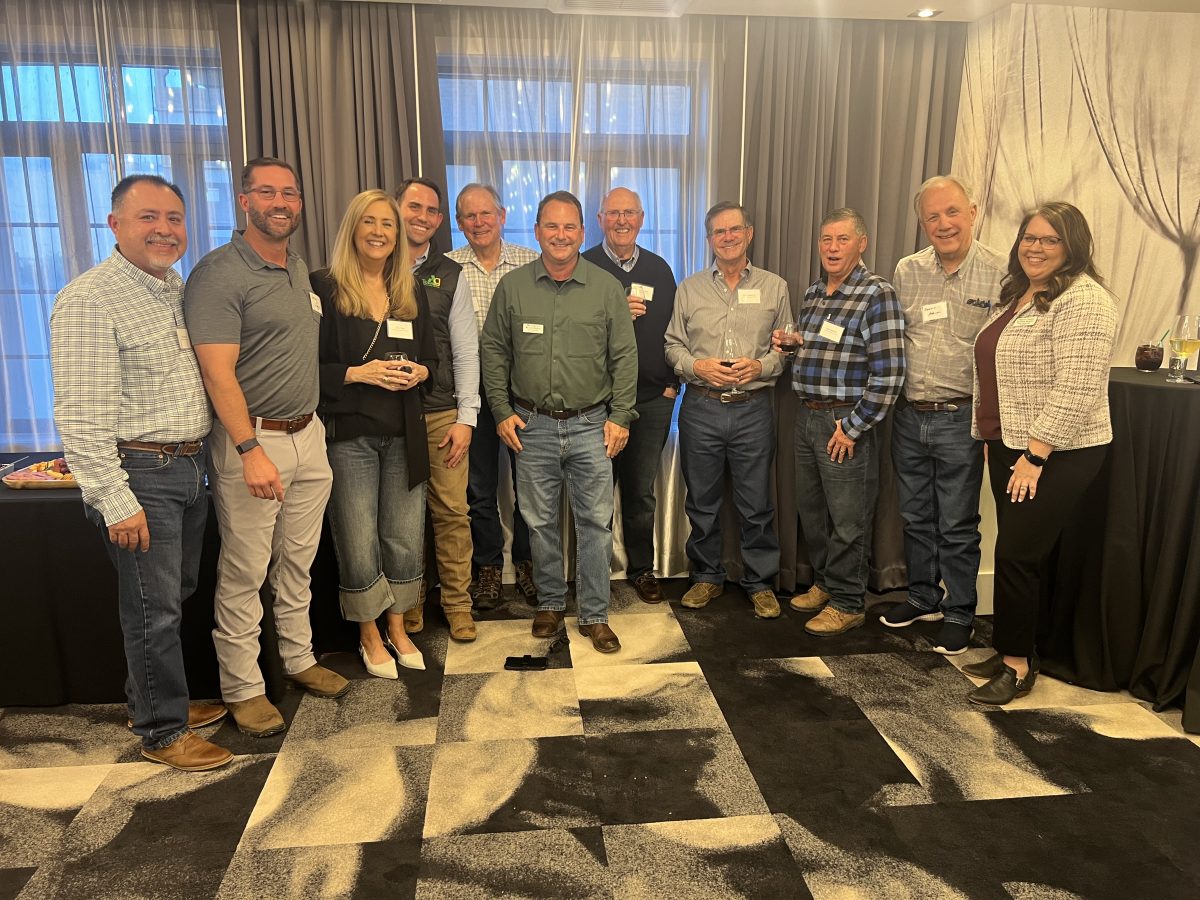
In 2024, Kern County Farm Bureau hosted a Past President’s mixer to network and learn from former leaders. (Photo courtesy of Rachel Nettleton, KCFB)
For a complete history of Kern County Farm Bureau presidents, visit kerncfb.com/past-presidents/.