By Natalie Willis, Reporter, Valley Ag Voice
As the gray wolf population increases in California, the California Department of Fish and Wildlife says the number of livestock depredation investigations has also risen. Livestock depredation refers to the act of a predator killing, injuring, or damaging livestock.
On November 17, CDFW announced it is changing the way these depredation incidents are posted online as it pertains to gray wolves, which are listed as an endangered species under the California Endangered Species Act.
Previously, individual depredation determination files were posted online for each investigation. Moving forward, CDFW will post these investigation findings in a single, regularly updated file that summarizes all investigations for a given calendar year. This announcement included the latest version of the document, updated as of November 1, 2025.
When a livestock owner discovers deceased or injured livestock, they may request a Livestock Depredation Investigation. According to CDFW, it is ideal for an investigation to occur within hours of the request. Conclusions of the investigation are classified as either Confirmed Wolf, Probable Wolf, Possible Wolf, Non-Wolf Depredation, Non-Depredation, and Unknown.
According to the new Wolf-Livestock Depredation Report, there have been 239 investigations in 2025, with 175 livestock killed or probably killed or injured by wolves. Of these, 52 occurred in the Sierra Valley, 48 in Plumas County, 37 in Lassen County, 20 in Siskiyou County, 10 in Shasta County, seven in Modoc County, and one in Tulare County.
IT’S WHAT’S FOR DINNER
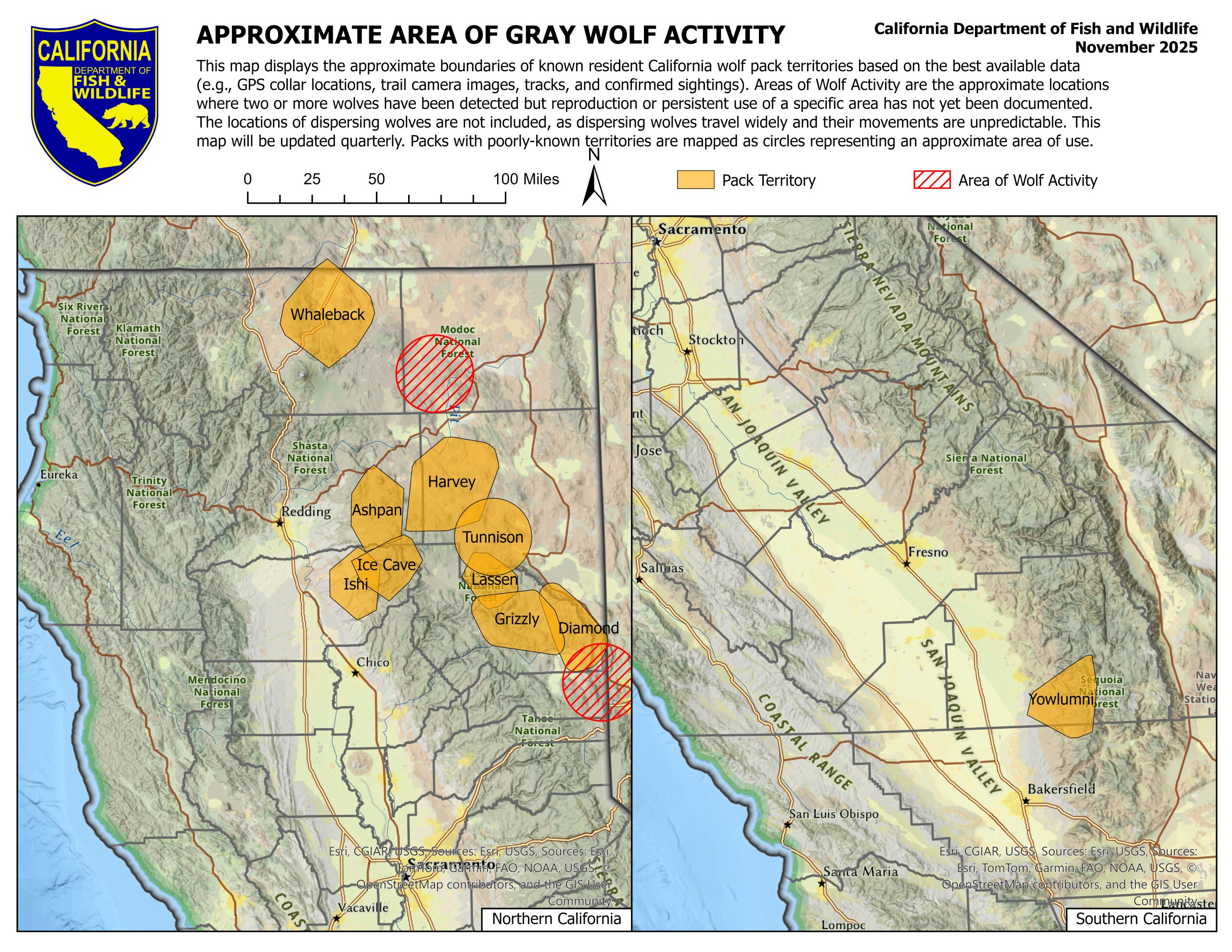
California has been in the second phase of its Wolf Conservation Plan since April 2025, triggered by the confirmation of at least four successful breeding pairs of wolves for two consecutive years. There are currently 10 confirmed packs in California, according to the updated “Known Wolves – November 2025” document.
In Phase 2, CDFW is tasked with initiating a review to evaluate the status of gray wolves in the state and evaluate legal pathways under the California Endangered Species Act and the Federal ESA to issue permits allowing for aggressive forms of hazing — known as “less-than-lethal harassment.”
These methods would include the use of firearms discharging nonlethal ammunition or the use of motorized equipment to follow or pursue a wolf to modify wolf activity or presence near livestock.
However, on October 24, the CDFW announced they lethally removed four gray wolves from the Beyem Seyo pack which were responsible for 70 total livestock losses between March 28 and September 10, 2025, across the Sierra Valley. Additionally, from September 10, 2025, to October 14, 2025, 17 additional confirmed or probable livestock losses were documented.
“With 110 confirmed or probable wolf-caused livestock losses statewide during this period, these specific wolves account for 63% of the total livestock losses across California during this timeframe,” CDFW stated.
According to the release, the action followed months of “intensive non-lethal management efforts” to deter the wolves.
“Despite extensive adaptive management deterrence efforts, including the use of drones, non-lethal bean bags, all-terrain vehicles, foot presence, diversionary feeding, fladry installation, and field presence 24-hours a day, seven days a week, these wolves became habituated to cattle as a primary food source, a behavioral shift that threatens both livestock and the ecological integrity of wolf recovery,” CDFW stated.
Three adult wolves — two breeding females and one breeding male — were lethally removed. Additionally, one juvenile was removed as it was mistaken for the breeding male. Remains of two juvenile wolves were discovered, but the cause of death is unknown. Additional efforts are being made to capture the remaining Beyem Seyo juveniles.
CDFW explained that the wolves became accustomed to preying on cattle, and that feeding pattern was taught to offspring, which would result in them eventually leaving to form their own packs and teaching the same cattle-preying behavior.
“Several things can be true simultaneously,” CDFW Director Charlton H. Bonham said in a press release. “Wolves are here in California and that is an amazing ecological return. Yet, their reemergence is a significant, disruptive change for rural communities. Wolves are one of the state’s most iconic species and coexistence is our collective future but that comes with tremendous responsibility and sometimes hard decisions. The Beyem Seyo pack became so reliant on cattle at an unprecedented level, and we could not break the cycle, which ultimately is not good for the long-term recovery of wolves or for people.”