
By Natalie Willis, Reporter, Valley Ag Voice
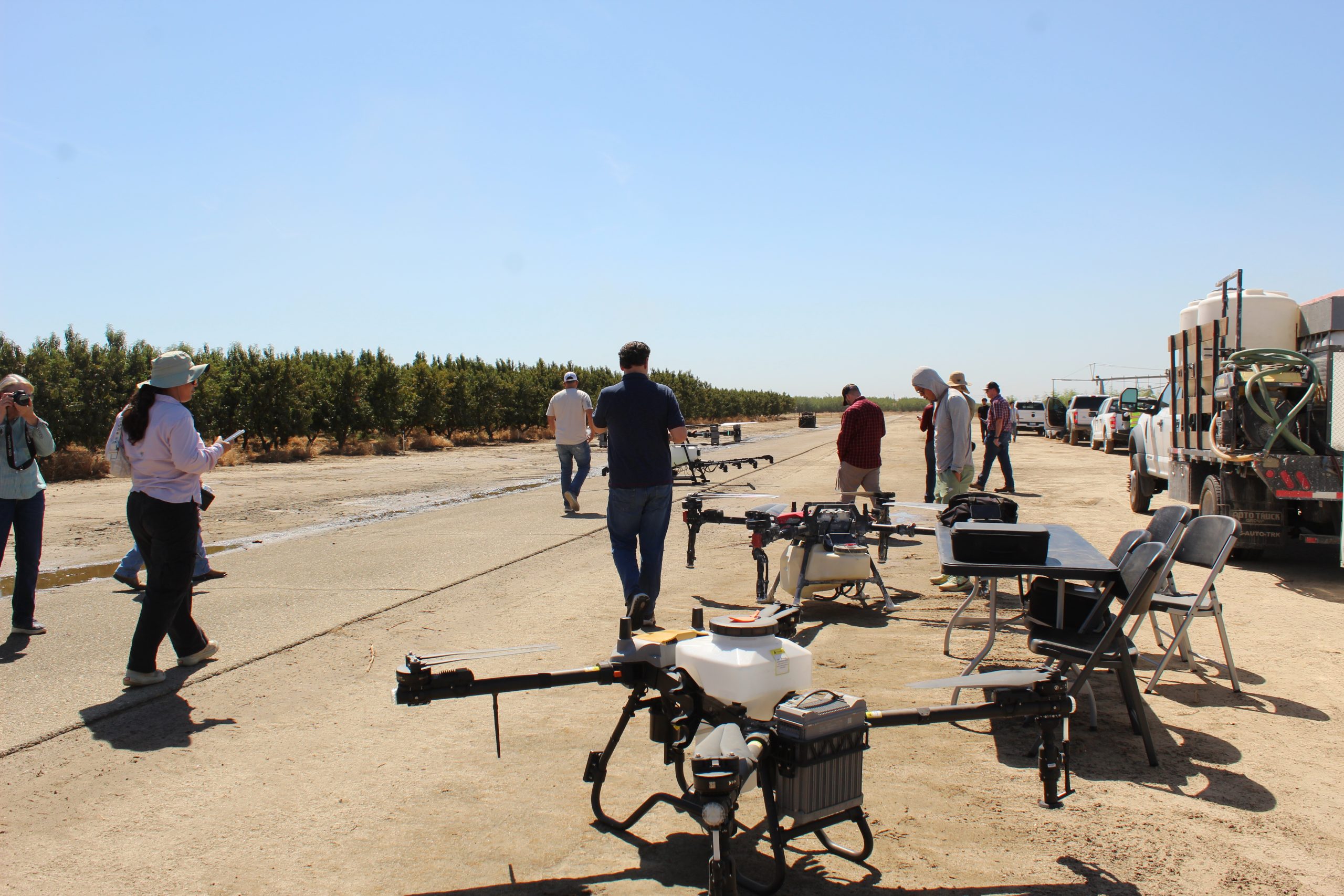
On September 9, the UC Kearney Agricultural Research and Extension Center in Parlier, California, hosted a workshop on drone applications in agriculture, featuring live field demonstrations.
Experts from the University of California Agriculture and Natural Resources division provided an overview of drone applications in agriculture as well as the regulatory requirements to operate the technology.
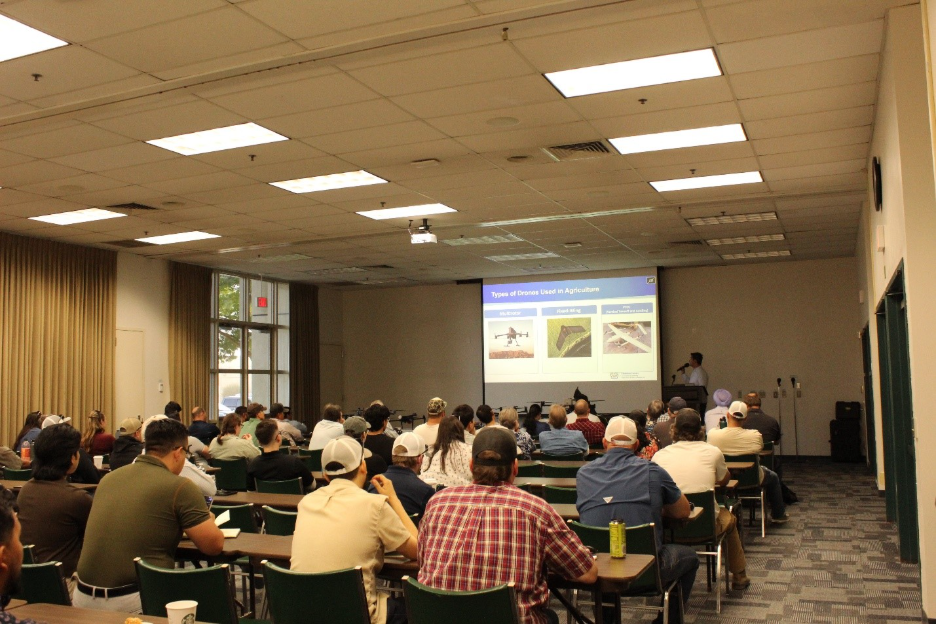
According to Anderson Safre, workshop organizer and assistant UC Cooperative Extension specialist for agricultural innovation and technology, the event was marketed toward growers, researchers, and other agriculture industry professionals interested in learning more about drone use in agriculture and the process to obtain the proper licensing.
“For us, as a research and extension center, we’re able to test these technologies…the orchards that we have here, they’re planted just the same way as the industry standard,” Safre said. “We can test these and then we can show them: ‘So, this is what you get.’”
Along with testing the technology at Kearney’s 330-acre research facility — with field studies occupying roughly 260-acres of orchard, vineyards, and fields — Safre explained that the center aims to provide educational resources for growers to effectively use the technology in their operations.
Safre also explained that drone applications in agriculture may act as a tool for growers in navigating high labor and input costs. Drones can be used for a variety of on-farm purposes such as data collection, high-resolution images, precision spraying, and precise releases of beneficial insects for pest control.
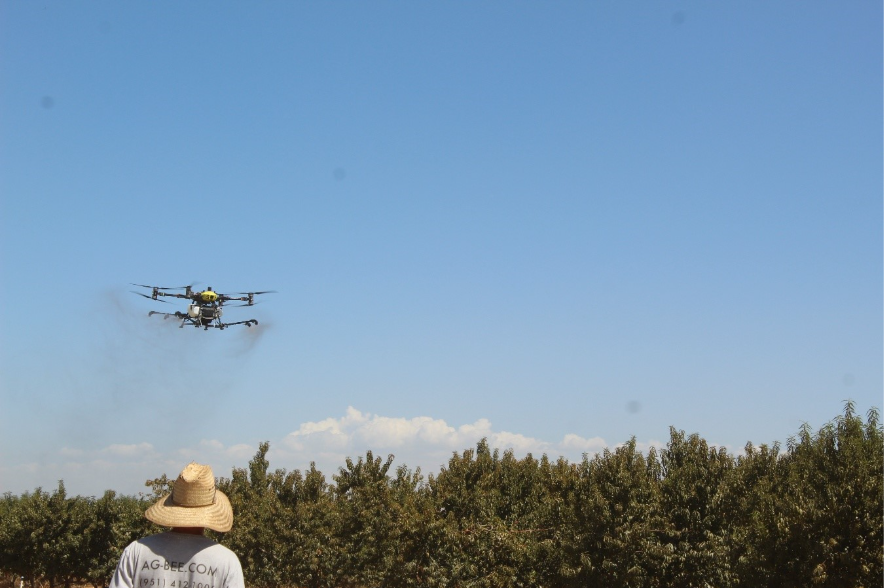
“If we look at the main needs for technology in agriculture in California, it would be labor, number one,” Safre said. “[Labor’s] very expensive in some of the crops. So, some of the things we can do with drones, some we can’t…the drones can replace some of the work that’s being done. Mainly for scouting, with the mapping, and for the application with the spray — we can cover a lot of area with one drone.”
Along with providing a potential solution to mitigate labor costs, Safre explained that drones can offer more precise water applications.
“We know each drop counts,” Safre said. “The drones are really good, and we’ve been using them a lot to calculate the water consumption by the plants.”
While Safre sees a significant opportunity for growers to incorporate drones into their operations, he explained that drones should be viewed as complementary tools to manned aircraft and ground sprayers.
According to Jon Slikker Jr., one of the few remaining aerial applicators in Kern County and managing partner of Vince Dusters in Bakersfield, the barriers of entry to incorporate drones in agricultural operations is relatively small.
“That’s where drones are doing really well, is that the barrier to entry is a lot smaller,” Slikker said. “You can have a farmer do his own avocado orchard, and where it would take a helicopter maybe a short amount of time, but [the farmer] would have to wait in a queue for quite a while to get [the pilot] on the orchard, but with him controlling his own drone, he can now do that work for himself.”
Nino Carvalho, founder and CEO of NC Ag Spraying — which operates a drone fleet in conjunction with ground applications — explained that drones are becoming more accepted among the grower community, but obtaining the proper licensing remains a barrier to widespread usage.
Carvalho also noted that drones cannot currently compete with the volume of acreage that a traditional ground rig covers.
“I think it’s just another tool in the toolbox,” Carvalho said. “I don’t think you’ll be able to replace an 802-air tractor.”
Still, the number of aerial applicators is declining in California, and according to the California Agricultural Aircraft Association, just over 400 pilots are registered through the California Department of Pesticide Regulation. This creates a unique pathway for innovation in Unmanned Aircraft Systems.
“I think where drones are right now, it’s a very small niche thing, but it’s just paving the way for manned aircraft to turn into the UAS system,” Slikker said.
RULES AND REGULATIONS
While drones are growing in popularity within the agriculture industry for their precision spraying, labor-saving, and versatile application features, there is a multi-layered regulatory process to operate a drone for agricultural purposes.
According to Sean Hogan with the Informatics and GIS statewide program of UC ANR, anyone using a drone weighing more than 0.55 pounds for fun or recreation in U.S. airspace is required to carry a TRUST certificate while flying.
Additionally, agricultural drone operators will need to obtain a Part 107 Remote Pilot Certification, as it is required for any job-related use. Some educational institutions may qualify for exemptions from Part 107, Hogan explained, but pilots may still need to complete TRUST, and universities may encourage Part 107 certification for additional legal and liability protection.
Flying a drone commercially without a Part 107 could lead to substantial fines, reaching up to $75,000 per violation under the Federal Aviation Administration’s increased enforcement authority. However, Hogan explained that more serious or willful violations could lead to fines as high as $250,000 or imprisonment.
“It can come back to haunt you in a very major way,” Hogan said.
The FAA estimated that the average person requires about 20 hours of study time for the Part 107 certification, with the test consisting of 60 multiple-choice questions. A passing score is at least 70%, or 42 out of 60 questions. The cost to take the test is $175.
Operators must register their drones through the FAA DroneZone — Hogan explained that it is the only real, valid registration site. Pilots must also check airspace restrictions before flying as flights near airports or in controlled airspace may require FAA authorization.
Medical clearance is required for drone operations, so operators must also obtain a Third-Class Medical Certificate to operate a drone over 55 pounds.
To legally spray or dispense chemicals, fertilizers, seeds, and other materials using a drone, growers are also required to have a Part 137 Agricultural Aircraft Operator Certificate. The California Department of Pesticide Regulation requires individuals applying restricted-use pesticides to hold a Qualified Applicator Certificate or Qualified Applicator License.
For more information on FAA rules and regulations, visit https://www.faa.gov/uas. UC ANR also provided a step-by-step certification process at https://ucanr.edu/blog/salinas-valley-agriculture/article/california-agriculture-takes-flight-guide-drone-spray-pilot.
Along with these FAA and state requirements, Hogan explained that any regulatory agency can make regulations within their jurisdiction, so growers should reference their county and municipal codes.
CONNECTING WITH KEARNEY
According to Safre, the UC Kearney Agricultural Research and Extension Center is looking to growers and agriculture industry professionals to collaborate on research, testing, and educational outreach for emerging agricultural technologies.
“I’m always looking for collaborations,” Safre said. “We want to bring this technology to the growers. We can do this at the research station, but it’s really good to also have it somewhere that we can bring them in and test some of these out in the fields.”
To learn more about Kearney’s agricultural innovation and technology research, contact Anderson Safre at andersonsafre@ucanr.edu.





