By Natalie Willis, Reporter, Valley Ag Voice
California agriculture is best understood by the 400 different commodities it produces, which contribute roughly $60 billion to the state’s economy. However, just like a human body, the agricultural industry includes various moving parts and essential subsectors that maintain its overall health.
Metaphorically, farmers and ranchers are the heart of California agriculture — without their steady rhythm, the entire body ceases to exist. The brain would be best understood as the research and development sector that drives innovation in farming techniques, technology, crop sciences, and agricultural economics. Vital infrastructure like roads and irrigation systems functions as the spine, providing the central structure and support for the agricultural body.
Within the complex networks of the industries that make agriculture possible and profitable, there is another sector that is often underappreciated, acting as a silent partner in the essential functions of the body.
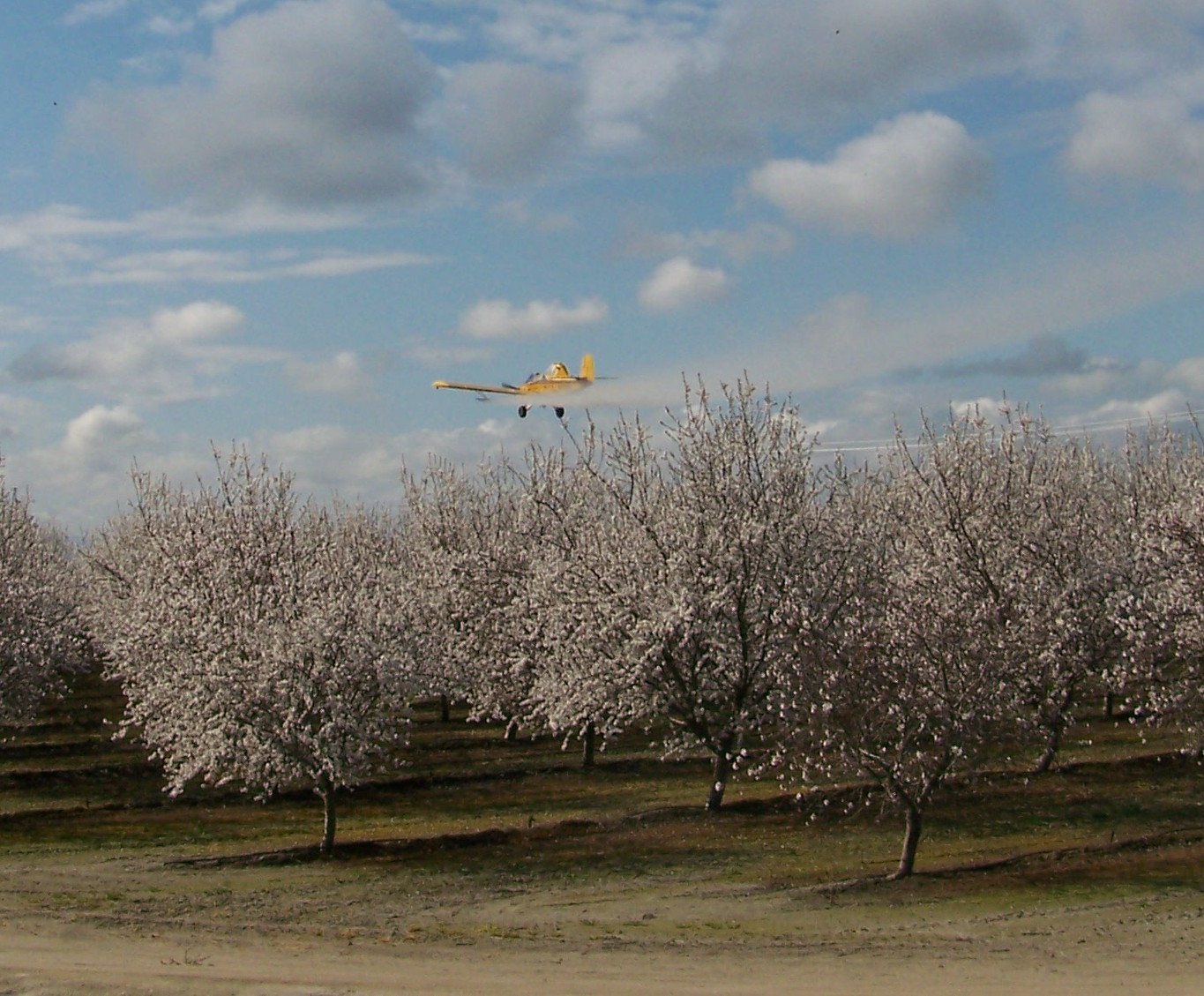
Like the diaphragm, the aerial application industry is crucial for farm life but is rarely noticed until the system struggles to breathe. While it may not be a grower’s first call in all scenarios, it remains a critical option, and in some cases, the only viable one.
“It’s just something we absolutely cannot live without,” James Reiman, a Pest Control Advisor in Ventura County, said.
Despite this, aerial applicators are often left guessing how farmers make the decision to call. The factors that push growers toward or away from aerial application are not always clear.
For Margaux Hein, a fifth-generation Sunkist grower and third-generation farm manager at Hein Ranch Company, aerial application is far from routine.
“Aerial application, to us, is normally our secondary,” Hein said.
Typically, Hein explained, ground application is the default due to logistical and financial reasons. As a large farm management company, she explained that using in-house equipment is preferable to outsourcing applications.
“I guess the first distinction is it’s not normally, ‘Oh, are we going to apply this via air or by land?’ It’s normally just our normal scheduled programming, which is by ground,” Hein said. “I guess we’re kind of guilty of reverting to, if it’s a specialty or a crisis, of why we would go to air.”
Commodity type and coverage needs are also a key concern, she explained. With 31 ranches across five counties and 11 different commodities, Hein Ranch requires flexibility to adapt its practices to diverse crops and growing environments.
Using citrus as an example, Hein explained that aerially applying thrip or red scale spray does not offer enough coverage.
“So, if you just threw on the thrip spray, we don’t think it gets enough coverage — you’re going way too fast, and your volume isn’t nearly enough. And so, we believe we get just a better, more consistent coverage [with ground rigs],” Hein said. “Obviously, it takes a lot longer, but a red scale lives on the bark inside a citrus tree, and so you need that ground rig going 1.5 miles an hour in a 1,500 gallon to really penetrate the inside of the tree from the top to the bottom.”
According to California Agricultural Aircraft Association President Terry Gage, aerial spray dynamics are often misunderstood, especially concerning coverage.
“I think there’s just a lot of lack of knowledge out there,” Gage said. “There’s been a lot of studies and drift mitigation efficacy studies that we know the right droplet size for whatever job it is, and applicators adjust their nozzles, pump pressure, application speed, depending on all these conditions to get the droplet size to maximize efficacy for the grower.”
Regardless, it is well understood within the growing community that aerial application is not negotiable when the alternative is losing the crop, or when rain and field conditions make ground access impossible.
For highly sensitive commodities like grapes, it can be the only viable option.
“All the way up until your berry reaches the age where it changes color and gets sugar, it has to be protected about once a week with a fungicide for powdery mildew coverage,” Hein said. “Sometimes, you’ll get these really big, heavy spring rains where you can’t get in the field — like my spray rig can’t get in the field, it’ll get stuck. That would absolutely be a time that I would call an aerial applicator. It really doesn’t matter how much it costs. Spray the grapes and cover them — if not, you’ll lose the crop.”
This reliability underscores the evergreen nature of the aerial industry, wherein the demand remains relatively stable, even during price changes, because growers have limited substitutes in times of crisis.
Lead horticulturalist and agronomist at Sunridge Nurseries, Linsi Gutierrez, views aerial application as a proactive part of their operation, not just a backup. For their operations, Sunridge grows grapevines, harvests the cuttings, and grafts the vines to either be planted in the field or the nursery.
“So, usually by mid-May, early June, those rows close up. Those vines grow across the rows, and we’re no longer able to get tractors in and out to apply anything,” Gutierrez said. “So, that’s why…historically we’ve used helicopters or any other kind of aerial application.”
Gage explained that certain crops rely heavily on aerial applications. For instance, 90% to 95% of rice is planted by aerial. According to a 2019 survey by the National Agricultural Aviation Association, rice was among the top crops for aerial application, with a single aircraft treating up to 1,579 acres in one day.
“From a PCA perspective, it’s a tool in the toolbox,” Reiman said. “Almost all avocado spraying is done by air, so we wouldn’t be able to do that program without them — it would be extremely difficult. While they may not be the first choice in other areas, they’re absolutely necessary, and there’s going to be a need for them. I don’t see it going away.”
CROP CALCULUS
For PCAs like Reiman, Jeff Rasmussen, and Justin Nay, aerial application is another tool to protect crop health, and they need all the tools they can get.
According to Rasmussen, a Kern County-based PCA and seasoned agronomist, choosing aerial application is not a matter of preference — it’s a calculated decision grounded in crop biology, environmental conditions, and practical limitations.
Each field scenario requires different solutions, and the use of ground rigs, air, or even chemigation depends on what a particular crop needs to achieve success with the least harm.
“There are all these factors that are put in the decision of what you’re going to do, why you’re going to do it. Time of year, wind, sensitive crops around you, or neighborhoods. And so, all these go into the factor of what we’re going to do, and why we’re going to do it, and when we’re going to do it,” Rasmussen said. “That’s why it’s difficult. It’s not 1, 2, 3. There’s multiple factors on multiple factors in what you’re trying to achieve.”
For Nay, a certified crop consultant, PCA, and founder of Integral Ag, Inc., the decision to go aerial is driven by urgency and terrain.
“It depends on the different sizes of growers that we have, and whether or not they own their own equipment, and how fast that equipment can cover the ground,” Nay said. “Because there are times, around weather events, where it’s not possible to either get on the ground because of rain or things of that nature, or it’s too wet, or the orchard’s being irrigated, and there’s an immediate need for a crop protection material. And so, those are the real easy decisions.”
The speed and access aerial application provides can mean the difference between a saved crop and a total loss, he explained. This kind of decision-making mirrors the approach of operations like Hein Ranch, which recognize the value of aerial treatments in emergencies.
“We have all these tools that we need to use, and we will need them all,” Reiman said. “So, it’s just another option for us that we really can’t live without.”
THE DRONES YOU’RE LOOKING FOR
Along with traditional forms of aerial applications, drone-based applications are becoming increasingly popular. In fact, they have become a particular favorite for Sunridge Nurseries.
“The coverage is great, I mean, it’s really no different from a ground rig,” Gutierrez, who now flies drones herself, said.
To confirm efficiency, Gutierrez placed water-sensitive cards ahead of applications, and the results showed consistent, even coverage across the board.
“So right there, we know the coverage isn’t any different,” Gutierrez said, “And being able to cover a lot of ground faster, that’s one thing too, because driving a traditional ground spray rig, it would take one rig to do all of our acreage in a little over a week. With the drone, we can actually get the product on much quicker.”
Even Hein has earned her drone license and begun integrating the technology where it makes sense.
“I actually have my drone license, so I’m a little bit biased and more involved in the flying kind of area,” Hein said. “I think there is a niche use for them, absolutely a benefit.”
While Hein does not see drones replacing ground rigs or traditional aerial applications, she explained that she uses a drone for certain situations, such as applying fungicide on wine grapes, where narrow rows make maneuvering traditional equipment difficult.
Nay is also optimistic about the future of drone technology, and he looks forward to having another tool in the PCA toolbox. He explained that, in recent years, weather events have made ground applications impossible, forcing growers to rely on aerial spraying. But access is limited, and if you’re not scheduled early, you miss out. Drones could help fill that gap.
“And so, if we get more applications with drones in the future, there will be situations where it could help in those types of situations. I also think there’s probably a lot of applications for biocontrol organisms, even some foliar fertilizers that they could probably do cheaper, that we wouldn’t need a full helicopter or airplane for,” Nay said. “It’s getting cost per acre competitive. But yeah, I’m looking forward to the future of drones.”
However, drones currently struggle with getting enough spray coverage, especially on trees, so they are not a full replacement yet, Nay cautioned.
Rasmussen echoed the growing view that drones are becoming a part of the future of aerial application, though their use depends on the type of crop and the timing within the season — factors that growers constantly weigh in their decision-making.
“Now, what I would say is that five years ago, people probably thought less of drones. And I think there’s more and more of it’s not a matter of not [using them], I think that it’s a matter of if and when can we start using drones,” Rasmussen said.
REGULATORY HOLDING PATTERN
While the sky is the limit for aerial applications and up-and-coming innovative technologies, California’s regulatory framework will continue to guide — or delay— that future. Thus, if the aerial application industry can be characterized as the diaphragm, policies and regulations are the appendix.
When they do not interfere with a grower’s bottom line or a PCA’s toolbox, policies can live comfortably within the agricultural body. But when they do interfere, surgical removal is the best bet.
According to Gage, part of the CAAA’s role is to monitor regulations and legislation and advocate on behalf of applicators and growers. She explained that, over the last two decades, the application industry has seen consolidation and a reduction of licensed applicators.
“Part of that is because we’ve gone to bigger aircraft, faster aircraft, and part of it’s just the changing dynamics in California agriculture,” Gage said. “It’s just a very tough regulatory framework that people need to operate in, and it’s expensive…there’s a lot of cost involved, a lot of compliance issues, and it becomes very complicated.”
In terms of the application industry itself, Rasmussen — who has worked with the California Association of Pest Control Advisers for many years and serves on its board — noted that many aerial applicators rarely take the time to build relationships with PCAs, which can create a disconnect.
“They’re still an important part of our tools. And part of it is that [applicators] are a dying breed because you don’t have many young guys coming out and getting into applications. It is a concern of ours, older PCAs, that we hope they don’t ever go out of business.” Rasmussen said. “These are things we discuss at coffee shops when we see each other. So, we’re trying to figure it out, but there’s no clear answer.”
Nay echoed that disconnect in communication, explaining that growers are not hearing direct outreach from aerial applicators, especially around emerging tools like drones.
“I’m not seeing it,” Nay said. “At least from my perspective as a PCA, I’m not seeing the advertisements and the information making it to the growers or the industry about where drones are fitting and working and being competitive currently.”
Closing the communication gap with farmers and PCAs is essential to staying relevant. The need for aerial will not disappear, but how applicators stay top of mind will define the future of the industry.
According to Gage, the CAAA is continuing efforts to improve connections with growers and offer educational resources. A healthy future for the application industry involves training the next generation of ag pilots, advocating against harmful regulations, and maintaining its place as a vital function of the agricultural body.
“We want to make sure that we help educate these folks as they come into the industry and mentor them, and make sure that these products are used properly…there will be biopesticides and softer products that are going to come onto the market and going to provide a lot of efficacy,” Gage said. “But, in the meantime, we’ve got to make sure that we have the products that we have now so that growers can continue to maximize their yields, and maintain a happy, healthy ag economy.”
For more information about the California Agricultural Aircraft Association, visit caaa.net.