Joshua Stevens, Faith Contributor, Valley Ag Voice
“‘That the man of God may be perfect.’ For this is the exhortation of the Scripture given, that the man of God may be rendered perfect by it; without this therefore he cannot be perfect. Thou hast the Scriptures, he says, in place of me. If thou wouldest learn anything, thou mayest learn it from them. And if he thus wrote to Timothy, who was filled with the Spirit, how much more to us!”1
The intention of this article is not to disprove tradition as an authority; it is to provide a positive argument for the confidence believers can have in using scripture as the ultimate guiding authority in their lives today. Though in the past, many protestants have used Paul’s epistle to Timothy as a foundation to build on this idea, we will not go further than John Chrysostom’s thoughts above. For if anyone wishes to argue with the saints’ own words, let them. However, this article will focus on Jesus’ response found in the gospel of Matthew and how our savior responded to temptation and questions. Thus, providing an example of how we ought to do the same.
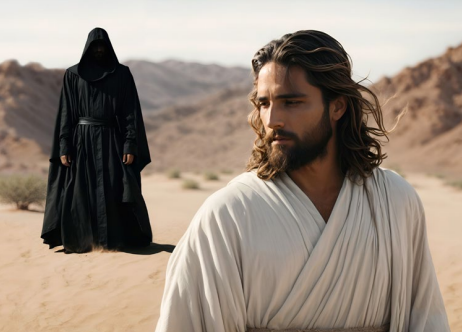
“But he answered, ‘It is written…’” 2 In Matthew chapter 4:1-11, we see Jesus being led into the wilderness, fasting, being tempted, and then being ministered to. If anyone should wonder where Christians could look for an authority by which we can live, one might humbly suggest looking first to our example in Christ. We see Jesus given three temptations in this passage, first to command the stones to be turned to bread so he may satiate his hunger, second to throw himself off a high place so he may have knowledge and assurance that the Father would save him, and third to become master of this world if only he bow and worship a part of creation.
When tempted by hunger, Jesus responds by quoting Deuteronomy 8:3, recounting Israel’s own time of testing in the wilderness when they were hungry and evaluating the nation. But where Israel failed, Jesus succeeded. Despite the devil’s attempt to persuade Jesus to act apart from the Father, Jesus instead submitted himself to the will and providence of the Father and refuted the temptation.
In the second temptation, we see the devil use scripture itself, out of context, to test Jesus, citing the Psalms and God’s promise to protect his people. Certainly, this temptation to force the Father to act would provide Christ with a great amount of confidence as he peacefully floats down from the highest point of the temple, which loomed far above the Kidron Valley.3 However, instead of succumbing to this temptation, Jesus chose the more difficult path—living by faith and trusting in the Father. He responded with another passage from Deuteronomy 6:16. Teaching us again that it is not in miracles and overt displays of wonder that we serve our Lord but in the overcoming of temptation in faith by trusting in our God to fulfill His promises as we live a life humbly, not seeking glory for ourselves but being ever ready to point any who may listen back to the Father who yearns for his children to come home and to the cross by which we receive redemption.
In the third temptation, the devil again offers a good thing: that the Son of God would be glorified. This easy road to a good thing is refuted by Jesus who quotes Deuteronomy 6:13 and commands Satan to leave. So, in these examples, we see Christ reject the appearance of food, knowledge, and riches of men, forgoing what is easy for what is ultimately good and aligns with the Father’s will. Jesus continues to be faithful where his predecessors, like the Israelites and Adam, both failed. He did so by leaning on the Word of God and remaining faithful to what the Father had said in the face of temptation and the hallowed promises of the enemy.
Yet this was but one scene in the gospel of Matthew where we see Christ lean on the scriptures to respond. Later in the gospel of Matthew (22:34-40), we are given another example. This comes after a series of questions attempting to trick and trap Jesus regarding taxation and the resurrection. There comes a group, among whom is a lawyer knowledgeable in the law. “Teacher, which is the great commandment in the Law?2” It would be at this time if Jesus wanted to elevate the role of recent tradition in the life of a believer that he might answer with his own words. He might challenge the use of the law and the role of the law; there would be no time like the present if Christ wanted to establish a tradition that would parallel the scriptures. He would have every right to, and there are certainly times when he does. However, Christ does not do so to circumvent or add onto the scriptures, nor does he seek to change them. Rather, as he promises, “Do not think that I have come to abolish the Law or the Prophets; I have not come to abolish them but to fulfill them. For truly, I say to you, until heaven and earth pass away, not an iota, not a dot, will pass from the Law until all is accomplished. 2
Here our Lord answers again from Deuteronomy (6:5) and then Leviticus (19:18). For Jesus knows it is by the scriptures we are made complete and ready for every good work. Jesus does not just affirm the scripture here but provides for all in attendance a response that contains both depth and clarity to appeal to all people regardless of education, background, race, or language. The barriers separating God from his people would be torn asunder, and all people would have the opportunity to follow and seek after the Lord.
In these scenes, he provides for all Christians an example of how we should live our lives, depending on the word of God to be our strength in times of temptation, our answer in times of question, and the ultimate standard by which we judge and live our lives. The following article will examine some of the church fathers to see if there is a beginning of the formation of such an idea as Sola Scriptura in their works.
Will you Pray with me?
Father, we thank you for the continued opportunity you have given each of us to push into your presence and wrestle with the questions of your will, your revelation, and how each of us can continue to glorify and serve you best. Thank you for your word which you have preserved that we might be edified by it and for preserving the words of so many of your servants who are with you now in eternity. For we stand on the shoulders of giants and are made more like you from their striving and suffering. Thank you for the worldwide body of believers who run the race faithfully alongside us, that we may be mutually encouraged by our love for one another and your working in our lives. I ask that for those reading this who may be doubting or questioning that you would provide them comfort, assurance, and confidence that the faith we hold today is true, good, and worthy of all suffering for the sake of your glory and your kingdom to come. In Jesus’ mighty name I pray,
Amen.
1 John Chrysostom, “Homilies of St. John Chrysostom, Archbishop of Constantinople, on the Second Epistle of St. Paul the Apostle to Timothy,” in Saint Chrysostom: Homilies on Galatians, Ephesians, Philippians, Colossians, Thessalonians, Timothy, Titus, and Philemon, ed. Philip Schaff, trans. James Tweed and Philip Schaff, vol. 13, A Select Library of the Nicene and Post-Nicene Fathers of the Christian Church, First Series (New York: Christian Literature Company, 1889), 510.
2 The Holy Bible: English Standard Version (Wheaton, IL: Crossway Bibles, 2016)
3 Daniel M. Doriani, “Matthew,” in Matthew–Luke, ed. Iain M. Duguid, James M. Hamilton Jr., and Jay Sklar, vol. VIII, ESV Expository Commentary (Wheaton, IL: Crossway, 2021), 74.