By Natalie Willis, Reporter, Valley Ag Voice
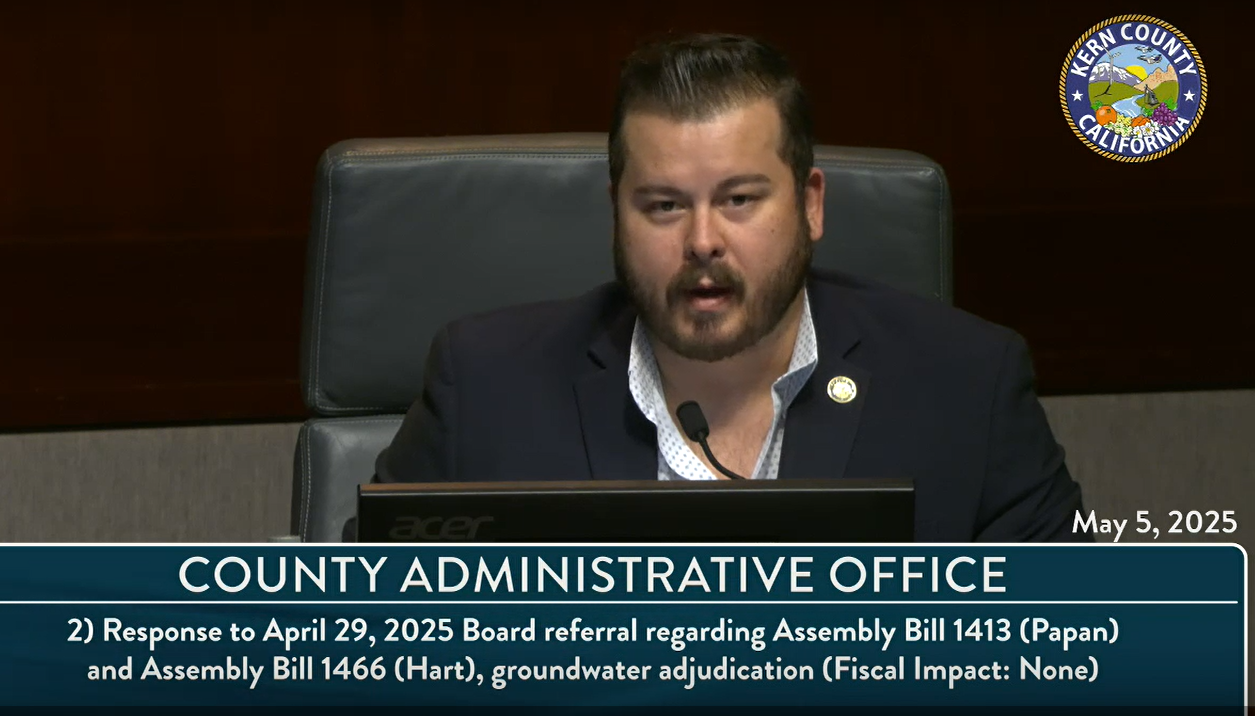
During a special meeting of the Kern County Board of Supervisors on May 5, a heated debate on two proposed assembly bills regarding groundwater adjudications took center stage, prompting agriculture groups and Indian Wells Valley interests to make their voices heard.
By the end of the meeting, First District Supervisor Phillip Peters’ motion that the board formally adopt a letter of support for two groundwater adjudication bills died without a second.
BILL OVERVIEW
The crux of the matter is that two bills — AB 1413 and AB 1466 — would aim to influence how groundwater adjudications interact with locally developed groundwater sustainability plans under the Sustainable Groundwater Management Act.
While the directive was for the supervisors to discuss the proposed legislation and provide direction, draft letters of support were included in the packet for the Board’s consideration.
Two Central Valley Assemblymembers, Dr. Jasmeet Bains and Stan Ellis, attended the Kern board meeting, speaking in direct opposition to these bills.
“I saw these bills in the Assembly Water Committee last month, and I can tell you that there is a very good reason why every lawmaker from the Valley voted against them,” Bains said.
Bains explained that the proposed bills in question are being presented as “relatively mundane” proposals to ensure proper SGMA implementation. The prospect of AB 1413 would require courts to accept a GSA’s sustainable yield determination as prima facie evidence — that is, accepted as true unless rebutted.
However, the current right under SGMA allows for affected parties to challenge the sustainable yield number. According to Rachel Nettleton, Executive Director of the Kern County Farm Bureau, AB 1413 would allow GSPs, which may be based on flawed or incomplete data, to be treated as final with little opportunity for landowners or water users to challenge them in court.
“I sympathize with the proponent’s stated attention of streamlining groundwater management and protecting small farmers who can’t afford expensive legal representation,” Bains said. “Those are admirable goals, but the problem is, you don’t protect the legal rights of some by taking away the rights of others.”
AB 1466 would further impede the ability to challenge a GSP, requiring courts to use a “substantial evidence” standard when reviewing a GSA’s actions during a groundwater rights lawsuit. Substantial evidence being that there is enough relevant proof to support a conclusion.
However, opponents of the bill explain that it is unnecessary because courts already use the substantial evidence standard. In actuality, they argue the bill would improperly ask GSAs to act like advocates, blurring the line between adjudication and GSA decision-making, leading to more, not less, litigation.
Bains explained that while there were significant concerns when SGMA passed, it has been mostly effective.
“Out of 93, groundwater sustainability plans developed statewide, 86 have been approved. Only five basins have gone to adjudication. The system isn’t broken, yet these bills are looking to change the rules that got us this far, and they create far bigger problems than they solve,” Bains said. “AB 1413 and AB 1466 do not strengthen sustainability. What they do is upset the careful balance that has worked in nearly every basin out there.”
PETERS’ PITCH
Supervisor Peters’ presentation argued in support of AB 1413 and AB 1466, claiming they would “close loopholes” that allow groundwater adjudications to override local sustainability planning under SGMA.
“Current law incentivizes parties to engage in costly pay-to-play groundwater adjudication processes. As supervisors, I don’t believe that we should be picking winners and losers in groundwater adjudications,” Peters said. “Current law should not allow big farmers to take away the rights of smaller farmers, or local water agencies, the military, or anyone else, because they can afford to pay for adjudications.”
One of Peters’ committee assignments includes the Indian Wells Valley Groundwater Authority, which is in the process of a groundwater adjudication. The adjudication was initiated by the Indian Wells Valley Water District.
In a press release by the IWV Groundwater Authority, they claim the IVW Water District “opened the door for Meadowbrook Dairy and Searles Valley Minerals to challenge the federal reserved water rights of the Navy’s Air Weapons Station China Lake.”
According to Peters, in an adjudication, local water rates increase to allow local agencies to defend their water rights and needs. As such, Peters claimed that water rates have increased to cover nearly $5 million in litigation costs.
“What is even crazier is that their plan if they lose water rights in the adjudication that they initiated, is to go buy the now very expensive groundwater from other parties,” Peters said. “Their hope is they can take water from the Navy and then make the Navy pay for that sustainability, but their rate payers are paying heavy costs for that.”
However, according to the Vice President of the Indian Wells Valley Water District Board, Chuck Griffin, the District is not seeking to challenge the Navy’s water rights and fully supports their mission at China Lake. Rather, he explained that the Groundwater Authority has not seriously considered
Griffin emphasized the need for collaboration, noting that the issue has deeply divided the Ridgecrest community.
DICHOTOMY OF INTERESTS
While the pieces of legislation in question have much broader implications for the state than the unique situation in Indian Wells Valley, the local debate highlights how state policy can inflame deeply rooted tensions.
From an agricultural perspective, many of the most vocal opponents of the bill — Wonderful Company, Grimmway Farms, Bolthouse, and other agricultural groups — explained that the bills undermine due process.
According to Daniel Clifford, Vice President and General Counsel of Bolthouse Properties, SGMA was ultimately passed in 2014 because it allowed for the possibility of groundwater adjudications to be used — there was never a loophole.
“It’s not a loophole. It was always there. It was there in 2014, and it was the reason, one of the reasons why SGMA was able to be passed,” Clifford said.
Still, representatives from the city of Ridgecrest and the Indian Wells Valley Groundwater Authority expressed their views that the adjudication process undermines the authority of SGMA.
In the end, the Board of Supervisors took no formal action on the proposed bills, largely because they recognized that a local issue like this could not be effectively resolved through one-size-fits-all legislation from Sacramento.
In his remarks, Second District Supervisor Chris Parlier explained that SGMA implementation itself and Kern County are expansive far beyond the situation in Indian Valley Wells.
“Essentially, you’re using a legislative hammer when you really need a legislative scalpel to go with a local issue,” Parlier said.
For his final remarks, Peters explained that he saw the value in these bills and the way they could potentially help Kern’s communities.
“And I know that there’s not adjudications happening in your districts right now. I don’t hold it against you that you don’t support this, but I also hope you won’t hold it against me when I say, ‘I told you so’ when those adjudications happen,” Peters said.