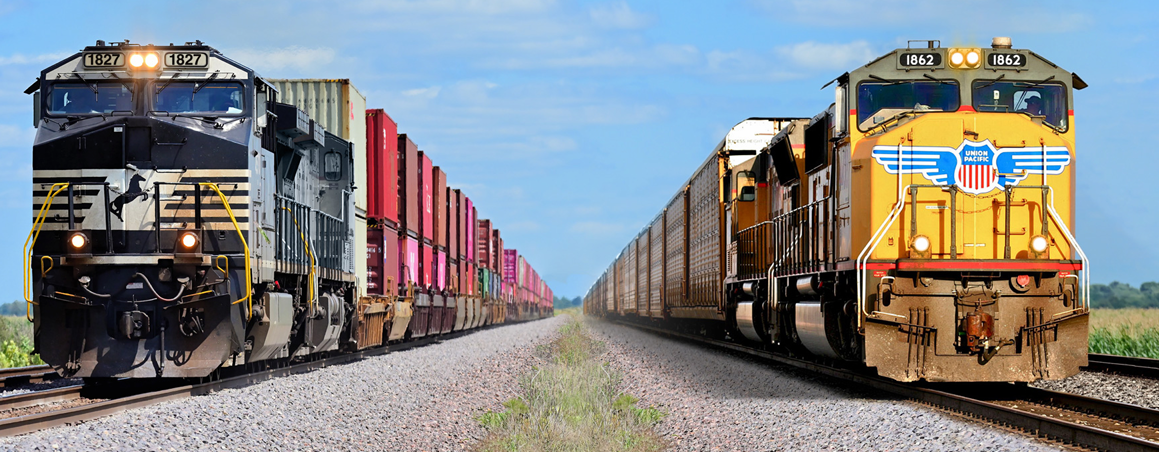
By Natalie Willis, Reporter, Valley Ag Voice
On July 29, Union Pacific Railroad announced a potential merger with Norfolk Southern Railway to create America’s first transcontinental freight railroad. This proposed $85 billion deal would join 50,000 miles of railroad tracks from New York to California, creating the first transcontinental railroad owned by one company.
For context, railroad tracks have been connected coast-to-coast since 1869, but until this proposed merger, no singular company has dictated rail freight prices.
According to Union Pacific, the merger will “unleash the industrial strength of American manufacturing and create new sources of economic growth and workforce opportunity that preserves union jobs.”
Under the agreement, Union Pacific will acquire Norfolk Southern in a stock and cash transaction, valuing Norfolk Southern at $320 per share — 25% more than Norfolk Southern’s recent average trading price. The deal gives Norfolk Southern an $85 billion enterprise value, creating a combined company worth over $250 billion.
The railroad would have access to 10 international interchanges and approximately 100 ports and is expected to remove several days from transit times by eliminating car touches and interchanges where rail cars are handed off.
Mike Steenhoek, executive director of the Soy Transportation Coalition told RFD TV that while rail lines are crucial to the success of U.S. agriculture, the merger may lead to higher shipping rates due to lack of competition.
“What can happen as a result of that is that, as an agricultural shipper, you will have a decreased number of transportation providers competing for your business, and that’s what we want within our industry,” Steenhoek said. “We want as many transportation providers as possible competing for our business…so the concern is that, as you start to limit those entities competing for your business, then that could result in higher rates and a decrease in service.”
MR. MONOPOLY
Union Pacific and Norfolk Southern represent two of the four largest freight railroads. Along with BNSF Railway and CSX Transportation, the four companies control over 90% of U.S. rail traffic, with Union Pacific and BNSF dominating the west and Norfolk and CSX dominating the east.
“One of the things that history does teach us is that mergers and acquisitions within the rail industry will often inspire and motivate further mergers and acquisitions within the rail industry,” Steenhoek said.
He warned that the deal could set a precedent for future rail mergers, with an expectation that BNSF and CSX would follow suit with their own deal. Meaning, two giant coast-to-coast companies would dominate the U.S. rail system.
The boards of directors of both Union Pacific and Norfolk Southern unanimously approved the merger, aiming to close the transaction by early 2027.
Still, the deal is not finalized and must receive regulatory approval by the Surface Transportation Board, which closely scrutinizes railroad mergers to prevent monopolies — sorry, aspiring Vanderbilts.
Regulators must also consider the effect the merger would have on the entire shipping system, including trucks and barges.
The most recent rail industry merger of significance was finalized in 2023 when Canadian Pacific acquired Kansas City Southern in a $31 billion deal, creating the first single-line railway spanning Canada, the United States, and Mexico. The regulatory process for that merger took two years.
Steenhoek explained that the new proposed merger between Union Pacific and Norfolk Southern carries more significant ramifications, which may lead to a longer regulatory review process. Additionally, there are currently only four members on the Surface Transportation Board, and President Trump is expected to appoint a fifth member.
“It’s important to note that the regulators are going to look at this as kind of a package deal,” Steenhoek said. “If they approve and allow the merger of Norfolk Southern and Union Pacific, it’s almost like they will also agree to a subsequent merger between BNSF and CSX, the two remaining U.S.-based Class 1 railroads, because there’ll be exceeding momentum and encouragement for those two railroads to follow suit so they’re not at a competitive disadvantage.”