By Natalie Willis, Reporter, Valley Ag Voice
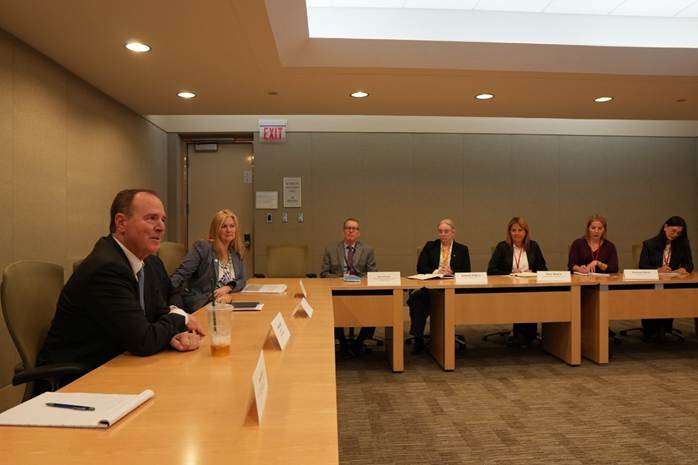
On October 14, Senator Adam Schiff (D-Calif.) hosted a press call following his recent Congressional Delegation visit to Canada. During the two-day trip, Schiff visited Alberta and Ottawa, meeting with officials to discuss ongoing trade disputes with the U.S. and the impact of tariffs.
He explained that the purpose of the trip was not to negotiate the United States-Mexico-Canada Agreement or any other trade agreement, but to discuss the bans and boycotts in place, particularly on alcohol as Canadian provincial liquor boards can restrict access for U.S. wines and alcohol.
“I found the visit to be incredibly illuminating and helpful, but it also was indicative of the challenge that we’re going to have going forward even when this current trade dispute is resolved,” Schiff said. “I think there’s going to be some long-standing ill will to deal with for a lot of our producers in California and elsewhere throughout the country.
Out of Canada’s 10 provinces, Alberta and Saskatchewan are currently the only provinces that allow American wines, beers, and spirits. However, Saskatchewan placed a 50% tariff on U.S. alcohol that took effect on September 8, 2026.
According to Schiff, one of his primary talking points in his trip was that boycotting California goods does not provide a direct benefit for Canada.
“Most Californians don’t agree with the tariff policies of the administration, certainly don’t agree with the hostility the administration showing our northern neighbors, and as [President Trump] doesn’t care a lot about what happens to California…it doesn’t really give Canada leverage with the administration to be punishing a state like California,” Schiff said. “So, it’s my hope and I plan to go back to other provinces I was not able to visit on this trip to try to restore and improve our relation between the state of California and individual provinces so that however long this dispute goes on, we can mitigate some of the harms.”
It’s unclear if the trip resulted in actionable steps or specific commitments to help California growers regain market access or lift remaining provincial boycotts. Schiff explained that the one provincial government he met with was Alberta’s Premier Danielle Smith, but Alberta is not actively restricting U.S. wine and other alcohol.
“The other officials I met with in Ottawa were with the national government and ostensibly they’re not in a position to lift the boycott themselves,” Schiff said. “I think it’s pretty apparent that absent a deal, Prime Minister [Mark] Carney isn’t going to tell the provinces that they should or encourage them to lift the boycott because there’s a feeling that it gives them leverage, and in some parts of the country it may give them leverage. As I mentioned, it doesn’t give them leverage, though, vis-a-vis California.”
Schiff explained he plans to go on future trips to visit other provinces but noted that the timing of his recent trip was not ideal.
“The time I was there was not ideal in the sense that you had Thanksgiving in Canada coming up,” Schiff said. “So, I want to go back and meet with more provincial officials in Quebec and in Ontario, which are the main alcohol producing provinces. Those are the most important ones in terms of California producers.”
WATER
Schiff explained that he is focused on efforts to improve California’s water infrastructure, and his particular interest has been in identifying ways to capture water in wet years.
“How do we capture the water in the really wet years — when we have them — and find a way to store it to recharge our aquifers? How do we convey it from where it is in excess during these atmospheric rivers to those places where, geologically, we can recharge the aquifers because it’s not always in the same locations?” Schiff said. “That is a real priority of mine.”
Schiff explained he is also interested in projects where solar panels are being installed over water canals to help mitigate water evaporation and generate solar energy. This would include Project Nexus, which Governor Gavin Newsom announced on April 29, 2026, as California’s first solar-covered canal.
“Looking for solutions like that, that can really improve the quantity of water as well as mitigate some of the other issues like the need for energy,” Schiff said. “So, those are a couple my top priority areas, and that is trying to figure out where is the most important infrastructure, what new infrastructure do we need, how do we improve the infrastructure we already have…I’m continuing to talk to those in the industry as well as those that are with the entire water conveyance system and those that are purchasing water for consumers about how to address these issues.”
FARM BILL
As the first California Senator to serve on the Senate Committee on Agriculture, Nutrition, and Forestry in over 30 years, Schiff is involved in negotiations for the future Farm Bill.
He explained that Congress will soon enter its lame-duck session which is the period of time Congress is in session after the November 3 election and before the beginning of the new Congress in January to conclude urgent or unfinished business.
During this session, Schiff is hopeful that a Farm Bill can be passed. However, he explained that negotiations between Democratic and Republican leaders, particularly over the Supplemental Nutrition Assistance Program, continue to hinder the bill’s passage.
Outside of the Farm Bill, Schiff believes there are larger issues within the agricultural system that will not be resolved during the lame duck session.
“I do think there’s some bigger, longer-term work, though, that we won’t be able to accomplish in lame duck when it comes to our farmers, and that is that the farm system just isn’t working for farmers, particularly for small and mid-sized farmers.” Schiff said. “It hasn’t been working for decades. It greatly advantages the huge Agri-corporations, doesn’t really help the family farmers and the small and mid-sized farmers who are just struggling more than ever…we need to revamp, I think, our agriculture system to make it work for family farmers, small and mid-sized farmers, not just for investors who may never get their hands dirty on a farm or their boots dirty.”