By Natalie Willis, Reporter, Valley Ag Voice
Despite its title as one of the most productive agricultural regions in the nation, water supplies to Central Valley farmers are unreliable. According to the California Farm Water Coalition, while the U.S. Bureau of Reclamation raised water allocations for south-of-Delta agricultural contractors from 50% to 55% at the end of May, insufficient and unpredictable allocations hinder the nation’s food supply.
“The recent increase to 55 percent is a welcome step, but it’s not enough to fully support the San Joaquin Valley’s agricultural engine or ensure equitable water access,” CFWC stated in a news release.
Yet, as south-of-Delta farmers brace for another unreliable water year, one district has a steady source that keeps the crops alive even when state allocations run dry.
Produced water — that is, wastewater that is brought to the surface during oil and gas extraction — is not a new concept to the Cawelo Water District in northern Kern County, which has relied upon it for decades.
According to David Ansolabehere, General Manager of the Cawelo Water District, roughly 15 gallons of water are produced for every gallon of oil pumped.
“We always joke to them, they’re a water company that has a side gig in oil,” Ansolabehere said.
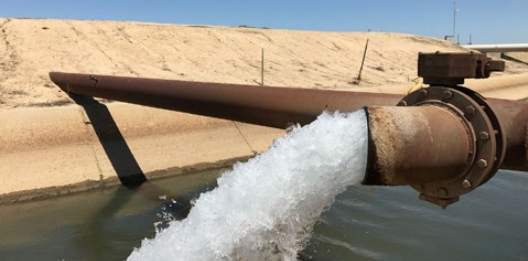
In the early 90s, when Chevron was Texaco, Cawelo made a deal with the company, and built a pipeline to bring the produced water to the district where it would be blended with fresh water for irrigation.
It is important to note that not all produced water is the same, and salinity is a determining factor in its viability as a source of irrigation. According to Ansolabehere, on the west side of the San Joaquin Valley, the produced water is too salty to use for agriculture without extensive treatment.
Conversely, the eastern part of the San Joaquin Valley, where Cawelo resides, has ancient fresh water which can be found in the same geological formation as oil. Meaning, when the oil is pumped, the water brought to the surface comes from a different underground layer that used to hold fresh water a long time ago.
On average, the produced water in Cawelo has an electrical conductivity of around 800, compared to over 20,000 in the saltier areas on the west side. For context, irrigation water from the Kern River, a pure source, measures about 100 EC.
After blending produced water with fresh water in Cawelo’s 140-acre-foot reservoir, it is safe for irrigation.
“All we need to do is blend it with a little bit of freshwater, like the Kern River, and it’s down in the 300-400 EC range, which is good for all crops,” Ansolabehere said. “The most salt intolerant crop is citrus, so that’s what we kind of govern by. If it’s okay for citrus, then all the other crops can handle the amount of salts without any issue.”
Importantly, the water is permitted and monitored under the Central Valley Regional Water Quality Control Board and has always met its standards. To abide with the monitoring and reporting program, Cawelo tests the water monthly, and provides quarterly reports to the regional board.
“We test it more than drinking water is tested,” Ansolabehere said.
This stringent oversight was of substantial importance during a media firestorm in 2014, when concerns were raised — mainly by environmental groups — about the use of oilfield water on crops. To quell concerns, the district worked on various studies with the Regional Water Quality Control Board.
The resulting white paper formalized the 300-item testing protocol Cawelo follows today. With those measures in place, much of the criticism died down.
“We spend probably $150,000 a year just in testing this water to verify that it is meeting all requirements,” Ansolabehere said. “At this point in time, and based on that study, this water meets drinking water standards.”
Currently, the district receives roughly 24,000-acre-feet of produced water annually. In wet years, this accounts for roughly 30–40% of the district’s supply. In dry years, when allocations from the State Water Project drop to zero, it can be closer to 80%.
“They have been consistent since the 90s in volume, whereas the State Water Project varies tremendously,” Ansolabehere said. “So, that has been our firmest water supply for the last 30 years, as opposed to paying all the money we pay to the state and getting only a portion of the water that we’re supposed to get.”
This reliability has prompted Cawelo to invest in expanding its infrastructure. On July 10, the Cawelo Water District Board awarded the construction of the Cawelo Collection Basin and Pipeline Project to W.M. Lyles Co.
The district began planning this project roughly three years ago in partnership with a small independent oil company east of its service area. Cawelo purchased land to build a lined basin and a connecting pipeline.
Ansolabehere explained that the district’s objective is to provide growers with more water security in dry years. The goal is to not only capture water from this partner but eventually bring in supplies from nearby independent operators as well.
“The produced water is outside of [Sustainable Groundwater Management Act] regulations, it is a non-potable aquifer, so it is not within the regulations of SGMA. When we pump those, even in dry years, that has nothing to do with hydrology,” Ansolabehere said. “So, if we have 0% from the state, those will still be operational and we’ll be able to bring those waters in, and it basically just gives us more flexibility. That’s why when we build things, we build them for additional flexibility.”
With the construction bid awarded, Cawelo aims to start construction in mid-August and have a completed project by the end of this year.
“We should have deliveries before the first of the year,” Ansolabehere said.
OI(L) VEY
Despite the benefits of produced water for irrigation, misconceptions persist. One of the most common points of ill-informed contention is that produced water is fracking. The other f-word may be a hot-button issue and a popular topic for middle school debate teams, but it does not relate to produced water.
Fracking water occurs through hard rock wherein it is pressure fractured, and the oil comes out of those fractures to be pumped out. The Cawelo Water District does not accept, use, or deliver water generated from hydraulic fracturing — fracking.
“The San Joaquin Valley is probably around, I don’t know the depth of it, but it’s nothing but sedimentation. There’s no rock to fracture, so we can’t frack over here,” Ansolabehere said. “Now, they do frack on the west side over by the coastal range, that’s bedrock, they fracture or frack over there. We can’t — there’s no rock to fracture.”
He explained that the water district spent years providing education about produced water, and once they had test results in hand showing the high quality of the water, criticism mainly fizzled out.
UNICORN RESEARCH
Due to the ancient fresh water and favorable geological conditions, the produced water situation in Cawelo is not easily replicated.
“There’s very few places that could actually do this,” Ansolabehere said. “This is kind of like the unicorn site. It’s just not the average.”
Still, there is potential for other regions to further explore produced water use. In Texas, for instance, recent state regulation — Senate Bill 1145 — transfers the authority to issue permits for the land application of water from certain mining and oil and gas operations from the Railroad Commission of Texas to the Texas Commission on Environmental Quality.
This means that SB 1145, passed in 2025, streamlines the regulation of produced water in the oil and gas industry while supporting water reuse and environmental safety. As a result, several pilot tests are being conducted across Texas to evaluate the use of produced water in agriculture.
There are six notable pilot projects that are laying groundwork for farmers to eventually use treated produced water. The research ranges from studying reverse osmosis, desalination, membrane and thermal treatment, and crop health trials. If successful, this research could help shift produced water in other areas from being a liability to a valuable resource.
Along with the Texas-based research, other educational institutions and labs are breaking through the barriers to broader use and adaptation of produced water in agriculture. On June 30, Berkeley Lab highlighted a new membrane technology that could increase the efficiency of wastewater treatment.
The new technology, developed by California-based company Active Membranes with funding from the National Alliance for Water Innovation led by Berkeley Lab, equips membranes used in the reverse-osmosis desalination process with electrical conductivity.
In doing so, it improves the membrane’s ability to separate salt and other contaminants from hard-to-treat waters such as the water brought to the surface during oil and gas extraction.
According to the news release, this produced water is packed with salts, particles, and hydrocarbons, which contribute to rapid scaling and fouling of conventional membranes.
“In a normal oil well, there is far more produced water than oil, and the disposal of this water often limits oil and gas production,” NAWI Executive Director Peter Fiske said. “Treating and desalinating produced water could allow this ‘wastewater’ to become a source of irrigation for agriculture.”
Reverse Osmosis is widely used to remove dissolved salts and contaminants from water by utilizing ultra-thin membranes that enable water under pressure to pass through the membrane while blocking salt and other contaminants, Berkeley Labs explained
However, a common problem with membrane-based water purification is the build-up of salts and organic matter on the membrane known as “scaling” and “fouling,” respectively. To avoid scaling, RO membranes must be frequently backwashed and cleaned, which raises costs and reduces water production.
The new approach by Active Membranes keeps membranes clean by applying an ultra-thin, electrically conductive coating on top of the membrane and charges the surface with low voltage so that the salt ions and other charged species in the water are pushed away from the membrane surface to reduce scaling and fouling.
A recent field pilot in Ventura County tested the electrically “active” membranes against conventional membranes. The active membranes demonstrated a 20-30% improvement in water production.
According to the co-founder and CEO of Active Membranes, Arian Edalat, the next step to move desalination forward and reduce its overall cost and footprint entails rethinking the membrane separation process by giving the membrane the ability to clean itself.
“Piloting in realistic operating environments is a critical step in validating a new water-treatment technology,” Fiske said. “Laboratory environments and simulated water chemistries can only take you so far. At some point the acid test is: Can this system make clean water from a complex source of water in a realistic environment?”
To learn more about Berkeley Laboratory’s research on treating produced water for agricultural use, visit lbl.gov.