By Scott Hamilton, President, Hamilton Resource Economics
Reprinted with permission.
In the controversial world of California water, executive orders at both the state and federal levels demand better use be made of available water, but efforts to capture surplus water meets with zealous resistance from special interest groups and their proxies in the legislature and resource agencies. The conflicts undermine the purposes of California’s Delta Reform Act of 2009, which established two “coequal goals” – securing a reliable water supply for California and protecting, restoring, and enhancing the Sacramento-San Joaquin Delta ecosystem. Achieving the co-equal goals necessarily requires a balancing between competing beneficial uses of available water resources.
Conflicts arise in the continuing case of management actions employed to help the delta smelt, a species reliant now on hatchery propagation for survival. In 2008 when the Fish and Wildlife Service was evaluating the effects of Central Valley Project and State Water Project operations on delta smelt, the agency concluded that those operations could jeopardize its continued existence and proposed a “reasonable and prudent alternative” that increased Delta outflow in the fall of wetter than normal years to benefit the species, primarily to increase the extent and quality of delta smelt habitat. That requirement was based on flawed studies. Not surprisingly, a number of more recent studies have found that either the management action was not effective, or that there was no evidence to support it. The cost to water users was estimated to be 200,000 acre-feet per year (with a replacement value of more than $100 million/year).
Moving on, supporters of the action suggested the specifics of the prescribed conservation action were wrong, but the principle was right. It was not outflow through the Delta in the fall that was important for delta smelt, rather it was outflow in the summer, and so the action was modified. The action is now referred to as the “summer-fall habitat action” (SFHA) and was included in the 2019 Biological Opinion for State and Federal water project operations. The California Department of Fish and Wildlife subsequently required another 250,000 acre-feet of outflow through the Delta for delta smelt when it issued an incidental take permit in 2020, more than doubling the water cost associated with the action. On reviewing the science, the United States Bureau of Reclamation (USBR) concluded that the SFHA did not provide population benefits to delta smelt and proposed elimination of the action. The California Department of Fish and Wildlife contested USBR’s view.
A fair question at this point is – on what side does the science lie?
In a report recently released – Summer-fall habitat actions for delta smelt – Report on effectiveness of actions taken between 2011 and 2024 – the Delta Coordination Group’s Science and Monitoring Work Group (DCG), an interagency team of government scientists and resource managers, summarized the science behind water management actions intended to improve habitat conditions for delta smelt in the summer and fall, and analyzed available data on the apparent effectiveness of the SFHA.
It is not possible to do justice to the nearly 200-page DCG report in a few paragraphs. The report considers key environmental requirements for delta smelt, systematically following a quasi-scientific approach considering hypotheses, methods, results and discussion on the topics of smelt habitat, smelt food, smelt growth and smelt health. The report uses a weight-of-evidence approach to evaluate the effectiveness of the actions intended to improve Delta smelt habitat, survival, and recruitment.
The report made numerous findings, of which a few key ones might be summarized generally as:
a) Higher outflow increases the extent of physical habitat available for delta smelt.
b) Existing zooplankton biomass in Suisun Bay is generally much less than is needed to sustain delta smelt. Higher Delta outflows increase food supply for delta smelt in Suisun Bay.
c) Delta smelt growth rates in summer were generally higher with higher outflow, but there was no relationship in the fall.
d) Differences in growth rate potential between years was driven by food density in summer.
Are these findings sufficient to support the SFHA? The science of the Delta is complicated. There are only a few environmental drivers impacting many environmental conditions, and, as a consequence, many of the environmental conditions are highly correlated. Disentangling causation from correlation in this system is challenging. The inability to separate the two has led to many ill-directed actions with dire consequences for delta smelt and substantial reductions in water supplies for a thirsty state.
Of great relevance here is the law of the minimum, dating back to 1840, which states that growth is limited not by the total resources available, but by the scarcest essential resource, or limiting environmental factor. Like gravity, this is a “law.” One can choose to ignore it, but that doesn’t make it any less relevant. To demonstrate its relevance, we can employ an analogy. Suppose a man staggering through the desert has little water left in his canteen. He has his physical environment – heat, blazing sunshine, and sand. But he also has biological necessities – food and water. If he is to survive, suppose he needs a gallon of water per day, far more than remains in his canteen. With this analogy in mind, the applied value of the DCG findings is worth reviewing.
a) The finding that higher outflow through the Delta increases the extent of physical habitat available for delta smelt is supported by numerous studies. However, it misses the essential element. Suppose our thirsty man has found refuge in the shade of a few palm trees. While resting, he finds a tent hidden in the brush. He had shade before. Now he has more shade, perhaps better shade. Did it help? He may have more shade but he is still dying of thirst. Not addressing the limiting factor has not improved his chances of survival. Thus, a finding that the SFHA increases the physical habitat is not an adequate justification for the action – it provides no sustained benefit for delta smelt.
b) The finding that existing zooplankton biomass in Suisun Bay is frequently much less than is needed to sustain delta smelt is coupled with a finding that greater Delta outflows increase food supply for delta smelt in Suisun Bay. Both findings are also supported by available data, but food supplies in Suisun Bay are often so low that increasing outflow, while it will increase the food supply, will not elevate food supplies to a level needed to sustain delta smelt in that Bay. Our thirsty man has one ounce of water in his canteen. Suppose he captures another ounce from a brief rainstorm. His water supply just doubled. But he needed much more. Without it, his chances of survival remain slim. Regardless of any percentage increase, an increase in a limiting factor is inconsequential if that factor is not sufficient to sustain life. Thus, the claim that an increase in food supply in Suisun Bay, as a result of the action, is justification for the action is invalid.
c) The finding that Delta smelt growth rates in summer were generally higher with higher outflow mistakes correlation for causality and is misleading if used to support the SFHA. We return to this issue shortly.
d) The finding that differences in delta smelt growth rate potential between years was driven by food density in summer is far reaching – a reflection of the problem delta smelt have faced for three decades. Evidence suggests that the inability to address that limiting factor has led to the demise of the fish more so than any other factor. The SFHA does nothing to provide sufficient supplies of food for delta smelt.
While certain information the DCG report has value in better understanding the ecology and behavior of delta smelt over the period of study, it has some fundamental shortcomings.
One is the failure to employ a valid conceptual ecological model – the graphical foundation used to guide conservation efforts targeting an imperiled species and its habitat. Failure to develop an appropriate conceptual model can lead to mistaking correlation for causation. Fundamentally, a conceptual model addressing delta smelt distribution and abundance must include big winter storm events, particularly the first big storm event of the winter. Those storm events increase flows across floodplains, bring nutrients into the Delta fueling the food web, and add turbidity, a physical attribute desired by delta smelt. Those benefits extend month to month, season to season, leading to good performance by delta smelt. Big winter storms and the associated snowpack also fill reservoirs. As the snow melts and the reservoirs release water, outflow through the Delta increases. But it was not flows in the summer that increase zooplankton production – there is no magic summer flow that produces food. Food production is a complex algorithm determined by nutrients, light availability, chlorophyl levels, water temperature, pH, and food upstream. It is the big winter storms that lead to a buildup of food into the summer and govern the annual performance of delta smelt that (Figure 1).
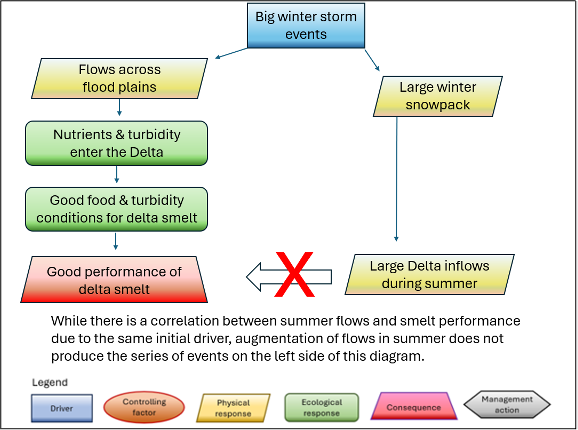
Figure 1 – Causal and correlated factors influencing the abundance of delta smelt
Second, the weight-of-evidence approach used by the state resource agencies to inform the conclusions in the report is not the preferred “scientific method” for inferring a resource management agenda from available data and analyses. Far better and scientifically defensible is to specify and quantitatively evaluate one or more management-relevant hypotheses.
The DCG report presented many thoughtful hypotheses. Many of the findings from evaluating those hypotheses were derived from univariate graphical analysis. Others were generated from or referred to more sophisticated modeling approaches. But even sophisticated computer models can have hard coded relationships that are not always well supported. Rigorous science emerges from quantitatively testing hypotheses using pertinent and reliable data.
It is possible to test the simple and essential hypothesis that relates outflow through the Delta to delta smelt performance with the agencies’ own time-series data. We tested that hypothesis:
Ho: high delta outflow in summer has a statistically significant effect on the change in abundance of delta smelt
We use a limited number of covariates.
- Change in abundance of delta smelt, the dependent variable – calculated as the Fall Midwater Trawl (FMWT) Index in Year t divided by the FWMT Index in year t-1
- Summer outflow – the average Delta outflow (cfs) in June through July (DWR Dayflow)
- Summer Food – the average adult copepod biomass in the northern arc in July and August at stations NZ028, NZ032, NZ054, NZ060, and NZ064 (CDFW Zooplankton Survey)
- First flush – calculated as the 30-day average Delta inflow following the start of the first flush from the first big winter storm event (in cfs) multiplied by the days from the start of first flush until April 30
- Summer water temperature – calculated as the maximum 7-day average water temperature at Mallard Island in July and August (DWR CDEC)
We used data for the period 1987 to 2014 – the period after the invasion of the Asian clam in the upper San Francisco Estuary until the last year the FMWT Index was in double digits.
If the only explanatory variable considered is summer outflow, it is marginally significant (P-value is 0.07) but certainly supportive of a relationship between flows and abundance of delta smelt (R2=0.247) as the DCG suggests. A model with all four covariates provides more explanatory power (R2=0.53). However, summer flows become statistically insignificant (P= 0.44) while summer food (P-value = 0.007) is strongly significant statistically. The model version with the highest adjusted R2 did not include summer flow, only the other three covariates. Based on those results, we rejected the null hypothesis and concluded that greater Delta outflow in summer does not have a statistically significant effect on the change in abundance of delta smelt. The association between summer outflow and changes in abundance of delta smelt is most likely due to its correlation with the magnitude of first flush and has no significance when more relevant factors are included in the model. That being the case, increasing summer flows is not expected to improve the abundance of delta smelt. The DCG findings presented above are valid, but their using them to support the SFHA is not.
Our analytical evaluation of relationship between Delta outflow and delta smelt population dynamics highlights the problems inherent in so many analyses of environmental variables affecting the status of threatened and endangered species. Correlations are mistaken for causation and management responses that follow are misdirected. If a comprehensive set of environmental covariates is not considered, significance can be attributed to the wrong environmental covariate – the wrong causal factor. When more causal covariates are included, false covariates will drop out.
The importance of summer food is pervasive (Figure 2). When summer food is sufficient, the delta smelt population typically increases (93% of years). When it is insufficient, the delta smelt population typically decreases (88% of years). This analysis makes the case that the abundance of the delta smelt’s zooplankton food, while not the only limiting environmental factor, is a factor limiting recovery in many years.
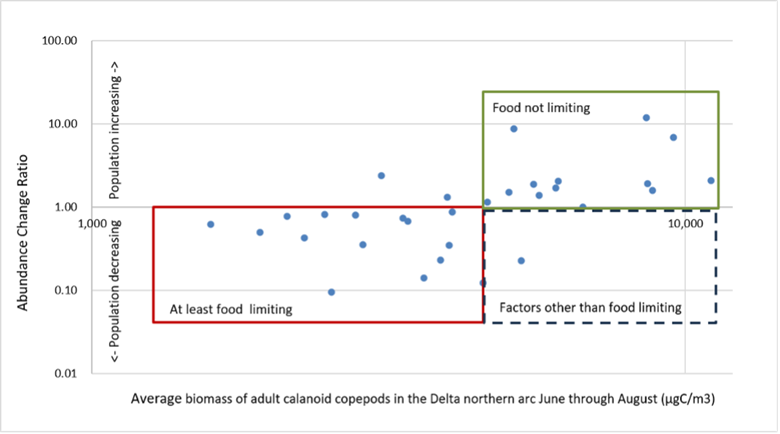
Figure 2 –The relationship between food availability in the northern arc in summer and changes abundance of delta smelt 1986-2016, showing that when food density exceeds 4,600 µgC/m3 delta smelt population typically increases and if less than that threshold, typically decreases
Through-Delta flow actions to benefit delta smelt are premised on the assumption that abiotic environmental conditions are limiting the recovery of delta smelt, when the more rigorous science indicates that it is the availability of the fish’s zooplankton food. If the estuary is to sustain delta smelt, effective management actions to address the factors that actually limit recovery of delta smelt must be implemented.
There are a number of actions that research based on historical data regarding wild delta smelt suggests can be taken to help delta smelt recover. A hypothesis test, evaluated quantitatively, using publicly available data, ecological principles, and decades of quantitative analysis indicate that the summer-fall habitat action is not one of them.