
By Natalie Willis, Reporter, Valley Ag Voice
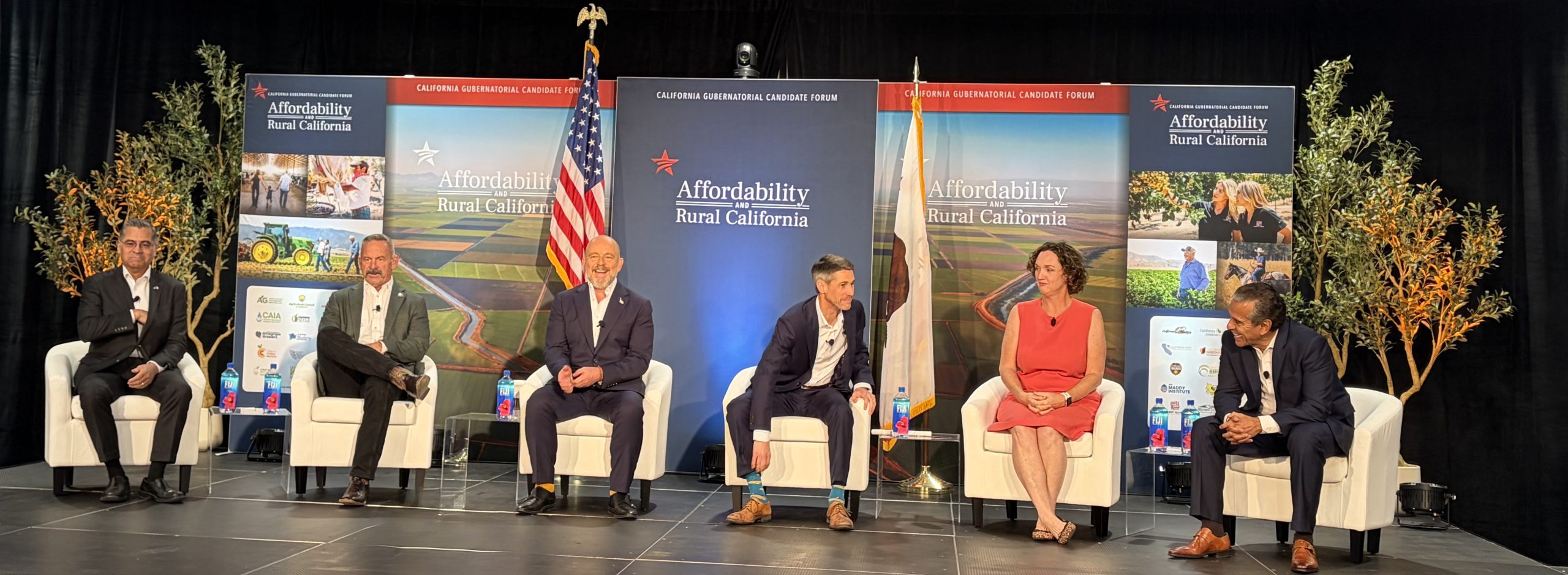
On April 1, six California gubernatorial candidates attended a bipartisan, agricultural-focused forum at California State University, Fresno. The event — titled “Affordability and Rural California” — was hosted by Western Growers and the Maddy Institute, along with 28 other supporting agricultural organizations.
Forum participants included Chad Bianco (R); Steve Hilton (R); Matt Mahan (D); Katie Porter (D); Xavier Becerra (D); and Antonio Villaraigosa (D). Democratic candidates Tom Steyer and Eric Swalwell were invited but did not attend.
Candidates discussed topics rooted in the issues Central Valley farmers and ranchers are facing, from water availability to the various compliance costs that weigh down operations. Much of the forum featured similar answers from the candidates on why California is facing an affordability crisis and the factors harming agricultural regions. For instance, when asked to raise their hands if they believe that the state needs to rethink how it balances climate goals and mandates with people’s needs for energy price relief, all six candidates raised their hands.
The forum was moderated by former Assemblymember and Stanislaus County Supervisor Kristin Olsen-Cate and Fresno County Supervisor Buddy Mendes. Mendes set the stage early, asking the candidates to be specific in their answers.
“We’re going to ask that you be specific. Voters want more than generalities,” Mendes said. “They want to hear what you would actually do to address affordability and challenges facing the Central Valley. We’re all professionals, so let’s be candid and have an honest conversation about what it’s going to take to get things done.”
ALLOW ME TO RE-INTRODUCE MYSELF
Ahead of the moderators’ questions, each candidate was allotted time to provide an opening statement.
Becerra (D) kicked things off, stating that the next California governor should not require “training wheels.” He served 12 terms in Congress and was the 25th Secretary of the Department of Health and Human Services under the Biden Administration. Becerra’s primary message, aside from stating that he’s from the northern Central Valley (Sacramento), centered on the state’s affordability crisis from housing and grocery shopping to healthcare.
“We do not need someone who needs training wheels. This is not a place for on-the-job training. I have balanced budgets, bigger than the budget of the state of California, four years in a row. I have had to declare a state of emergency, a national state of emergency, [for] COVID, avian flu, monkeypox,” Becerra said. “Even in Lahaina, Hawaii, I had to declare a state of emergency to help out our communities. It is time to have real leadership that’s not based on inflated promises, it’s based on record.”
During his introduction, Bianco (R) detailed his 33-year background in law enforcement and his service as the Riverside County Sheriff since 2018. According to Bianco, California’s “downfall” can be traced back to partisan politics.
“It wasn’t farmers that ruined your industry. It wasn’t farmers that ruined the water industry. It wasn’t farmers that put all the regulations on yourselves. It was all of these people, and it was their policies, and it was partisan policies,” Bianco said. “And until we decide that we’re going to make the choice to be honest about how we got here, and who the people are, and who the ideological agenda is that put us here, we’re never getting out of it.”
Hilton (R) took the stage next, explaining that he grew up in England with Hungarian parents who fled from a communist regime. He moved to Silicon Valley in 2012 and became a U.S. citizen in 2021. Hilton criticized Democrats, accusing them of harming the state’s agriculture industry through harmful policies and regulations.
“I think every single Democrat on this stage today should start with an apology. An apology for what their party has done to this area and this industry. Stealing your water, piling on the regulations…cutting the pay of agricultural workers,” Hilton said. “The assault on this industry has to stop, and they should start by apologizing for what they did. As your governor, you won’t have a stronger champion for farming and for agriculture than me.”
Hilton’s remarks were followed by Mahan (D), who currently serves as the Mayor of San Jose. Mahan explained that Sacramento policies have failed the state’s agriculture industry, stating that most policies are not working in practice and have made it difficult to expand infrastructure and water supply.
“We will work together to deliver the results that you deserve and challenge the status quo when our policies and regulations and programs aren’t delivering results,” Mahan said. “You deserve better from Sacramento, and I’ll work with you to make sure we deliver it.”
Porter (D) was a U.S. Representative from 2019 to 2025. She currently works as a professor at the UC Irvine School of Law. Porter explained that she grew up on a farm in Iowa, but decided against a career in agriculture due, in part, to the pressures facing American agriculture.
“It’s being felt here in California, but it’s been felt across the country. Family farmers, smaller farmers are losing day after day, year after year, and it is to the peril of not just our agricultural communities, but to our entire country. To the character of our country, to the national security of our country, to the health of what we eat and consume,” Porter said. “We demand a lot of California agriculture. The world and California demands a lot of agriculture, but we don’t always respect and prize the innovation, the hard work, the tough decisions, and the risk that agriculture takes on when it delivers food to the world.”
Villaraigosa (D), former Speaker of the California State Assembly and Los Angeles Mayor, was the last to provide introductory remarks. He called for greater cooperation between the nation’s dominating political parties and highlighted his intentions to work with both sides.
“The next governor is going to have to be somebody that gets things done. Somebody who works across the aisle and can work with everybody and stop the screaming,” Villaraigosa said. “This part of the state is important, and I intend to represent it. That’s why I came here last time 55 times, and this time more than two dozen.”
CANDIDATE COMMONALITIES
With a largely agricultural and rural audience, the forum’s topics centered on cost of living and viability of sustained agricultural production in the state, with water infrastructure, input costs, and overregulation serving as the driving issues.
In terms of lowering food costs for consumers, Democratic and Republican candidates agreed that cutting excessive regulation and lowering energy costs would take precedence. Moderator Olsen-Cate referenced a 2025 Public Opinion Strategies poll of 1,000 California voters where 91% of respondents said grocery and food prices are “a problem for their family” and more than half recognize that regulatory costs increase food prices.
According to Mahan, the leading cause of high food prices is the regulatory burden placed on California’s agriculture industry.
“It’s not one regulation, it’s the fact that over the last 20 years, we’ve increased the cost of complying with regulations for farms by 13 times. Not 13% — 13 times what it took to comply just 20 years ago,” Mahan said. “That’s monitoring, reporting, getting a permit for every little thing you want to do. It is overwhelming.”
He explained that the power of appointment bestowed on the governor would allow him to install agency leaders to reform the regulatory environment.
Porter echoed this sentiment, stating that California’s regulations are “choking off” the agricultural community, and that effect trickles down to consumers. She explained that farmers have innovated to adapt to these regulations, but it’s time to listen to what the agriculture industry needs.
“Nobody should be at risk of dying or getting hurt on a farm, and people should get paid what they’re owed. Those are the touchstones for employment regulation. You should get paid what you’re promised. You should be safe on the job,” Porter said. “But we don’t need thousands and thousands of regulations to get that done. We need to focus on holding bad actors accountable and freeing our hard-working, good businesses to innovate and deliver cheaper groceries. So, I agree, we’ve gone too far on regulations. We need to look hard at them.”
There must have been an echo in the room, because Villaraigosa also spoke out against high regulatory costs, stating that in the last decade, compliance costs have increased from $160 an acre to $1,600 an acre. He explained that there is consensus that Sacramento is “broken” and the regulatory costs are not sustainable for continued agricultural production.
Becerra agreed that regulatory costs are exorbitant and stated that, if elected, he will declare a state of emergency, allowing him to pinpoint which regulations are getting in the way. He also added that the state needs to give growers more predictability in water supply.
“Because if you’re going to grow, you need to know what you can forecast. You need to know how much you need to spend, and if you don’t know how much water you’re going to get, you could be making a big investment in your farm, in your production, and not be able to produce all the way through,” Becerra said. “So, we need to give you some predictability when it comes to your business.”
Bianco remarked that the solution for lowering food prices and production costs is simple — do away with harmful regulations. He explained that he will push for greater oil independence in the state, reduce the price of gas and electricity, and give farmers the ability to grow more food.
“You can’t just believe what’s on this stage. You have to listen to what they say in groups that don’t think like you,” Bianco said. “Because everything that they’re saying here contradicts what they say in those groups with more cap-and-trade, with more regulation, with more everything else.”
As the last to speak on the topic, Hilton stated that everything expressed by the candidates is correct. However, he claimed that the only way to reduce costs is to “abandon the climate dogma.”
He explained that the carbon neutrality by 2045 target is driving the cost of energy up and should be abandoned.
WATER PROMISES
According to Hilton, increasing water deliveries to farmers is one of his top priorities.
“We don’t need new infrastructure for that. Within the current infrastructure that we have, we can just increase the amount of water that is flowing into our system here, into irrigation, and increase surface water,” Hilton told Valley Ag Voice. “You do that through getting rid of the biological assessments that have been put there in recent years that divert water into the Delta and out into the ocean and increase deliveries for agriculture.”
He explained his plans to make new appointments to the State Water Resources Control Board and create clear executive orders to direct their work toward increasing water supply. Hilton also explained that he will act quickly to increase California oil and gas production and begin bringing the cost of energy down.
Villaraigosa told Valley Ag Voice that he does not know if State Water Project allocations for farmers can get up to 100% of requested supplies but said there needs to be a plan in place to get increased water deliveries.
“I think what you have to do is you have to put a plan, and you’re going to say in a five-year period, that’s how we’re going to get there, right?” Villaraigosa said. “What I do believe is, and I talked about it at the State Water Board, Fish and Game, California Air Resources Board, the Coastal Commission, they’re kind of, they’re operating as if they were the legislature and the government, and they’re coming up with regulations that have no interest in determining, ‘what’s the cost of that?’ And I think that’s true for water, but it’s true across the board.”
According to Bianco, water is not a scarce resource, but it is “wasted.” He explained that increasing water storage capacity is paramount.
“They’re taking all of these reservoirs away. In California in the summertime, those rivers and streams will dry up. There will be no water without reservoirs,” Bianco said. “We’ve gone so far backwards in the name of environmental activism that we’re killing our state.”
Porter told Valley Ag Voice that water policy must stand to the test in both drought years and wet years. This, she explained, requires the stabilization of groundwater through sustainable groundwater management, capturing storm water, and modernizing the state’s water infrastructure.
“We have had water abundant years in recent memory. The last decade we have also had water scarcity years…so anybody who’s saying water’s so abundant or water’s so scarce isn’t looking at the data. We have both,” Porter said. “The question is, are we doing everything we can do in those water abundant years to help provide that stability in those drought years? The answer is clearly no.”
TO THE TEST
Early polling surveys place Hilton and Bianco as favorites, followed by Swalwell, Porter, Steyer, Becerra, Villaraigosa, and Mahan.
Events like the agricultural-focused candidate forum at Fresno State give the agriculture industry a chance to hold candidates accountable. Candidates openly acknowledged that California agriculture faces heavy regulation and stressed the need for more predictable water supplies. Regardless of who wins, the leading gubernatorial candidates are on record supporting California farmers and ranchers. It’s up to the agriculture industry to hold them to it.
To watch the full forum, visit https://www.youtube.com/watch?v=ecuIRt5zXws.





