By Natalie Willis, Reporter, Valley Ag Voice
In March, the 2025 Dairy Sustainability Summit in Visalia gathered dairy producers and industry experts to explore best practices for advancing environmental and economic sustainability in the dairy sector, with a notable focus on navigating California’s regulatory environment.
According to Dairy Cares, the number of dairies in California has decreased by 94% over the past 70 years. Yet, California is the top dairy-producing state, accounting for nearly one-fifth of the total U.S. supply.
Along with the clear economic contributions of California’s dairy industry, the sustainability summit highlighted a critical fact — the unprecedented leadership of the industry in addressing the state’s methane reduction goals.
According to Frank Mitloehner, an expert in animal agriculture and air quality in the UC Agriculture and Natural Resources Cooperative Extension and director of the CLEAR Center, the dairy industry is not only complying with California’s methane emission reduction requirements, it is exceeding expectations.
The state’s goal is for the dairy industry to reduce 40% of its methane emissions, or 7.2 million metric tons by 2030. In 2025, the industry has already achieved a reduction of nearly 5 million metric tons, with five more years to reach the state’s goal.
“Again, 7.2 million metric tons is the goal — we will reduce 7.6 to 10.6 million metric tons,” Mitloehner said. “We will not just achieve the 40% reduction, but we will achieve more than the 40% reduction and sizably so.”
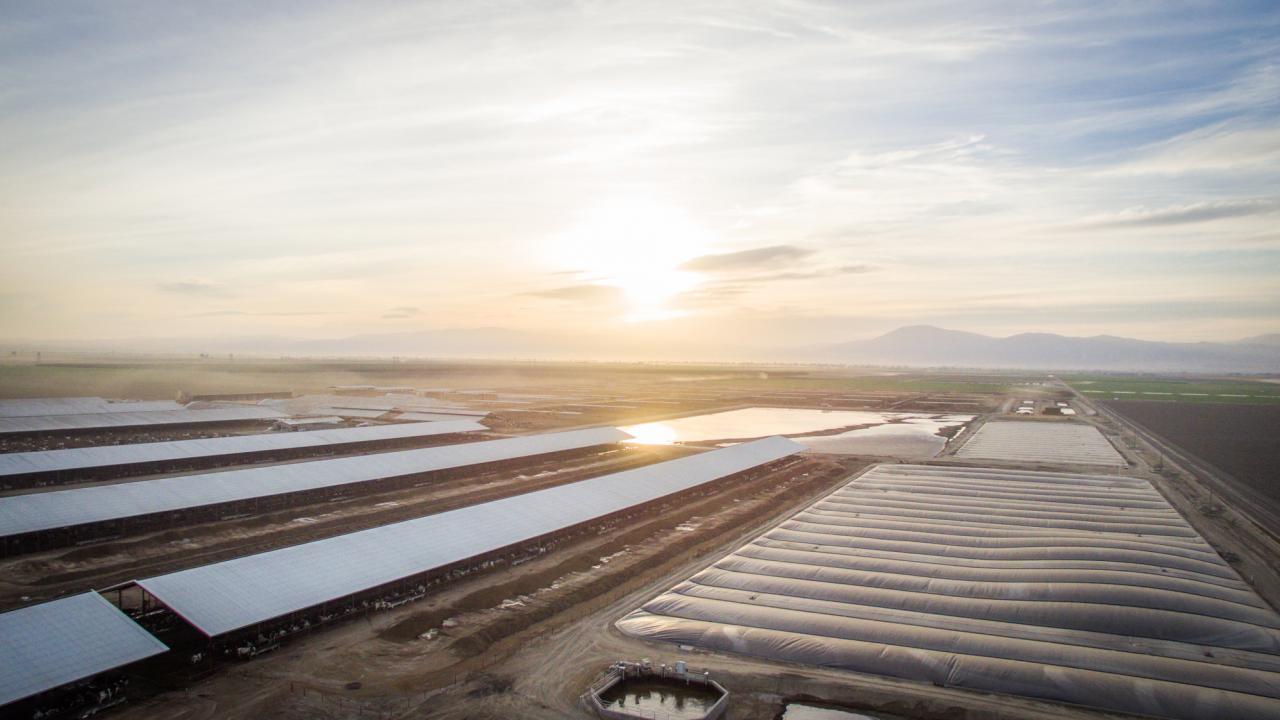
Aerobic digesters will account for most of the reductions, Mitloehner explained, as well as other technologies such as alternative manure management practices and feed additives.
Despite the strides the California dairy industry has made, a lack of communication on these efforts and achievements have been misconstrued, Mitloehner explained. In terms of reducing environmental footprints — especially as it pertains to greenhouse gas emissions — California’s dairy sector is the benchmark.
However, according to Mitloehner, global conversations on dairy and livestock are dominated by the argument that eating less dairy and meat will help protect the environment. He pointed to an example of media misinformation leading up to the COP28 UN Climate Change Conference in Dubai, wherein headlines claimed that the United Nations’ Food and Agriculture Organization was calling for a global reduction in the consumption of animal-sourced foods.
“The media worldwide announced the FAO report that was shared at that meeting as one that suggests that the world’s population needs to change what they eat,” Mitloehner said.
However, the actual report released by the FAO offered a “toolbox” approach of science-backed solutions for reducing the environmental footprint of livestock systems. The second least effective approach in reducing the carbon footprint would be adopting an omnivore diet, whereas the most effective approaches include productivity increases, breeding, better animal health, and smarter feed practices.
CARROT VS CANE
The success of the dairy industry in reducing its methane emissions is due in large part to California’s “carrot approach,” Mitloehner explained. In contrast to the proverbial “cane approach” the rest of the world uses — rules, regulations, fines, taxes, to force emissions reductions — the carrot is a voluntary incentive-based approach.
“What that means is, we want you to reduce emissions, and in order to achieve that, we will work with you by financially incentivizing methane emission reductions,” Mitloehner said. “That carrot approach that was used here and is being used in California has been a very, very important enabler of achieving what we have to achieving here.”
Mitloehner explained that his and his colleagues’ research highlighted the strategies that the carrot approach has offered producers. Firstly, there is an anticipated herd size reduction between 0.5% to 1% annually. This means that a given amount of milk is still being produced with a decreasing number of cows, leading to less manure and belching.
Other methods, as aforementioned, include dairy digesters, alternative manure management, and feed practices. Because the carrot approach has been largely successful in California, on May 19 to 21, UC Davis is hosting a State of the Science Summit with several agricultural ministers from around the world in attendance to learn about California’s approach and how to model it.
“They are coming to us because they want to know what we have done here that works so well that they can copy and paste,” Mitloehner said. “And that makes me very proud and all of us very proud that we are used as an example to much of the rest of the world on how to achieve sustainability.”
He explained that the achievements of the industry are not “greenwashing” or a marketing spin — the results are measurable. The methane captured from dairy digesters is tracked precisely because the biogas is sold into the energy grid, Mitloehner explained.
Further, researchers are actively measuring emissions down to the cow level, using tools like head chambers and controlled environments to calculate exact methane outputs. This scientific rigor, combined with support from state agencies, universities, and industry partners, has created a functional ecosystem to meet the state’s goals.