By Natalie Willis, Reporter, Valley Ag Voice
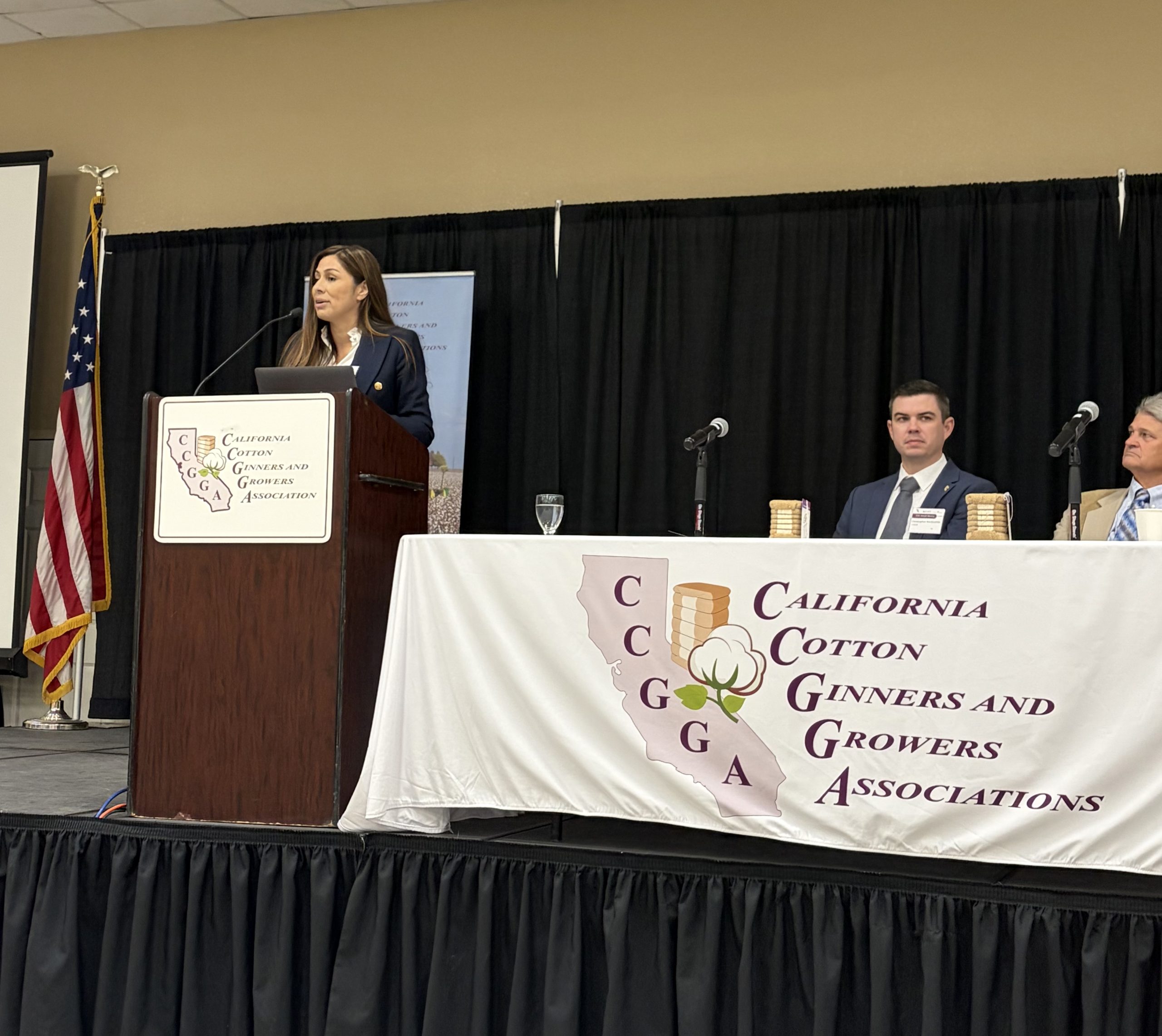
On May 20, the California Cotton Growers and Ginners Association’s 2026 annual meeting brought together growers, ginners, and agricultural leaders for a day of industry updates, legislative discussions, and networking.
During the meeting, CCGGA staff provided regulatory updates, and the potential effects current and proposed legislation would have on the state’s cotton and agriculture industries.
DUDE, WHERE’S MY EV?
On May 14, the federal Environmental Protection Agency proposed the rollback of Tier 4 emission control standards for light- and medium-duty trucks. According to the announcement, this action is “Part 1” of EPA’s review of the Biden-era vehicles emission standards for criteria pollutants. Part 1 proposes delaying the Tier 4 standards for light- and medium-duty vehicles by two years, until model year 2029.
According to the EPA, the proposed action is in response to the “existing and unrealistic” Tier 4 standards that require manufacturers to meet declining emission levels for standards starting in model year 2027 and fully implemented by model year 2032. The EPA stated that the fleet average standards were based on Biden-era EPA assumptions regarding the anticipated electric vehicles that would be produced by manufacturers, but there has been “low consumer appetite” for EVs.
“EPA announced that they’re rolling back the Tier 4 emission control standards for light- and medium-duty trucks, saying that the last administration’s push towards EV and utilizing these Tier 4 emission standards were a pipe dream,” Christopher McGlothlin, Director of Technical Services for CCGGA said. “They wouldn’t be able to achieve this push for EV that everybody expected them to have…it’s a two-year delay in implementation, and a lot of automakers are happy about that. The administration expects that it’ll be $1.7 billion in savings to consumers.”
According to the EPA, the Part 1 action will provide time for the agency to reconsider the longer-term Tier 4 standards and related program elements.
McGlothlin explained that CCGGA also continues to monitor potential regulations targeting farm equipment emissions, especially in light of the proposed Tier 5 emissions standards for tractors under consideration by the California Air Resources Board.
According to McGlothlin, California regulators are under pressure to reduce fine particle pollution to comply with the federal Clean Air Act, so the state is looking at more ways to cut emissions from agriculture equipment and farming operations. That could include stricter rules on tractors, dust from farm roads and land preparation, and harvesting activities.
“Our association’s been heavily involved with CARB,” McGlothlin said. “They actually came to our office, I believe it was 15 staff members from the Air Resources Board, five or six from the local air district, and we talked about all of the different ways that ag has implemented technology changes to achieve some of these emission reductions ahead of time.”
2026 LEGISLATION TO WATCH
Priscilla Rodriguez, Assistant Vice President at CCGGA, discussed various pieces of proposed legislation that CCGGA is opposing in 2026.
Assembly Bill 1603, introduced by Democratic Assemblymember Nick Schultz, would ban the California Department of Pesticide Regulation from registering new pesticides that contain perfluoroalkyl and polyfluoroalkyl substances (PFAS).
“What it would do is, any chemical that has PFAS would be considered restricted material in 2028, and then would be banned by 2030,” Rodriguez said. “There’s over 1,200 registered chemicals right now that would be included into this.”
Rodriguez explained there is no formal scientific finding that supports the ban of PFAS as proposed in AB 1603.
“The level [of] PFAS that are in the pesticides is not harmful because it’s gone through the EPA process, it’s gone through the DPR process, and there’s obviously security factors that they’re gonna consider before they’re gonna put something out on the market,” Rodriguez said. “So, we’re strongly opposed to this AB 1603.”
Another Assembly Bill opposed by CCGGA is AB 2447, introduced by Democratic Assemblymember Rebecca Bauer-Kahan. This bill would have required the Regional Water Quality Control Boards to update the Irrigated Lands Regulatory Program to reduce nitrogen waste discharges from commercial irrigated agricultural lands.
AB 2447 was held under submission in the Assembly Appropriations Committee and is currently “dead,” according to Rodriguez. However, CCGGA expects to see similar legislation next year.
Another proposed bill, AB 2646, would increase the minimum wage for agriculture workers. Introduced by Democratic Assemblymember Maggy Krell, the bill would increase wages for H-2A workers to $19.75, beginning January 2027 and followed by automatic annual cost-of-living adjustments.
Rodriguez also discussed AB 1777, introduced by Democratic Assemblymember Robert Garcia. The bill would be a statewide indirect source rule that authorizes the state Air Resources Board to adopt regulations to reduce or mitigate emissions from indirect sources of pollution.
“So, what this state’s doing is they’re trying to find a way to get those emission reductions, and so, what they’re considering now is an indirect source rule,” Rodriguez said. “Consider your property line. Anything that comes into your property line is now your obligation to try to find reductions. So, whether that be your C truck, your module trucks, any service trucks that come on, you’re gonna have to account for those emissions and find a way to reduce it.”