By Valley Ag Voice Staff
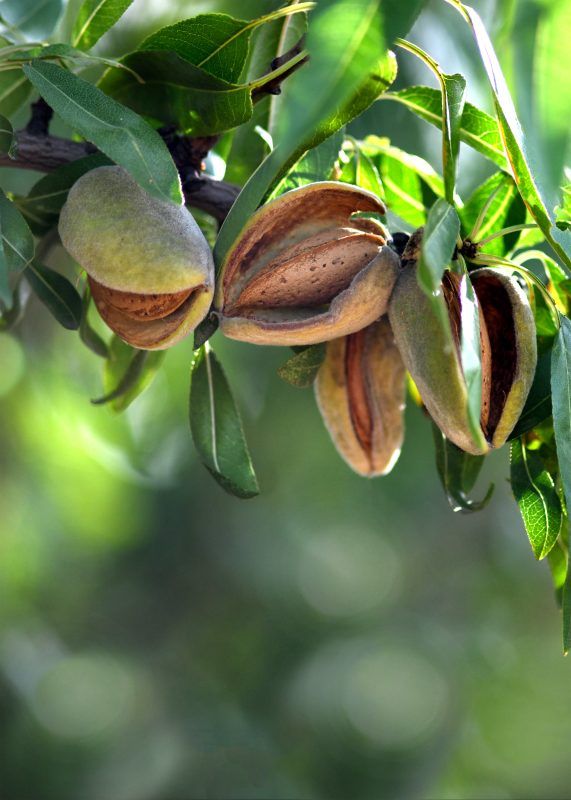
California almond production in 2025 is up 3% over last year’s 2.73 billion pounds, according to the U.S. Department of Agriculture.
The 2025 California Almond Subjective Forecast is released annually by the USDA, providing early estimates of the coming crop through a survey conducted from April 21 to May 7 of 500 randomly selected California almond growers.
According to the Almond Board of California, this report is conducted to provide the industry with the necessary data to make informed business decisions. For 2025, USDA’s National Agricultural Statistics Service estimates that the 2025 harvested crop will come in at 2.8 billion pounds, with the forecasted yield at 2,010 pounds per acre — up 30 pounds from the 2024 harvest.
“This larger crop estimate is what the industry expected after a solid water winter and generally good weather during bloom, but it’s also a testament to the hard work done by almond farmers throughout California,” Clarice Turner, president and CEO of the Almond Board of California, said in a press release. “Demand for California almonds around the globe continues to grow, and our almond farmers constantly deliver, producing high-quality California almonds to meet that demand.”
The 2025 almond bloom began the first week of February in Sacramento Valley and peaked during the middle of the month, the USDA forecast explained. However, the weather during bloom varied throughout California, and crop development in the San Joaquin Valley was slower than normal as a result of cool temperatures and lower bee flight hours. Still, improved conditions in early March allowed the crop to progress.
According to the report, the Nonpareil variety experienced significantly lower yields, attributed to a lighter flower set compared to their pollinator varieties.
“The impact on orchards from the intense summer heat in 2024 continues to be assessed,” the forecast stated. “Growers are actively irrigating, fertilizing, and treating their orchards for pests and diseases. Water is not expected to be an issue this year.”
The annual Subjective Forecast is the first of two production reports from USDA-NASS — the Objective Report, which is based on actual almond counts in approximately 1,000 orchards, will be released on June 10.
ECONOMICS OF PRODUCTION
According to the Central Valley Journal of Agriculture and Food, released by California State University, Bakersfield, California almonds account for 99% of the U.S. supply and roughly 80% of global production.
In February 2024, CSUB’s Grimm Family Center for Agricultural Business released a journal explaining that from 1980 to 2023, almond bearing acreage grew significantly — from 327,000 acres in 1980 to 770,000 in 2010, and then nearly doubled to 1.38 million acres by 2023.
Production followed a similar trend, rising from 332 million pounds in 1980 to over 3 billion pounds by 2020. However, by 2022, supply dropped to 2.57 billion pounds due to lower yields caused by drought, frost during bloom, and falling almond prices after COVID.
According to the journal, almond prices have historically followed a boom-and-bust cycle since 1980, typically every five years. While farm gate prices peaked near $5.00 per pound several times in 1980, 1995, 2005, and 2014, they dropped sharply after each peak.
After the peak in 2014, prices followed a steady decline and remained low, especially during and after COVID-19. As a result, the CSUB report explained, it has been increasingly difficult for growers to cover production costs.
Behind Fresno, Kern County is California’s second-largest almond-producing region, contributing between 16% and 25% of the state’s total production since 2000. According to UC Davis studies, all regions experienced financial losses in 2022, with Kern County production costs at roughly $1.87 per pound and returns at only $1.27, amounting to a loss of $0.60 per pound.
“Assuming Kern County produces the same volume of 458MM Lbs (as in crop year 2022), the 60-cent/Lb loss would be estimated at $275MM,” the report stated.
Potential solutions to reverse this trend include increasing demand through domestic consumption or expanding export markets or reducing supply. Based on Land IQ’s 2025 Standing Acreage Initial Estimate, bearing almond acreage in California has slightly increased by roughly 6,000 acres from the previous year.
Thus, export markets will remain critical, as 63% to 72% of California almonds are exported. Major export markets include Europe and Asia, and the almond industry has been actively developing emerging markets, with key growth seen in the UAE, Turkey, and Morocco.