By Natalie Willis, Reporter, Valley Ag Voice
In 1977, tractor safety regulations from the California Department of Industrial Relations focused on traditional tractors with human operators. As such Title 8, Section 3441 (b) which covers the operation of agricultural equipment states that “all self-propelled equipment shall, when under its own power and in motion, have an operator stationed at the vehicular controls.”
Such regulation was enacted several years before the rise of autonomous equipment — designed to relieve labor challenges and promote efficiency in farming operations — making current safety regulations challenging to apply to the new era of agricultural technology.
In an article titled “Perspective: Closing the Regulatory Gap: Addressing Challenges for Autonomous Agricultural Equipment in California” in the Journal of Agricultural Safety and Health, the authors explain that since agricultural equipment has advanced, producers have faced challenges in complying with existing regulations for autonomous machinery in California.
Efforts to modify the safety regulations through two petitions — No. 571 and No. 596 — were rejected by California’s Occupational Safety and Health Standards Board. Petition No. 596 was submitted in December of 2021 by Monarch Tractor — developer of the first fully electric, driver-optional smart tractor.
The petition explained that autonomous and driver-optional machinery has several benefits for the agriculture industry, such as improved air quality, sustainability, and food quality. One of the most significant benefits it claimed is improved farm worker safety.
“Tractor accidents are a leading cause of serious injury, accounting for about one-third of farm fatalities annually. The majority of tractor fatalities are from side or rear rollovers that can occur due to a range of factors including improper weight distribution, user error, and bad terrain conditions. Rollovers can happen to any operator; roughly 80% of fatalities involve experienced operators [NASD Tractor Overturn Information],” the petition stated. “Autonomous operation removes the possibility for human error and harm to tractor drivers and also allows farm workers to avoid fields when chemicals are sprayed, significantly reducing – if not eliminating – employee exposure to dangerous chemicals.”
In 2022, Cal/OSHA staff recommended that the board deny the petition, citing that the technology is still new and that although the technology has the potential to increase worker safety in the agricultural sector, further study and review of this technology is needed.
“While some study has been done in this emerging industry, the current dataset is too small to allow for Cal/OSHA to conclude that safety provided by an autonomous tractor is equivalent to safety provided by a human operator,” Cal/OSHA staff concluded.
The Cal/OSHA Board subsequently denied the petition but did grant the petitioner a temporary experimental variance to gather the necessary data and information to inform the rulemaking process.
“Subsequent to the completion of the Cal/OSHA temporary experimental variance process and the data gathering currently underway, the Board anticipates being able to establish whether the proposed technologies require new regulations be added to title 8, or modification of current standards,” the Board’s adopted decision stated.
In a recent development, Cal/OSHA issued a memorandum to the Standards Board from Cal/OSHA Director Debra Lee in August 2024 explaining that while the petitions were originally rejected because the technology had not been proven safe around workers, Cal/OSHA has since developed a better understanding of the technology.
“Since the denial of the petitions, Cal/OSHA through review of manufacturers’ literature, discussions with manufacturers, experts, and academia, and observing the vehicles operate during site visits and tests, has learned much about the autonomous vehicle technology. Based on the new knowledge, Cal/OSHA rescinds its opposition to the use of autonomous vehicles in agriculture,” Lee’s memorandum stated. “Cal/OSHA supports the use of certain autonomous vehicles that are unlikely to cause injury or harm. Cal/OSHA recommends that a balanced advisory committee be convened to further discuss possible regulations for certain autonomous vehicles in agriculture.”
Now, the Cal/OSHA Standards Board is installing an advisory committee to examine the regulation and consider potential revisions.
INDUSTRY PERSPECTIVE
Automation and labor-saving technology were key aspects at the 2025 World Ag Expo in Tulare, California. As the state moves toward potential regulatory changes, industry leaders are weighing in on the future of autonomous agricultural equipment.
John Deere, a global leader in farming machinery, has been at the forefront of developing autonomous technology for large-scale agricultural operations. According to Greg Christensen, marketing manager for John Deere, the company has already deployed semi-autonomous and autonomous machinery, working closely with regulatory bodies such as Cal/OSHA to ensure compliance with safety standards.
“We are working very close with companies like PG&E to kind of say, ‘Hey, here’s where we’re going. What can we do together to help prepare the industry for what’s coming in the agricultural space?’” Christensen said. “We’ve worked with them for probably the last two or three years. Cal/OSHA is another one we brought in very early and said, ‘Hey, these are the needs that California farmers have — we need to try and help solve these together or risk agriculture struggling in California.’”
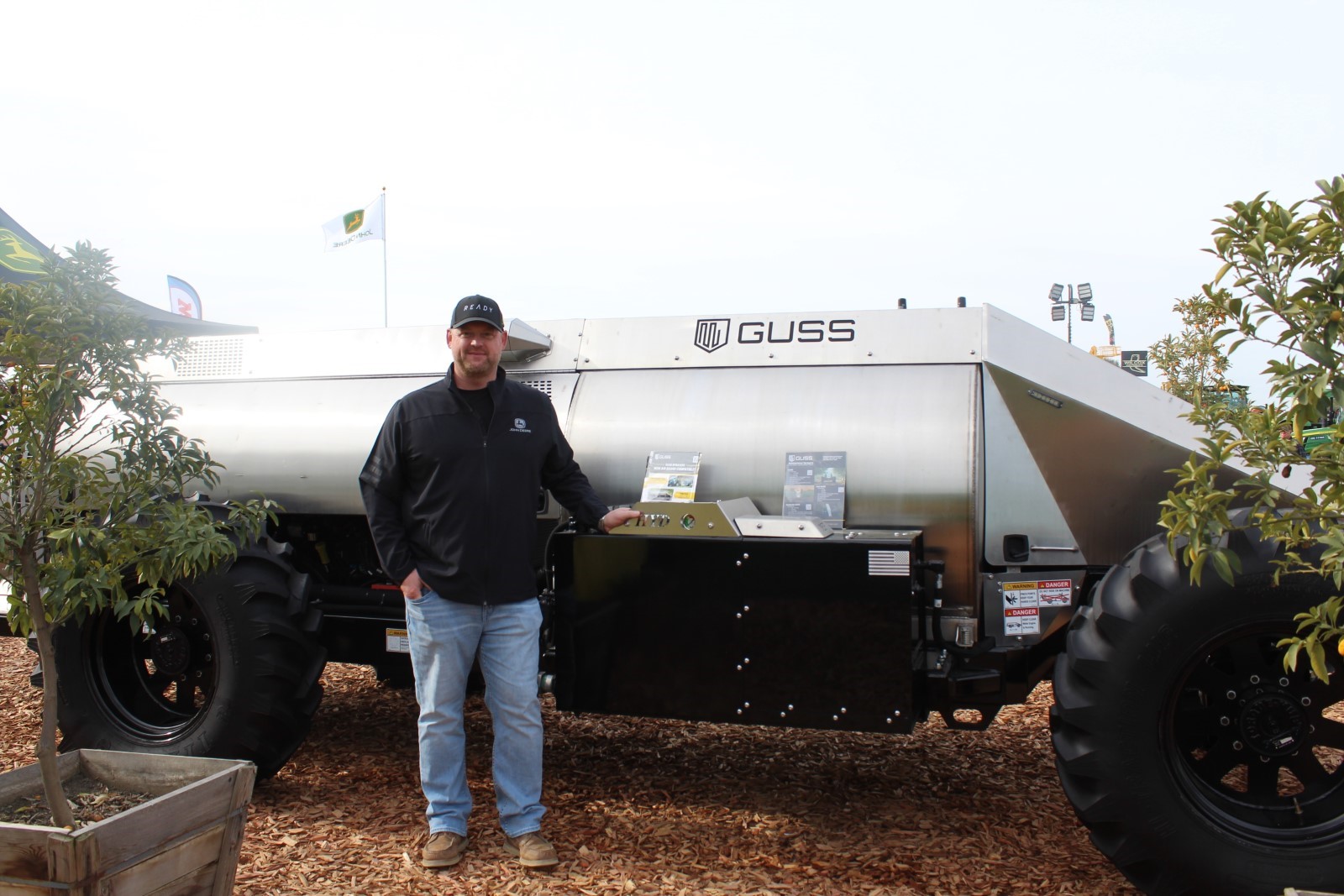
At the Ag Expo, John Deere showcased two pathways to autonomy. The first involves the company’s joint venture with GUSS Automation — GUSS stands for Global Unmanned Spray System.
According to Christensen, GUSS Sprayers have sprayed over 2 million acres autonomously over half a million hours of runtime.
“So, why are farmers asking for autonomy? It’s a challenge to get skilled labor,” Christensen said. “We have multiple solutions through GUSS whether that’s for orchards, the mini one is for vineyards, and then we have a herbicide GUSS as well for orchard floor hygiene. So, if a customer wants to get into autonomy today, this is the solution or that path they can take to autonomy.”
The second pathway includes broadening the accessibility of autonomy to more customers with tractors they may already have in their operation. A “Precision Essentials Kit” allows smaller agricultural operations to access a precision farming technology stack at a lower upfront cost. The kit includes a G5 display, SF 7,500 receiver, and JDLink modem which can be used with a yearly subscription to various levels of precision farming tools and capabilities.
According to Christensen, this technology provides fleet management, machine health monitoring, and agronomic data tracking to improve efficiency and productivity. John Deere is also developing autonomous capabilities that can be retrofitted to existing tractors, enabling fully autonomous operation in orchards and vineyards, leveraging lidar, radar, and cameras to navigate and detect obstacles without the need for a human operator.
“The majority of our food comes from California…so being able to use our technology with growers out here is critical for us and good for the farmers too, to be able to save time, save money, save input, and do it more efficiently,” Christensen said. “Because the challenges they have are so great — labor, skill level, availability. We can help bring some automation and autonomy to help keep agriculture in California.”