By Scott Hamilton, President, Hamilton Resource Economics
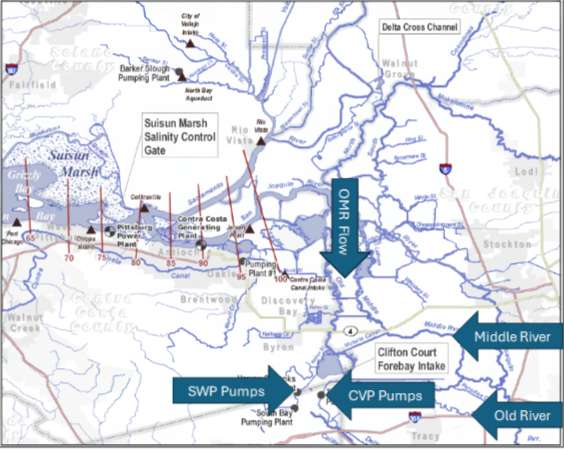
On January 30, 2025, total Delta inflow was estimated to be a little under 20,000 cubic feet per second (cfs). The Delta was still in “excess” meaning minimum flow requirements and water quality standards were being met and there was surplus water in the system. Flow to the ocean was around 13,000 cfs, considerably above the 4,500 cfs minimum outflow required by the State Water Resources Control Board. However, the San Joaquin River was flowing at around 1,150 cfs. That was a problem for Delta exporters because the net flow toward the pumps in Old and Middle Rivers (OMR flow) is not allowed to exceed 5,000 cfs — to help reduce the loss of endangered fish at water project pumps. Some of the San Joaquin River flow makes its way north along Old River and Middle River and increases the amount of water that can be pumped. On January 30, the total water being exported was 5,900 cfs. That is, 900 cfs of the 1,150 cfs of San Joaquin River flow was making its way to the pumps. But storms were on the way.
Over the next 40 days, over 8-million-acre-feet would flow into the Delta. Unfortunately for the San Joaquin Valley, most of the water from those storms fell in northern California. While the Sacramento River would swell to 10 times its size during this period, the San Joaquin River struggled to double its flow. Still, that little bump in San Joaquin River outflows did help and exports increased, reaching a maximum of 7,200 cfs for a period of 4 days — an increase of 22% over exports on January 30.
During the proverbial 40 days and 40 nights, the water projects in the South Delta diverted around 365,000 af — around 4.5% of the Delta inflow. More than 7.5-million-acre-feet flowed out to the ocean. Had it not been for the regulatory restriction on Old and Middle Rivers, the exports could have increased by 500,000 af under their permitted capacity. The average annual groundwater deficit in the San Joaquin Valley is estimated to be around 2-million-acre-feet. An extra 500,000 af in 40 days would have provided some relief to groundwater agencies challenged to make their groundwater basins sustainable.
The operators of the State Water Project and Central Valley Project — the California Department of Water Resources and the U.S. Bureau of Reclamation respectively, continually struggle to balance the needs of endangered fish with contractual obligations to deliver water. They operate under a tight and complex set of regulations. Some environmentalists advocate for more outflow. Water users advocate for more diversions. If there is to be a different balance, it will be contentious. Given what is at stake, ideally the balance will be based on science and not emotion.
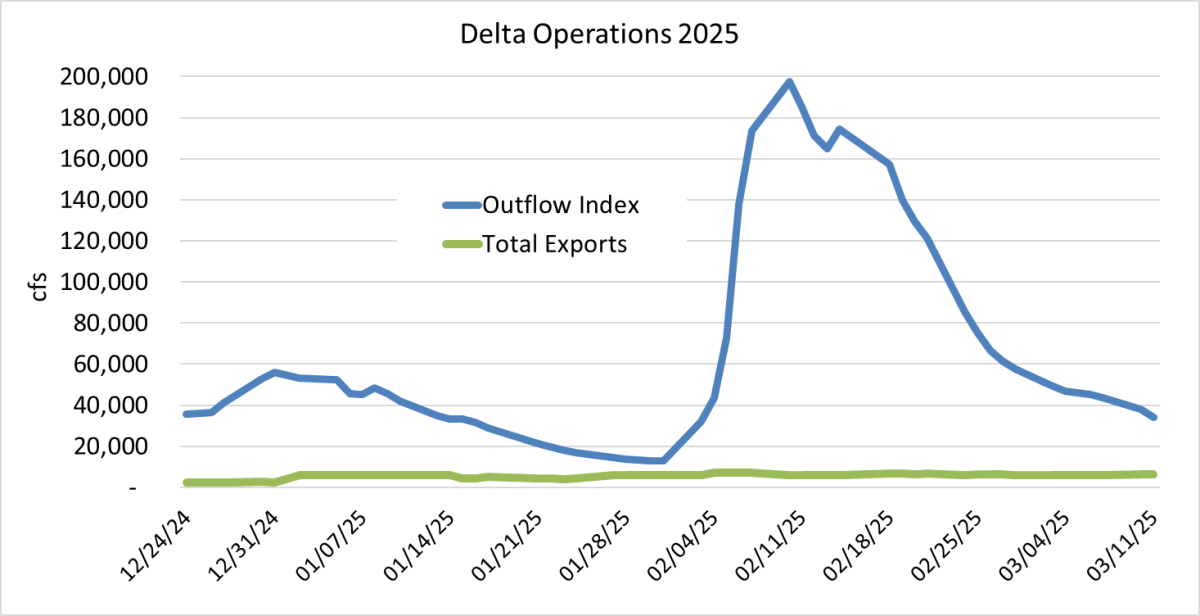
Delta Operations in 2025. Since January 30, more than 7.5-million-acre-feet of water has flowed to the Pacific Ocean.