By Julie Finzel, Livestock and Range Advisor, UC Cooperative Extension, Kern, Tulare, and Kings Counties
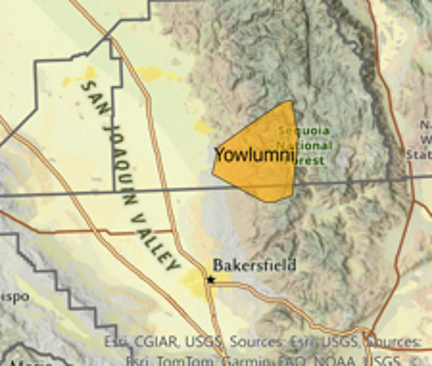
In December 2011, a collared wolf from Oregon, OR7, crossed into California becoming the first confirmed wolf in California since 1924. The Yowlumni Pack in southeast Tulare County and northeast Kern County was confirmed by the California Department of Fish and Wildlife in July 2023.
This pack’s area, as defined by CDFW, includes the Tule River Reservation, California Hot Springs, and areas of northeast Kern County near Glennville.
Since the confirmation of the Yowlumni pack in 2023, CDFW has confirmed three wolf depredations and three probable depredations on cattle with a total of 20 investigations. At its peak, the Yowlumni pack numbered 16. However, there is a known issue with mange in the pack, and the current pack population is uncertain. According to the latest quarterly report from CDFW, there have been no detections of individuals from the Yowlumni pack since the beginning of 2026. One collared female (CA-091), dispersed from the Beyem Seyo pack remains in the area. If anyone has any information regarding wolves in the area, please visit the CDFW Gray Wolf Webpage and use their sighting reporting tool, available here: https://wildlife.ca.gov/Conservation/Mammals/Gray-Wolf/Sighting-Report
Currently there are 12 confirmed wolf packs in California. Wolves in California are protected by the California State Endangered Species Act and the federal Endangered Species Act. As a result, it is not legal to harm, harass, or kill wolves in California. These restrictions leave ranchers with few options to protect their cattle; however, some non-lethal tools are available and may be effective under the right circumstances.
In some cases, ranchers might use night penning of cattle during especially vulnerable times such as calving. Guard dogs, motion sensor lights, and loud noises can help deter wolves from night pens. Turbo-fladry, or electrified flagging, is also an option; effective use is limited to about three months at a time. Some ranchers report that keeping a few Corriente cattle in the herd can help deter wolves. Wildlife cameras are useful for detecting and confirming wolf presence in the case of a possible depredation. Wildlife cams have also captured evidence of wolves pursuing cattle, in some cases causing cattle to travel long distances in a short period of time. This behavior is generally uncharacteristic of cattle.
A recently published study by UC Davis researchers Dr. Tina Saitone and the late Dr. Kenneth Tate tracked the summer dietary habits of two packs in northeastern California (Lassen pack – 2022 and 2023; Harvey pack – 2023). They found that cattle accounted for about 55% of the wolves’ diet while mule deer and small mammals accounted for about 27% combined (Saitone TL, Tate KW, Sacks BJ (2026) Gray Wolf Diet Composition in California’s Human-Dominated Landscape. PLoS One 21(7): e0351768).
CDFW tracked the summer diet of the Lassen Pack from 2017-2019 and found that cattle accounted for about 59% of the wolves’ diets (Dellinger JA, Laudon K, and Figura P (2021) Summer diet of California’s recolonizing gray wolves. California Fish and Wildlife 107(3):140-146).
The California Wolf Project out of UC Berkeley reported that wolf diets are expected to be highly seasonal with cattle representing a majority of the summer diet and native ungulates more common in the winter diet (California Wolf Project 2025 annual report).
The economic impact of the Beyem-Seyo pack (removed fall 2025) was analyzed by Dr. Tina Saitone and Tracy Schohr (Saitone, Tina L. and Tracy K. Schohr. 2025. “The Beyem Seyo Wolf Pack: Economic Toll of Unprecedented Livestock Conflict in California.” ARE Update 29(2): 1–5. University of California, Giannini Foundation of Agricultural Economics). The Beyem-Seyo pack became habituated to feeding on cattle, a trait that is taught to offspring, and was responsible for 110 confirmed or probable depredations between March and September of 2025. Their report estimates total losses of cows, calves, and yearlings at just over $230,000.
Saitone and Schohr’s report shared commonly used multipliers for estimating wolf depredation. For example, a conservative number using Washington state’s multiplier (2:1), estimates that confirmed depredations should be multiplied by two to represent actual losses on the ground since some animals are never found, or animal remains have been disturbed by scavengers and confirmation of wolf depredation is no longer possible. Multipliers from other states include Wyoming at 7:1 and Oregon at 3:1. In 2025, CDFW reported a total of 198 confirmed or probable livestock depredations in California (including the numbers from the Beyem-Seyo pack).
The State of California maintains a livestock compensation program to help offset the cost of livestock depredations for ranchers. Funding amounts vary from year to year, but the state continues to support the program. Administered by CDFW, ranchers can apply for compensation for direct losses due to depredation events. While the livestock compensation program previously supported compensation for indirect losses due to stressed livestock and compensation for the use of non-lethal deterrents, the state is currently focused on direct loss compensation.
For more information on wolves in the southern San Joaquin Valley and California contact the California Department of Fish and Wildlife or visit: