By Julie Finzel, UC Cooperative Extension Farm Advisor Kern, Tulare and Kings Counties; Dr. Gabriele Maier, Extension Veterinarian for Beef Cattle Herd Health & Production, UC Davis; Dr. Roselle Busch, Extension Veterinarian for Small Ruminants, UC Davis; and Alec Gerry, Professor of Entomology and Extension Specialist, UC Riverside
On June 3, the first confirmed case of New World Screwworm (NWS), found in Zavala County, TX, hit the news. Since that time, there have been additional confirmed cases of NWS across multiple counties in Texas and New Mexico. The majority of cases have been reported in cattle, followed by sheep, goats, and dogs.
The New World Screwworm (Cochliomyia hominivorax) is a flesh-eating fly larva (maggot) that infests open wounds or body cavities in warm-blooded animals, feeding on live tissue and enlarging the wound. Affected animals can include livestock pets, wildlife, and occasionally poultry or humans.
NWS was eradicated from the United States in the 1960s through the successful release of sterile male flies. Female NWS flies only mate once in their lifetime, so a mating with a sterile male will result in no offspring. The eradication of New World Screwworm from the United States has been an exceptionally successful federal program resulting in an estimated $2.8 billion in annual economic benefits to the USA. Currently the U.S. maintains a sterile fly breeding facility in Panama and recently an additional sterile fly facility opened in Mexico. A third facility is expected to open in Texas in 2027.
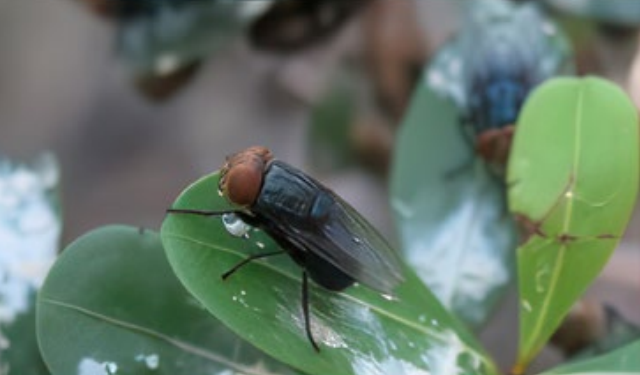
Adult screwworm flies are about the size of a common housefly or slightly larger. They have orange eyes, a metallic blue or green body, and three dark stripes along their upper back. However, adult screwworm flies are not easily identified by untrained personnel. Ongoing surveillance in California and elsewhere through trapping aims to detect the presence of the fly in an area. The adult fly spends the majority of time in brush or away from animals, feeds briefly on wounds and quickly lays hundreds of eggs within minutes. Thus, it is not uncommon to identify larvae in wounds without ever encountering the female fly in the area.
If you own pets or livestock, please watch closely for signs of NWS. Larvae are often deposited in the navel of newborn livestock, wounds created by dehorning, ear tagging, castrating, or tail-docking, any other open sores, or body openings (mouth, nose, anus, vulva, or the prepuce of males). Affected animals may separate from the herd, appear very irritated and display head shaking. Maggots may be seen in the wounds and there is often the smell of decay. If left untreated, infestations (myiasis) can be fatal to animals within 7 days. It is recommended that livestock be monitored for signs of NWS at least twice a week. Report any suspected NWS to your veterinarian, your local branch of the California Department of Food and Agriculture, or the USDA Animal Plant and Health Inspection Service (APHIS)(see below for phone numbers). You may also sign up to receive SMS text alerts and stay up to date on the situation in California at https://www.cdfa.ca.gov/ahfss/Animal_Health/screwworm/.
It is of utmost importance to report signs of NWS right away, before a population can become established in your area. Early detection and response are key to successfully controlling the spread of NWS and reducing the impact to pets, livestock, and wildlife. A confirmed case will trigger the inspection of all animals on the premises by professionals so that additional cases are caught early. The first detected case in Texas, a calf with an affected umbilicus, has recovered thanks to prompt action by the astute producer. In addition, sterile fly release in the area surrounding new detections, triggered by the reporting of a case, may limit the spread of the pest. Without reporting, these opportunities for control will be wasted.
In order to prevent NWS infestations, work with your veterinarian on a specific prevention plan for your operation. Some of the commonly recommended prevention measures are to postpone or avoid animal handling procedures during heavy fly season that may create wounds, such as castration, ear tagging, or branding. Disinfect equipment such as taggers between animals to reduce infections and promote fast healing. Treat all wounds, including newborn navels, with an appropriate fly control product. Treat pinkeye cases and cover with an eye patch until healed. Even a wound as small as a tick bite can be a target for NWS. Careful vigilance and attention to detail will help protect your animals. Premise sprays to reduce fly populations can be effective against NWS under some circumstances. A list of insecticides approved for use against screwworm in California can be viewed using the QR code below. Due to concerns about potential resistance to fly control products, careful, judicious use of fly control products is recommended.

Insecticides approved for use against screwworm can be viewed using the QR code to the left. Check product labels for use restrictions including animal species that may be treated and milk/slaughter withdrawal periods.
Report suspected cases of NWS infestations in animals to your CDFA branch or USDA/APHIS
| Animal Health and Food Safety Services Animal Health Branch | |
| Headquarters | (916) 900-5002 |
| Redding District | (530) 225-2140 |
| Modesto District | (209) 491-9350 |
| Tulare District | (559) 685-3500 |
| Ontario District | (909) 947-5932 |
| USDA APHIS Veterinary Services | (916) 854-3950 or (877) 741-3690 |