First use of cyproconazole for green mold and sour rot in citrus.
Natalie Willis, Reporter, Valley Ag Voice
A serving of mashed potatoes at dinner is always a welcome treat, but fruit that resembles the creamy side dish is best avoided. Two of the most pervasive diseases in citrus cultivation are sour rot and green mold, which wreak havoc on fruit quality and profitability during post-harvest processes.
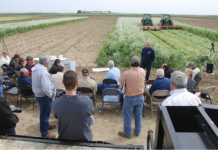
At the 41st Citrus Post-Harvest Pest Control Conference, Ph.D. candidate Albert Nguyen, who specializes in plant pathology, explained that the decay in a citrus plant caused by sour rot can quickly spread to surrounding fruit.
“This pathogen creates a lot of pectic enzymes that break down the fruit’s structure, and over time, as the decay develops, the fruit becomes macerated, sort of like mashed potatoes,” Nguyen said.
Common packing house treatments for sour rot and green mold include Imazalil and Propiconazole. These fungicides, along with potassium sorbate and sodium bicarbonate, are globally accepted for post-harvest treatment.
However, according to Nguyen’s research, resistance against these fungicides registered for decay control is growing in commercial packinghouses, marking a need for new post-harvest technologies. Under Principal Investigator Jim Adaskaveg at the University of California, Riverside, Nguyen introduced a new post-harvest fungicide that can be used in mixtures or rotations with other DMI fungicides.
Cyproconazole is an agricultural fungicide used primarily on cereal crops in the Midwest for pre-harvest care. Experimental trials headed by Nguyen and a team at UC Riverside showed efficacy in the management of green mold and sour rot in citrus. The research is funded by the Citrus Research Board of California, Syngenta Crop Protection, Decco US Post-Harvest, and packinghouses within Ventura.
Despite the innovative usage of the chemical for post-harvest treatment, the regulatory process through the EPA and IR-4 program is lengthy.
“This is the first [post-harvest] use to the best of our knowledge because cyproconazole is used elsewhere but mostly on staple crops in the Midwest,” Nguyen said. “But, for post-harvest, it’s very hard to get new active ingredients registered, and the market is very small.”
Nguyen achieved up to 99% decay control for green mold with cyproconazole treatments. However, he explained that experimental results and proof of concept do not perfectly align with real-life agricultural operations.
“My work is to show, first of all, that the chemical can control the disease and, second, how you might be able to use it in your real-life setting,” Nguyen said. “With the combination testing that I’ve tried, cyproconazole is able to be used with all of the equipment that you normally have.”
Despite a positive outlook in experimental efficacy, registering cyproconazole as a post-harvest fungicide may take longer than the anticipated domestic registration in 2025 and subsequent export market registration in 2026.
At the conference, Heidi Irrig, Senior Regulatory Manager at Syngenta, remarked on the proposed timeline for the registration of cyproconazole in the export market, explaining that domestic registration within the U.S. is significantly different from obtaining import tolerances. However, both registration processes require considerable persistence.
The USDA administers California’s Interregional Research Project No. 4 program to support pesticide registrations for specialty crops. Most of California’s agricultural production includes specialty crops with low acreage and high value. As a result, pesticide manufacturers register their products to high-acreage crops, according to the California Department for Food and Agriculture.
Nguyen’s research is funded through the IR-4 program, which will measure cyproconazole usage by the amount of residue on the fruit or peel. Because the post-harvest market is minimal, industry leaders prefer the IR-4 program to register new chemicals rather than investing a personal stake in the regulatory process.
“It’s all regulatory, mostly in export markets…because once registration happens here in the States, then you have to start the process abroad,” Nguyen said. “Because if they detect residue, then they reject a lot of fruit because it’s above the limit.”
The urgency for establishing a new post-harvest fungicide for citrus stems from California’s Proposition 65, which requires the state to publish a list of chemicals known to cause cancer. Recently, the list was updated to include Imazalil, which is widely used in the post-harvest treatment of citrus.
According to Nguyen, Imazalil will go under review in the next two years, and if it is canceled, cyproconazole is hopeful to replace it.
“The EPA has classified cyproconazole as not likely to be carcinogenic to humans. So, this is our justification for introducing cyproconazole to the citrus industry,” Nguyen said.