By Natalie Willis, Reporter, Valley Ag Voice
St. Francis Parish School is adding an AG to STEM program to its curriculum, providing hands-on learning opportunities for students to learn about agriculture, animal science, and the role the agricultural industry plays in the Central Valley.
According to St. Francis Principal Kelli Gruszka, the idea of connecting students to agricultural education has been discussed over the years, but the opportunity officially presented itself with the school foundation’s purchase of an adjacent piece of property. The property is about one-third of an acre, and according to Gruszka, there is another adjacent piece of property that the school may acquire in the future.
St. Francis plans to build a livestock corral on the property to connect students with agriculture education opportunities, specifically through the care of livestock.
“We live in a very ag-centric community. A good chunk of our students come from some level of farming, even if their immediate parents are in the workforce in a different way…there’s just so much agriculture here right in the community,” Gruszka said. “I think it’s an important thing for the children to learn about. To learn about all levels of agriculture, because it’s not just the growing of plants and raising of animals. We do feed the world; that’s the motto of the Central Valley.”
Juliana Antongiovanni — who has been involved with St. Francis as a parent, physical education teacher, and is now helping steer the ag program — explained that they are currently in the research and development phase, but they are actively building out the curriculum.
“We got a hold of this property thanks to our foundation,” Antongiovanni said. “Now, we’re just slowly building ideas from the ground up, and now we get to start, hopefully soon, seeing things develop.”
St. Francis offers education from preschool through eighth grade, with the AG to STEM program planned as an elective course for junior high students.
Gruszka explained that St. Francis serves as a feeder school to Garces Memorial High School, which has developed a robust Future Farmers of America program. She envisions the St. Francis corral and its hands-on learning opportunities as a pathway to future FFA participation.
“We like to do whatever we can here to help our children be as well prepared as possible to jump in and get involved in whatever suits them when they get to high school. Having more of a direct AG-STEM program here where the kids have that level of introduction in advance of getting to high school, like anything else, it will open more opportunities for them when they get there,” Gruszka said. “They’ll have the background already, they’ll have the exposure, and it won’t be such a fresh start. We always say we like to educate the whole child, and this is just a unique thing to throw into that balance.”
LOOKING AHEAD
The school hosted its first “Holy Cow” fundraiser on September 19 to support the development of the corral. Gruszka explained that as a small, privately funded school, the cost of the program falls outside of its budget.
A generous anonymous sponsor donated $100,000 toward the AG to STEM program, according to Gruszka, allowing the school to move forward with the project in earnest. Along with support gathered from the fundraiser, students are getting creative with their own efforts to support the project.
According to Antongiovanni, one idea to raise funds involves her family’s pumpkin farming operation where students can create succulent pumpkins, establish a marketing strategy and website, and begin selling their projects in November.
Gruszka explained that they are also seeking in-kind donations from families and the local community to perform vital work such as tilling the ground.
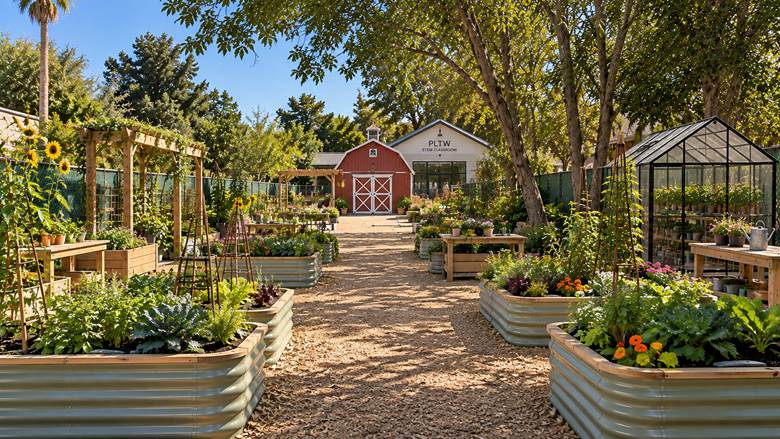
At full build-out, Gruszka envisions the property to be equipped with a greenhouse, planter boxes, a permanent classroom structure, and an area to care for livestock and learn animal science.
“Our long-term goal would be to have a physical structure on the property,” Gruszka said. “We will be starting with the simple. I mean, our hope is, before the end of this school year, that we see a greenhouse and planter boxes in place.”
According to Gruszka, the total estimated cost of the project, including the interior property, interior structure, and various other components, will be about $1.35 million.
She explained that some of the funds raised during the school’s annual Crabfest fundraiser in February will also go toward the ag program. Beyond the financial aspect of getting the AG to STEM program established, Gruszka explained that it will help set St. Francis apart while providing irreplaceable hands-on education for students.
“We’re seeing kids now saying, ‘Why should I learn anything?’ Because everything is online. You can find out anything you need to know just by typing it into Google. But with our kids having their hands in the dirt, building things, constructing things, seeing the value of putting things together and what that looks like, and what it takes — not only financially, but physically and mentally,” Gruszka said. “You can’t send a flower bed to a computer and ask it to make it for you. To build it for you….I think this is going to be a really great opportunity for kids to actually put their education to work for them, and to see the fruits of their labor, and to have a better level of respect for the farming industry.”
According to Gruszka, St. Francis is calling for collaboration from the agriculture community to help inform the program as it moves forward.
“If there’s anyone out there that has thoughts on what they wish kids were learning these days, what they feel is lacking,” Gruszka said. “[For] students that are coming out of ag education, is there something that’s still missing? Is there something that we can hit on at this early age to help drive and improve on the education kids are going to be receiving in the future?”
To learn more about the project and ways to support, reach out directly to St. Francis Parish School at (661) 327-4734.