
By Natalie Willis, Reporter, Valley Ag Voice
As industry and real-world workforce demands evolve over time, higher education institutions are increasingly prioritizing workforce development and aligning programs with current market needs, according to a 2026 Policy Issues Survey by the State Higher Education Executive Officers Association.
The survey found that 97% of higher education leaders across 40 states identified economic and workforce development as important or very important.
According to a March 4, 2026, Purdue Agribusiness Review article through Purdue University’s Center for Food and Agricultural Business department, between 2025 and 2030, the food, agriculture, renewable natural resources and environment sector will face structural workforce tension where strong employment demand is paired with an insufficient supply of graduates from colleges of agriculture prepared to fill available positions.
“The central challenge is not a lack of employment opportunities,” the Purdue Agribusiness Review article, “Human talent in the food and agriculture industries 2025-2030” stated. “Rather, the issue is a mismatch between the volume and composition of available jobs and the pipeline of talent emerging from agricultural colleges.”
The Purdue University analysis found that the gap between the available jobs within the food, agriculture, renewable natural resources and environment sector, or FARNRE, and FARNRE graduates means that over half of the talent entering the food and agricultural industries over the next five years will not hold a food and agriculture degree.
“For industry leaders, this is the defining workforce issue for the next five years: not whether jobs will exist, but whether the right talent will be available in sufficient quantity and with the right mix of industry-specific, technical, managerial and digital skills,” the article stated.
In Kern County — one of the top three agricultural-producing counties in the United States — Bakersfield College and California State University, Bakersfield are consistently workshopping and expanding programs to meet modern industry needs and adapt to the changing agricultural workforce environment.
According to Vice President of Instruction at Bakersfield College, Dr. Jessica Wojtysiak, agriculture is more than an educational discipline — it’s a way of life.
“It’s a way of life, and a recognition of the broader impact of the industry really means that, if you grew up in Kern County, then you should have a background, a working knowledge of agriculture, how your food is produced, because so much of it is produced locally. I think that was a conscious shift for us,” Wojtysiak said. “It wasn’t just ‘Let’s prepare people for careers in agriculture,’ but it became ‘Let’s prepare people to be informed consumers of agriculture, to be knowledgeable about the industry, to in some ways work against the negative stereotypes of the industry.’”
The agricultural department at BC was founded in 1915, making it one of the first community college agricultural programs in the nation. Students can choose from seven disciplines, including agriculture science, forestry, and natural resources, plant science, agriculture business, ornamental horticulture, mechanized agriculture, and food science and technology.
According to Heather Baltis, faculty chair of agriculture at BC, the college meets with an agricultural advisory committee twice a year to gain direct insight from industry leaders on their workforce needs. This collaboration ensures that BC’s programs remain relevant and well-equipped to bridge the gap between academics and career readiness.
“The input that industry gives us in the curriculum development, how we bring those ideas through the classroom and teaching models that helps us stay connected with industry and making sure that our students are prepared for industry,” Baltis said. “Just having that strong connection to be able to make sure we’re doing what industry is expecting.”
Wojtysiak noted that BC also offers early pathway opportunities to students at local high schools to generate prospective student interest in agricultural education and pave the way for a pipeline of local talent.
“BC agriculture has been a leader for over a decade in our early college program. Our faculty, they go out and teach at local high schools, whether it’s Wonderful or Wasco or Lost Hills,” Wojtysiak said. “They’re showing high school students at a young age, while they’re still participating in [Future Farmers of America] and interested in supporting their families, that there are real career options that are available to them.”
Wojtysiak and Baltis explained that BC is plugged into emerging industry trends such as industrial automation and precision agriculture techniques. Specifically, the college offers a Bachelor of Science degree in industrial automation, focusing on the use of computer technology, electronics, and control systems in industrial environments.
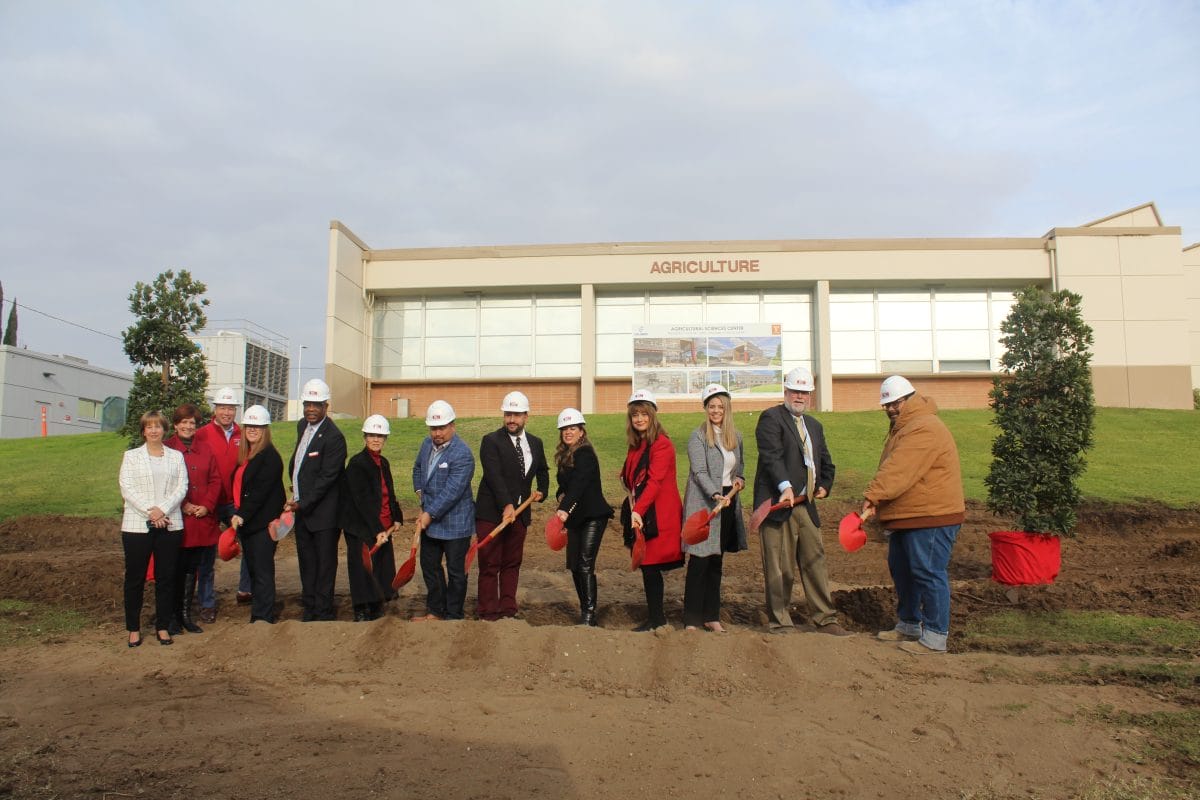
BC has made additional investments to support modern industry trends and technological advancement through a new Agricultural Sciences Building. The college broke ground on the building in 2023.
“We’re getting a new agriculture building and state-of-the-art technology so that we can make sure that we are at the same level as industry,” Baltis said. “That’s been really exciting to kind of see come into fruition. So, we’ll be in our new building soon.”
According to the project description, the facility will house a single-story general agriculture building, greenhouses, a horticulture shop, and a mechanized agriculture show.
Along with a general interest among industry leaders and students to learn and work with new technologies, Wojtysiak explained that industry partners have been increasingly asking for students with “soft skills” such as effective communication, work ethic, and management and leadership skills.
Several courses also incorporate topics shaping the industry — such as water and resource management under the Sustainable Groundwater Management Act — to prepare students for the modern realities of working within the ag industry.
AGRONOMY – COMING SOON, TO A COLLEGE NEAR YOU
Perhaps one of the most exciting, and recent, developments for BC is a partnership with CSUB on a degree in agronomy.
According to Dr. Aaron Hegde, a professor of economics at CSU Bakersfield and Executive Director at Grimm Family Center for Agricultural Business, CSUB is developing its first-ever applied agricultural science program outside of its traditional ag business offerings.
Currently, CSUB offers a Bachelor of Science in Agricultural Business, designed to prepare students for management roles in the food and fiber sectors. Known as a “2+2” program, it combines core upper division undergraduate courses in agricultural business at CSUB with lower division agricultural science and agricultural business foundation courses that can be completed at a community college like Bakersfield College.
Now, CSUB is creating a similar program for agronomy.
“CSUB was recently approved for that bachelor’s degree, and so we would work with them as our partner to build that path. So, they spend their first two years with us, and then they do a transfer agreement and head over to CSUB for their last two years,” Wojtysiak said. “I’m really excited about that program because it keeps our students here, and it keeps the degree building here, and so it’s really exciting.”
According to Hegde, the new degree will be CSUB’s first hands-in-the-dirt agricultural program. While currently in escrow, CSUB has confirmed intent to utilize the historic Shafter Cotton Research Facility which is a 20-acre campus with 23 buildings and 60 acres of experimental plot land.
Hegde explained that the university will potentially take possession of the facility at close of escrow in October. Because the Shafter Cotton Research Station is an older facility with maintenance and upgrade needs, the university anticipates launching the agronomy degree in the Fall of 2027 or at the latest, the Spring of 2028.
“We’ll have a couple hundred students doing research with faculty, and we’ll also be doing collaborative research with industry,” Hegde said. “So, we’ll be leasing out some space to industry partners, and then they’ll work with students as appropriate and collaborate with them on these things.”





