
By Natalie Willis, Reporter, Valley Ag Voice
In the famous story, “Three Little Pigs,” each pig proved they could build a structure whether it was made from straw, or sticks, or bricks. Once the structures were in place, it became an afterthought for the pigs with straw and stick houses, as no storm had swept away their work. But the smartest pig with his house made of bricks understood that the strength of his house could only be understood when the wolf arrived.
California’s water management landscape now finds itself at a crossroads, but it faces more than one wolf. Instead, hundreds of locally built plans must withstand economic pressure, competing water demands, and the scrutiny of a law that still has over a decade before its final deadline.
SHE’S A BRICK….HOUSE
The Sustainable Groundwater Management Act of 2014 led to the creation of over 260 groundwater sustainability agencies in 140 basins by the initial planning milestone of June 30, 2017. These GSAs are tasked with creating and implementing Groundwater Sustainability Plans to manage groundwater overdraft and achieve SGMA’s sustainability goals by 2040.
As of December 2024, there are a total of 257 GSAs across 142 basins, established by a single local agency or a combination of local agencies, according to the Department of Water Resources’ official and most comprehensive report of groundwater monitoring, conditions, and management across California — “California’s Groundwater: Bulletin 118 — Update 2025.” The official DWR report was published in March 2026.
While establishing GSAs and developing GSPs marked a major milestone under SGMA, the implementation phase is where the strength of those plans will be tested.
In March 2023, six basins were deemed to have inadequate groundwater sustainability plans by DWR, prompting possible intervention by the State Water Resources Control Board. Since then, the Kern, Kaweah, Delta-Mendota, and Chowchilla Subbasins have returned to DWR jurisdiction following State Water Board probationary hearings, while the Tulare Lake and Tule Subbasins were designated as probationary.
Regardless of determination status, basins are required to submit annual reports to DWR following the adoption of a GSP or Alternative to track how the plans are working in real conditions. The latest reports cover Water Year 2025 — that is, from October 2024 to September 2025.
Annual reports for the prior water year have been submitted across California, but analyzing the Kern Subbasin’s report, specifically, offers a detailed look at how SGMA implementation is unfolding in one of the state’s most productive agricultural regions.
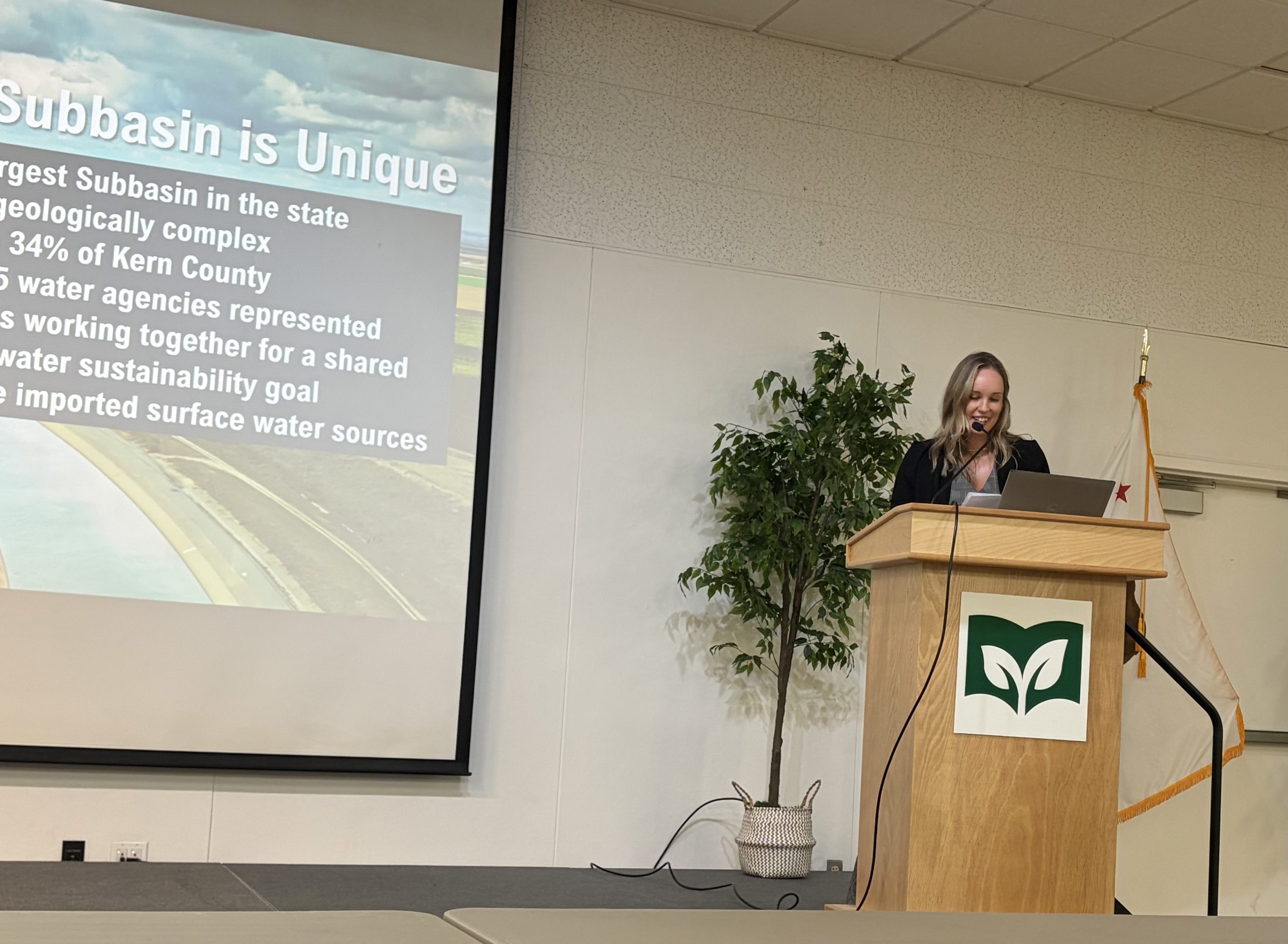
On June 30, the Water Association of Kern County hosted a public workshop to review the Kern Subbasin’s 394-page annual report. The Kern Subbasin is the largest subbasin in California, according to the annual report, covering 1.78-million acres, with 35 water agencies and 20 GSAs.
After extensive revisions to the GSP, the Kern Subbasin was cleared from the probationary process in September 2025 and sent back to the jurisdiction of DWR. In an email from the Kern Subbasin Groundwater Sustainability Agencies’ (Kern GSA) representatives, the subbasin continues to work closely with DWR as GSP implementation moves forward.
DWR is currently reviewing the Kern Subbasin’s 2025 Amended GSP.
During the WAKC workshop meeting, Kaitlin Palys, senior water resources scientist at INTERA Inc., outlined the projects and management actions occurring throughout the Kern Subbasin.
“These reports are important to the Department of Water Resources because they provide transparency, track trends over time, and help evaluate whether water management practices are working,” Palys said.
The 2025 water year’s hydrologic index was classified as “below normal,” with Kern River flows reaching about 80% of the long-term average. The Kern Subbasin received about 1.5 million acre-feet of surface water in 2025, which included 63% from imported supplies, 33% from local sources, and the remainder from recycled water and other sources.
The volume of groundwater extraction in the subbasin was compiled through directly measured extraction data collected by local water agencies as well as estimated extractions based on land use methods using the Integrated Water Flow Model Demand Calculator tool developed by DWR.
Under this methodology, groundwater supplied roughly 1.2 million-acre feet, or 45% of total water used in WY2025. The total water supply in the subbasin during WY2025 — including groundwater, surface water, recycled water, and reused water — was roughly 2.72 million-acre feet.
Groundwater pumping was concentrated in agricultural and major urban areas, reflecting reduced surface water supplies compared with the previous 2023 and 2024 water years which were identified within the hydrologic index as “wet” and “above normal,” respectively.
Palys explained that groundwater pumping in WY2025 remained well below the critically dry years of 2021–2022.
“In much of the Kern Subbasin where groundwater is used, there’s access to both of these sources [surface water and groundwater] through a practice known as conjunctive use, meaning that during wet years, surface water is used and excess supplies are either recharged, exchanged, or banked for future use,” Palys said. “During dry years, reliance shifts to groundwater pumping and recovery of the previously banked groundwater, which in the context of SGMA, most of the time, that’s still reflected as groundwater use.”
According to an email from Kern GSA representatives, the Kern Subbasin did not experience any undesirable results in the 2025 water year.
The 2025 Plan defines an undesirable result when any of the following occurs: groundwater levels exceed minimum thresholds at 25% or more of representative monitoring wells over a single year (based on two consecutive seasonal measurements); more than 15 drinking water wells are reported dry in a year; or a GSA cannot meet well mitigation needs under the 2025 Plan.
BUILDING SUSTAINABILITY
While the annual reports provide a snapshot of the subbasin’s conditions, Palys emphasized that long-term trends are an integral part of evaluating whether groundwater management is working. The first GSPs were active in January 2020, Palys explained, making that year a benchmark to evaluate whether the management structure built under SGMA is moving toward its intended design.
“Cumulative trends over time are more useful,” Palys said. “An annual comparison is just comparing to the prior year. If you had a really good year the year before, your next year could look like it’s trending downward. That doesn’t mean the whole story is trending downward.”
The subbasin’s “sustainability goal” is to implement the 2025 Plan to achieve sustainable groundwater management within the SGMA 20-year implementation period. A key component to accomplishing that goal are the Projects and Management Actions (P/MAs) included in the 2025 Plan.
The P/MAs are cumulatively proposed to achieve the subbasin’s sustainability goal. There are 182 P/MAs the GSAs developed for inclusion in the 2025 Plan, and an additional 56 P/MAs could be implemented if necessary to achieve the sustainability goal.
These P/MAs aim to address existing or potential future overdraft conditions that could result in the chronic lowering of groundwater levels, reduction of groundwater storage, degradation of water quality, land subsidence, and interconnected surface water depletions.
Meeting SGMA requirements does not include a one-size-fits-all solution across the 20 distinct GSAs. As such, there is a diversity of project and management actions across the subbasin aimed at achieving the sustainability goal.
“One question we often get in the Kern Subbasin is, ‘So, what’s the groundwater pumping rule?’ And that’s a fair question,” Palys said. “The problem is it is so large and so complex. One size doesn’t fit all. So, that’s why we have these individualized agencies to manage the localized conditions, both hydrogeologically and also with the jurisdictional complexity.”
The types of P/MAs are divided into two categories — demand reduction with the benefits of reducing water use and water supply augmentation with the benefits of increasing the available water supply. Demand reduction P/MAs, specifically those that use permanent land or water use changes, are the primary means of reducing water use over time, the report explained. Water augmentation P/MAs rely on the acquisition of supplemental water supplies which are more variable from year to year.
According to the report, the cumulative benefits from the 2020 water year to the 2025 water year indicate that the Kern Subbasin GSAs are actively implementing their P/MAs.
“What we’re seeing, simply, is that the Kern Subbasin is actively implementing the Projects and Management Actions listed in the 2025 GSP, and that the subbasin is aligned with that roadmap towards sustainability,” Palys said.
In Water Year 2025, these management actions reduced water demand by about 133,757 acre-feet, according to the report. This demand reduction came, in part, from temporary measures such as drought-related land fallowing programs from water years 2020 to 2022.
Permanent demand reductions, such as land retirement and land-use conversions, continued to grow, reaching 12,523 acres of converted or retired land in Water Year 2025, with 11,540 acres retired and 983 acres converted from agriculture to urban use.
Land retirement is defined as a permanent change from irrigated to non-irrigated, and Ag to Urban conversion is defined as the conversion of land from irrigated land to urban.
In terms of land fallowing, Kern GSA representatives explained that while groundwater allocations can inform annual and long-term cropping decisions, fallowing is influenced by various factors such as surface water supply, crop markets, crop rotations, recharge activities, changes in cost-of-operations unrelated to water management, and other regulatory programs.
“The GSAs are not providing a Subbasin-wide forecast of acres expected to leave active production next year because outcomes will depend on water-year conditions, surface-water availability, local programs, crop economics, and landowner decisions,” Kern GSA representatives stated.
According to the report, the subbasin also added water supplies through recharge, banking, and other projects. In WY2025, those projects provided about 162,742 acre-feet of additional water supply. However, the amount of added supply varies depending on weather conditions. During the wet years of 2023 and 2024, greater surface water availability allowed GSAs to recharge more groundwater and improve conditions in the Kern Subbasin.
Progress reports from each GSA and their subsequent P/MAs are located in Appendix F of the 2025 annual report.
BLUE TAPE WALKTHROUGH
While land subsidence — the sinking of the land surface — did not create an undesirable result for the Kern Subbasin in Water Year 2025, subsidence in neighboring areas can affect regional conveyance facilities, Kern GSA representatives explained in an email.
“Where there’s groundwater pumping underneath very specific geologic conditions where you have these very specific clays,” Palys said. “If there’s pumping that occurs below those clays, and it affects the pressurization of the clay, what can happen is the clay can compress and therefore the land surface sinks. So, when we think of the concerns related to land subsidence…what we’re really concerned about is impacts to infrastructure.”
According to Kern GSA representatives, subsidence is a critical issue because it can affect groundwater storage, domestic and agricultural wells, roads, canals, pipelines, and other infrastructure used to deliver water across the region.
The Kern, Tule, and Tulare Lake Subbasin share connected water infrastructure and regional water management challenges. As such, the significant subsidence or “vertical displacement” occurring in the Tulare Lake and Tule Subbasins depicted in Figure 25 of the Kern Subbasin’s annual report highlights the need for coordinated groundwater management across neighboring subbasins.
“The Kern Subbasin GSAs will continue coordinating with neighboring subbasins and the California Department of Water Resources to better understand and address this regional challenge,” Kern GSA representatives stated.
According to Kern GSA representatives, the Kern Subbasin’s annual report confirms that groundwater management will continue to become more active, data-driven, and locally specific.
“Growers can expect continued attention to pumping measurement, groundwater-level monitoring, recharge opportunities, well information, and GSA-specific projects and management actions,” Kern GSA representatives stated.
Groundwater remains a critical part of the regional water supply, especially in below-normal years, Kern GSA representatives explained. The next annual report for Water Year 2026 will likely highlight progress on new P/MAs included in the 2025 Plan.
“Because the amended plan was adopted near the end of Water Year 2025, many of its most significant updates began implementation during Water Year 2026,” Kern GSA representatives stated.
More information on upcoming public meetings and engagement opportunities can be found at www.KernGSP.com/stay-engaged/.
“For growers and other groundwater users, the practical message is that sustainable groundwater management will require continued participation,” Kern GSA representatives stated. “That includes supporting accurate monitoring, using available surface water and recharge opportunities when they occur, responding to local GSA requirements, and planning for a future in which groundwater pumping must be balanced with long-term aquifer conditions.”





