Residents and stakeholders urge the State Water Board to consider the revised 2024 Groundwater Sustainability Plan rather than relying on outdated assessments.
By Natalie Willis, Reporter, Valley Ag Voice
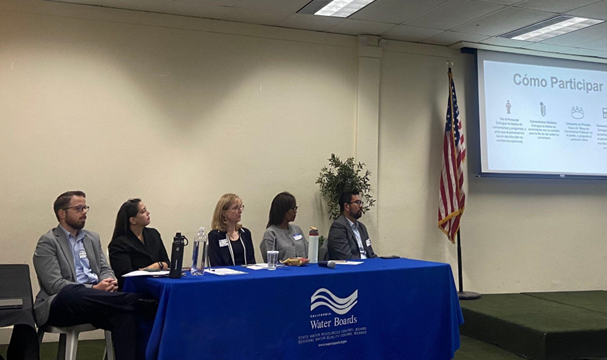
Despite receiving the submittal of a revised 2024 Groundwater Sustainability Plan for the Kern County Subbasin in May, the State Water Resources Control Board proceeded with a public workshop on the former 2022 plan on August 29.
The rationale for doing so, according to SWB staff, is that based on a preliminary review of the revised plan, deficiencies remain in the new plan that may further impact groundwater users in the basin.
“Any delay could further impact groundwater users in the basin if the basin is not guided back on track,” Jeevan Jayakody, senior engineering geologist with SWB’s Sustainable Groundwater Management Office said. “Because the deficiencies observed in new draft plans are similar to those identified in 2022 plans, the draft staff report is still relevant to getting the basin back on track.”
Jayakody explained that the final staff report on the proposed designation of the Kern County Subbasin as a probationary basin under SGMA will be updated based on comments received at the public workshops and throughout the written comment period which closes on Sept.23.
“Staff recommend probation because the 2022 and draft 2024 plans, as written, lack coordination and would allow substantial impacts to people who rely on wells for drinking water by causing wells to dry or become contaminated,” Jayakody said. “The plans would allow for substantial impacts to critical infrastructure due to land subsidence, or the sinking of land due to groundwater pumping, there will be significant impacts to groundwater quality and potential depletion of interconnected surface water. Also, these plans are unlikely to achieve sustainability as they would likely result in overdraft occurring beyond 2040.”
One of the primary concerns in SWB staff’s review of the obsolete 2022 plan centered on the lack of coordination across the Subbasin’s GSAs, specifically in terms of data and methodologies.
According to the Kern Subbasin GSAs and Technical Working Group, the revised 2024 GSP — which SWB staff has yet to thoroughly review — coordinated among the subbasin’s 20 GSAs to develop a comprehensive plan that addresses identified deficiencies.
For context, the Kern Subbasin is roughly 1.8 million acres making it the largest groundwater basin in California. According to Stephanie Hearn, senior water quality specialist at GEI Consulting and lead of the subbasin’s water quality subcommittee, 40 of the 71 basins with approved GSPs — many with multiple GSAs — could fit into the Kern Subbasin.
“By those standards, realistically, a minimum of 40 plus GSAs and GSPs could be managing the Basin, as opposed to the 20 GSAs who developed a single coordinated plan,” Hearn said. “All of the complexity notwithstanding, the 20 GSAs have come together to develop a 2024 plan that is highly coordinated and relies on standardized and best available data and methodologies to address the deficiencies.”
At the hearing, SWB staff explained that while significant improvements were seen in overall GSA inter-coordination in the 2024 plan, a new issue arose with the methodologies chosen, causing groundwater management challenges “outside of coordination.”
“Board staff at this time continue to recommend that the State Board place the basin on probation at the February hearing. Pending further improvements to the plans, we ask that the Kern County Subbasin agencies continue to work with us to address the issues as identified in the staff report,” Jayakody said.
REASONABLE AND PROTECTIVE
In the draft staff report released in July 2024, key deficiencies were identified as being “significant and unreasonable,” relating to GSA coordination, chronic lowering of groundwater levels, land subsidence, degradation of groundwater quality, and depletion of interconnected surface water.
However, according to the local GSA’s presentation, the 2024 plan for the Kern Subbasin represents a significant shift in approach from the 2022 GSP, addressing the identified deficiencies and introducing a highly coordinated strategy to achieve groundwater sustainability
Hearn explained that the GSAs acknowledged the deficiencies in the prior sustainability plan, and cited an initial fragmented approach wherein the 2022 plans were developed at the GSA level before aggregating into a Subbasin umbrella.
As such, the 2024 plan utilized a different approach, gathering approximately 20 technical experts to create a revised GSP, Hearn explained. Six subcommittees were formed, each with a specialized focus on the identified deficiencies. Subcommittees focused on critical areas such as groundwater levels, subsidence, water quality, water budgets, water banking, well inventory and mitigation programs, and monitoring networks.
“The subcommittee’s work was the foundation of the 2024 plan,” Hearn said. “This approach gives us great confidence that the 2024 plan accurately represents Subbasin conditions and the subsequent minimum thresholds are protective of beneficial users.”
The revised GSP is built on a set of foundational principles meant to simplify the complex conditions of the Subbasins for stakeholders and SWB staff. Along with a substantial emphasis on coordination among the various subbasin agencies, the plan is believed to fully address the deficiencies in the 2022 plans and incorporate feedback from the Department of Water Resources and SWB staff.
In response to DWR’s identified deficiency that the 2022 GSP did not establish consistent Sustainable Management Criteria for the entire Subbasin, the new 2024 plan utilizes the same data and methodologies to define Subbasin-wide definitions for undesirable results (UR), minimum thresholds (MT), and measurable objectives (MO).
According to Hearn, the 2024 GSP thoroughly assessed the potential impacts on drinking water wells and ran 5,000 potential scenarios where different combinations of up to 25% of Representative Monitoring Wells reached minimum thresholds.
This stochastic analysis revealed that, on average, 103 drinking water wells could be impacted between now and 2040. Considering the Subbasin spans 1.8 million acres, these wells represent roughly 2% of the domestic and municipal supply, Hearn explained.
“The level of potential impact is not significant and unreasonable, especially given the well mitigation program being developed, and is certainly less than anticipated in several basins that DWR has approved plans for,” Hearn said.
The well mitigation plan was formed in partnership with Self-Help Enterprises, to establish a detailed Subbasin-wide well mitigation program to address the impacts of declining groundwater levels and degraded water quality on domestic and small community users. The mitigation plan will be operational by Jan. 2025.
Along with establishing partnerships for well monitoring and mitigation with the Kern Water Collaborative and Self-Help Enterprises, the GSAs have conducted extensive stakeholder outreach throughout the 2024 plan development process, Hearn explained.
The GSAs coordinated closely with Kern County Environmental Health and the Division of Drinking Water to enhance the well inventory, with support from the California Aqueduct Subsidence Program and Friant Water Authority on subsidence issues.
Public drinking water suppliers, including those from disadvantaged communities within the basin, have been actively involved, with many serving directly on GSA boards and committees, and there has been direct coordination and data sharing with neighboring basins.
Hearn explained that the public is invited to continue engaging with and offering comments on the 2024 plan.
COMMUNITY VOICES
Several community members requested that SWB staff take time to adequately review the revised 2024 GSP before moving forward with probationary proceedings. According to Tamara Johnson, district manager for the California Water Service Bakersfield District, utilizing the 2022 plan to determine probationary status is a disservice to the extensive work and effort put into the revised plan.
“Cal Water wants to make sure that the efforts and the coordination of the updated 2024 plan are considered when evaluating the basin for probationary status,” Johnson said. “Utilizing a review of the 2022 plan to recommend probationary status for the Kern County Subbasin does not consider the best available science and data, nor the coordination of the groundwater sustainability agencies.”
Similar sentiments were echoed throughout the public comment period. Todd Turley, representing Farmland Reserve, Inc., emphasized that the efforts of the various Subbasin GSAs deserve recognition. He explained that if SWB staff thoroughly reviewed the revised GSP, it would become clear that the plan is adequate and does not warrant probation.
“The most recent submittal was conscientiously and carefully revised to specifically address previously identified deficiencies, including frequent check-ins with State Board staff along the way, soliciting feedback to ensure efforts were on track,” Turley said. “Consequently, we are very concerned that the State Board staff was primarily focused on the superseded GSPs instead of the well-coordinated GSPs submitted this past May.”
Community members also discussed the economic ramifications a probationary status would bring to the agriculture industry. According to Carmen Garza, who comes from a long line of farmworkers, farms and related industries in Kern County provide countless jobs, but placing the subbasin on probation would limit these opportunities.
“In the town of Delano, California, I have worked in agriculture, starting in the fields as a young woman and retiring just about a year and a half ago. I cannot understate the importance that agriculture has to my community and others like it in the Kern Subbasin,” Garza said. “Farms and related industries in my hometown employ our sons, daughters, and spouses. The honest and steady work that agriculture has provided due to adequate water supplies has grown our communities, earned us wages to buy our homes, allowed us to send our children to colleges, and has filled us with a sense of pride to know the world enjoys the fruits of our labors.”
A probationary status, she explained, would pose a detriment to the already stressed agricultural industry.
“Such a designation will result in a loss of jobs and ultimately a loss of our communities,” Garza said. “Field and packhouse workers will not be the only ones to suffer, but other agriculture-supported industries such as truck drivers, packaging, manufacturing, and wineries then also have to cut their workforces.”
Garza joined the various community representatives urging the State Water Board to adequately review the revised 2024 GSP before making probationary determinations.
“When you consider your choice to either adopt the current Subbasin GSP or to initiate the state intervention process, I ask that you consider the citizens of the community sensitive to your decisions and the work that is being done to comply with the Sustainable Groundwater Management Act on a local level,” Garza said. “We want to keep our jobs, houses, and neighborhoods intact.”
Following the public comment period, E. Joaquin Esquivel, Chair of the State Water Board explained that he understands the importance of agriculture in Kern County, and that the board and staff members will conduct a thorough review of the 2024 GSP.
“Also, for what it’s worth, I’d just like to mention my father was actually born here in Bakersfield. My grandparents were migrant farm workers. I know how critical agriculture is, not just to the economies and livelihoods, but to the lives and opportunities that it provides so many, including me standing here before you,” Esquivel said. “I know I can speak for us here broadly — we’re not looking to collect groundwater basins. The State Board administers water rights, water quality, oversees drinking water, [and] funds an incredible amount of infrastructure in the state. We have a lot on our plate already, and so we’re here truly to support you all and your leadership and work.”
The State Water Board’s public hearing to consider designating the Kern County Subbasin as a probationary basin under SGMA is set to take place on Feb. 20, 2025. Community members and organizations are invited to submit public comments before the Sept. 23 deadline. For submission details, review the State Water Board’s instructions for written comments.