By Natalie Willis, Reporter, Valley Ag Voice
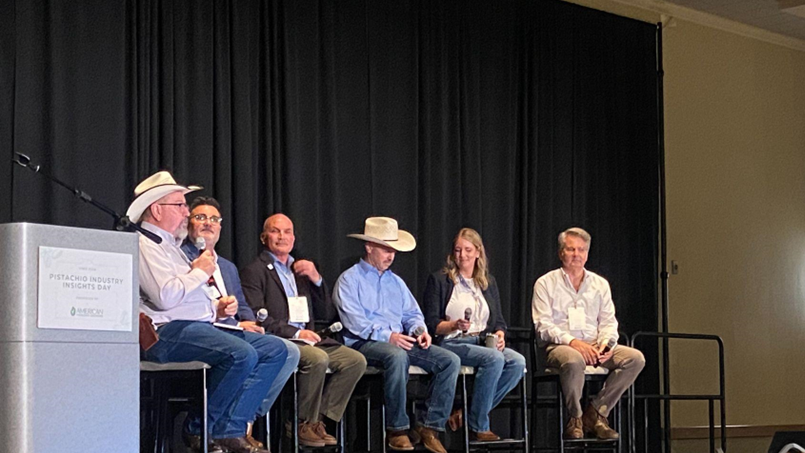
At the first-ever Pistachio Industry Insights Day hosted by the American Pistachio Growers in July, a panel of experts discussed water security in California’s agricultural sector and the pending biological opinions set to come out in November.
The panel, moderated by Don Wright, founder of Water Wrights, included Congressman John Duarte, Johnny Amaral, Chief Operating Officer of Friant Water Authority, Steve Blumenshine, Executive Director of California State University’s WATER (Water Advocacy Toward Education Research), William Bourdeau, President of Bourdeau Farms, and Lindsay Cederquist, Director of Water Resources at Maricopa Orchards.
Congressman Duarte, representing both the Central Valley and the agricultural community, highlighted the pervasive issues of water and resource availability in California as part of a broader national trend.
“First of all, I want to say, please look at California’s water issues on your farms and your communities up and down the state, affecting home prices, affecting food prices, affecting jobs, deleteriously affecting the environment, the air quality here in the valley — we’ve got a policy dust bowl in the brewing — in the context of resource abandonment nationwide,” Duarte said.
As a member of the Natural Resources Committee, Transportation and Infrastructure Committee, and the House Committee on Agriculture, Duarte emphasized the widespread mismanagement of resources in the U.S.
“We are abandoning resources across America everywhere we can,” Duarte said. “Whether it’s mismanagement of our forests, flushing our water out to the ocean with no objective gains under the Endangered Species Act, destroying irrigated landscapes up and down the state, whether it’s farms, urban landscapes, or ecological resources. We’re doing this in oil and gas. We’re doing it in mining and minerals. So please don’t feel special. This is a broad theme, and I can’t look at it as innocent mistakes by disconnected bureaucrats.”
Expanding on the theme of resource mismanagement, Amaral elaborated on the critical role of biological opinions in agriculture. These opinions serve as guiding documents for the rules and regulations that govern water allotment.
“But what really matters is those are the guiding documents that determine how water moves in California, where 80% of the rainfall and snowpack happens north of the Delta, but 80% of the demand for water is south of the Delta,” Amaral said. “So, you can see why that plumbing matters for all of you here. Any time a document like that is being put together with a political calendar as part of that motivation or consideration, watch out.”
Biological Opinions — BiOps — are documents prepared by federal agencies, such as the U.S. Fish and Wildlife Service or the National Marine Fisheries Service, under the Endangered Species Act. These opinions assess the impact of a proposed federal action, like construction projects or land use changes, on endangered or threatened species and their habitats.
These opinions stand to significantly impact agriculture in the Central Valley as its water resources are often subject to federal regulations aimed at protecting endangered species. The latest biological opinions, issued in 2019 under the Trump administration, faced backlash and litigation from environmental groups for continuing operations on California’s State Water Project and the Central Valley Project.
Amaral explained that if the 2019 BiOps had governed this year’s operations, the Central Valley Project allocation would have been 65% rather than 50%, providing an additional 180,000 acre-feet of water for Westlands alone.
“If you remember the rhetoric from back then, you would have thought that the development of the 2019 biological opinions was the end of earth, end of civilization. It was going to kill every species, every shrub, everything,” Amaral said.
In 2021, the U.S. Bureau of Reclamation requested to reinitiate Endangered Species Act consultation for the long-term operations of the CVP and SWP with the new BiOp expected in November 2024.
Meanwhile, the interim operations plan, essentially the old BiOps, governs current water movements. Amaral cautioned that the forthcoming BiOps could impose stricter regulations.
“What’s being developed, what’s being contemplated for the new BiOps that I talked about earlier is something worse…than what’s being implemented today,” Amaral said.
As the industry anticipates new biological opinions in November, panelists urged agricultural stakeholders to stay informed and prepare for potential changes that could reshape water management practices in the region.