By Scott Hamilton, President, Hamilton Resource Economics
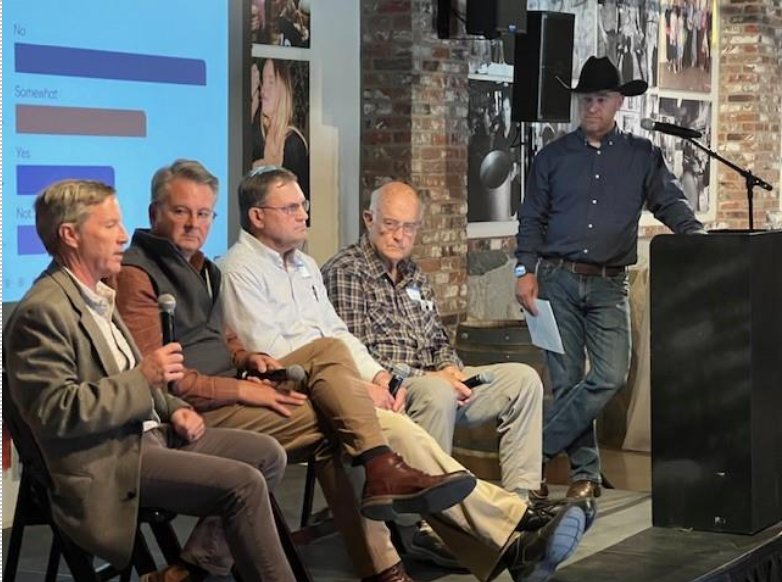
Is abundance realistic when it comes to water availability in the San Joaquin Valley? The American Pistachio Growers raised that issue at their seminar titled “Cultivating a Sustainable Future” held in Bakersfield on November 13th. The sentiment behind the issue was that the Valley, and indeed most of California, has insufficient water to meet its current needs and the available supplies must be allocated with the result that water scarcity is now a fact of life – a reality that many farmers must face.
But John Duarte of Duarte Nursery, and a former congressman, advocated moving away from scarcity as the norm and replacing it with a strategy to achieve abundance. He was well supported by Congressman Vince Fong, who had flown through the night from Washington, D.C., to attend the seminar. Fong was emphatic in the need to create water policies aimed at abundance. Duarte argued that there are many potential projects that can be implemented to solve the state’s water problems, with the only real limitation being funding — and that funding is a choice. One percent of the state’s $300 billion budget for 10 years would largely resolve the water scarcity, he argued.* The resulting $30 billion if applied to the implementation of a well-developed water plan over a sustained period, could move the state from scarcity to abundance. One way to justify that expenditure is to present it as compensation for water supplies promised but never delivered.
Such a strategy aligned with other concerns expressed at the seminar. Commodity prices generally do not support the concept of farmers being able to fund large water projects. Alternatives are needed. One of the most pressing concerns is related to subsidence. While implementation of the Sustainable Groundwater Management Act was intended to occur systematically over the next 15 years, the need to halt subsidence is presenting a more immediate concern. All major conveyance systems in the Valley are being impacted by subsidence with choke points in key locations affecting delivery capacity. Paul Gosselin, deputy director at the California Department of Wate Resources and one of the seminar’s guest speakers, noted that capacity in the California Aqueduct was predicted to decline by 87% if subsidence was not corrected. That would devastate supplies for the Kern County Water Agency and the farmers that depend on those supplies. But with a price tag for a fix amounting to billions of dollars, who should pay?
Duarte argues that even if the farmers caused the problem, they simply do not have the capacity to pay. Rod Stiefvater, a Central Valley pistachio farmer and panelist at the seminar, concurred, suggesting a farmer-pays strategy would be futile while causing immense hardship. Duarte was direct about where the blame lies – subsidence is a direct result of failed environmental policies that depleted surface water supplies and forced farmers to turn to groundwater. On those grounds, the state and federal governments have the obligation to fix the choke points in the conveyance systems.
Who then is responsible for delivering the water plan for abundance? Geoff Vanden Heuvel, vice chair of the Water Blueprint for the San Joaquin Valley, updated the audience on the Blueprint’s efforts in preparing that plan. He explained that the first three chapters have been released for review, with the remaining chapters expected to be available by the end of the year. During that process, coordination between DWR’s planning team and the Blueprint is anticipated to align and largely consolidate various efforts into a single vision. Meeting all water demands in the Valley is unlikely, but the plan is likely to present opportunities to significantly reduce the water supply-demand gap.
Vanden Heuvel made the case that perhaps once, in every century, there is a need and an opportunity for new thinking to realize California’s potential through thoughtful planning and commitments to investments. For the Valley, that time, for this century, is now.
There are many challenges that remain: the need to improve permitting and incentivize recharge, the need to coordinate efforts between state and federal administration that currently are adversaries, the need to develop incentives for the “haves” in the water world to guide the “have nots,” the need to reorganize and realign government agencies to better manage groundwater management, flood management, drinking water quality, and environmental enhancement.
With water availability on growers’ minds, the seminar produced by the American Pistachio Growers was well organized, interesting, and informative. The challenges remain, but this seminar raised the thoughtful question of how to advance policies that promote water abundance in a thirsty state.
Editor’s Note: This article was originally posted in the December 2025 print issue. The printed version of this article misstated the size of the state’s budget as $400 trillion. The section has been corrected to more accurately reflect the state’s budget figure.