By Natalie Willis, Reporter, Valley Ag Voice
The new California Water Year began on October 1 and, according to the California Department of Water Resources, extreme flooding will be a concern this year.
California water years run from October 1 until September 30, acting as the official 12-month timeframe for water managers to compile and compare hydrologic records. According to an Oct. 9 outlook from the National Oceanic and Atmospheric Administration’s Climate Prediction Center, weak La Niña conditions are present and expected to persist through December 2025 to February 2026.
A common forecast for a La Niña winter is a drier and warmer pattern for Southern California, which could impact agriculture production in the San Joaquin Valley. But, with a weaker La Niña, effects on production remain uncertain.
According to UC Davis’s Center for Watershed Sciences “WaterBlog,” the 2025 water year was close to average — not too wet, not too dry, and with no major floods or droughts.
Northern California saw about 108% of its normal rainfall, with some wet months in November and February and a dry January. Southern California, however, had a late and weak wet season, leading to dry conditions overall and severe wildfires in January 2025. The San Joaquin Valley was also slightly drier than average, UC Davis explained.
“As we leave California’s long dry season, and prepare hopefully for the wet season, it is a good time to reflect on the last water year and prepare for what is also California’s flood season,” the UC Davis post stated. “At this time, it also is customary for people to make largely futile predictions and speculations of precipitation for the coming 12 months.”
SIERRA SNOWPACK
According to the Public Policy Institute of California, most of the state’s annual rainfall arrives between Oct. 1 and April 1, with 12 large reservoirs and over a hundred smaller reservoirs capturing and storing this water.
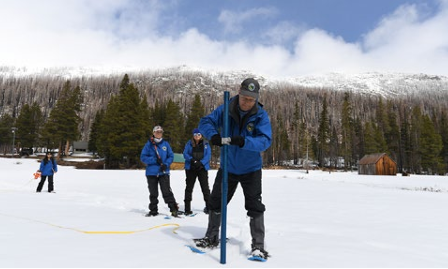
At the start of spring, California’s snowpack historically contained roughly 70% as much water as all of the state’s reservoirs combined. The PPIC post, “California’s Snowpack Is the State’s Biggest Reservoir—and It’s Declining,” explained that in the wet season, snowpack helps mitigate the chance of flooding by retaining winter and spring precipitation.
“As it melts, snow slowly replenishes reservoirs in the dry season. Snowmelt also helps keep our trees and other vegetation supplied with water through the dry season,” PPIC stated. “This makes it harder for wildfires to start and makes them less severe when they do occur.”
However, snowpack in the Sierra Nevada is melting earlier and holding less water than in the past, PPIC explained. As such, it is becoming a more unreliable source. Water managers, on average, may not face less overall precipitation, but it may fall as rain instead of snow, with the snow that does manage to accumulate melting earlier in the spring, according to Scripps Institution of Oceanography.
Efforts to confront the storage issues, thus far, include developing improved weather and streamflow forecast techniques to manage California’s water supplies. According to PPIC, climate models are valuable tools to understand and prepare for changes in snowpack and water supply as they estimate how future conditions might look under various scenarios.
However, global models alone are too broad to guide local or regional decisions. To address this, scientists use a process called downscaling which refines global data to reflect local and regional conditions more accurately. According to PPIC, recent improvements in these downscaled models provide more realistic information about California’s snowpack.
“By comparing model predictions to real-world measurements of snowpack in the southern Sierra Nevada mountains, we found that these models are good at capturing the timing of peak snowpack,” PPIC reported. “However, less water is actually stored in snow than the models predict. The group of models we used collectively overestimate water stored in snow at the peak date by about 19% over the southern Sierra Nevada between 1986 and 2005. And the snowmelt season is ending earlier than the models indicate, too.”
As such, they recommend that water managers use conservative estimates when planning to reduce the risk of impacts from extreme floods and droughts. Visit cal-adapt.org to access downscaled model data for California.
GROUNDWATER MARKETS
As California agriculture becomes synonymous with uncertainty with regard to water resources — from regulatory hold ups and delayed infrastructure projects to dam removals and pumping limits under the Sustainable Groundwater Management Act — groundwater markets may help farmers find balance.
According to UC Berkeley Law, SGMA allows groundwater sustainability agencies to assign groundwater extraction allocations to local pumpers and authorize transfers of these allocations under certain circumstances, potentially opening the door to local groundwater markets.
Another PPIC research fellow with the Water Policy Center, Bradley Franklin, has extensively covered the institution of groundwater markets in California. In an August 2025 PPIC post, Franklin explained that water markets have been used in California for years, mostly between water agencies that trade supplies to balance shortages and surpluses. Yet, the idea of buying and selling water raises some concerns.
Common concerns include worries about losing water rights, being pushed out by larger agricultural operations, and whether water markets would operate fairly and transparently. However, according to Franklin, a well-designed market may provide a resource to navigate uncertainty, especially as surface water supplies vary year to year.
“To be effective, however, markets must be transparent, low cost, and easy to use. And along with simplicity, clear rules must protect other water users, rural communities, and the environment,” Franklin stated.
There are also risks involved where trading may result in too much groundwater pumping in a given area, exacerbating subsidence, dry wells, and saltwater intrusion.
If done carefully, local groundwater markets could help manage water use more efficiently. Meticulous planning as well as ongoing collaboration among farmers, GSAs, and communities may help ensure that groundwater trading supports groundwater health and local livelihoods.